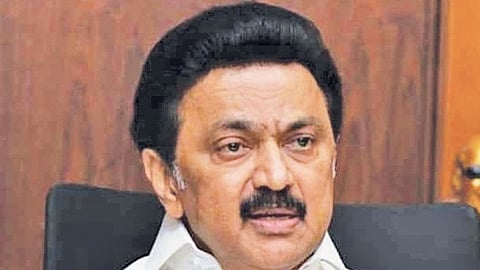

CHENNAI: The questionnaire of the High-Level Committee on Union-State Relations (HLUSR) of the Tamil Nadu government, released by Chief Minister MK Stalin on Saturday, has put forth 234 questions revolving around an overhaul of the 75-year-old Constitution to make India a ‘genuinely’ federal country in all key areas.
The questionnaire is set in 20 broad heads including nature of Indian federalism, creeping centralisation since 1950, procedure for amendment of the Constitution, formation of new states and alteration of areas, boundaries or names of existing states, GST reforms, union-state financial relations, role of the governors and the President, language, delimitation of constituencies, elections and anti-defection provisions, inter-state river disputes, union-state administrative relations, national security and state autonomy, union-state legislative relations among others.
It can be answered on https://hlcusr.tn.gov.in.
The first question is whether the respondent agrees with the contention that the Constitution heavily borrowed from the Government of India Act, 1935 and continued with a colonial design that centralises power in New Delhi.
Ever since the Constitution was approved in 1950, there have been criticisms against it. Many political parties have been demanding a review of the Constitution for decades based on their own ideologies. While the BJP has been seeking review of the Constitution to ‘Indianise’ it, the DMK has been seeking a review to ‘federalise’ it.
The HLUSR seeks to examine and review the provisions of the Constitution of India and the existing laws, orders, policies and arrangements that bear upon union-state relations.

The committee will submit its interim report by January 2026 and final report within two years.
At a time when political parties in Tamil Nadu are raising their voice in support of power share in the state government, two questions posed by the committee assumes significance: “Do you agree that the dominance of a single national party ruling both in the union and in most states has historically reinforced unitary trends in India, limiting state autonomy? Has the rise of coalition governments at the union and regional parties forming governments in the states improved the federal balance?”
There are also questions relating to post-partition centralisation and its continued relevance, amending the Constitution for stronger states and federalism, decentralisation of union ministries and state functions, why there is reluctance to let the state government participate in the management of airports, sea ports, railways, etc, at a time when private entities are allowed in that.
SOME KEY QUESTIONS
1 Do you believe India’s federal system inadequately protects its regional, linguistic and cultural diversity, with attempts to impose uniformity?
2 With the idea of India now firmly established, is the centralisation in the Constitution still justified?
3 Should large union ministries handling State List and Concurrent List matters be decentralised to improve governance?
4 Has the “High command culture,” where chief ministers are imposed by party headquarters, weakened state autonomy?
5 Should India make constitutional amendments harder by reducing provisions amendable by a simple majority, raising the quorum to 50%, and requiring approval of the total membership of each House?
6 Should constitutional amendments by special majority require two-thirds of the total membership of each House, rather than two-thirds of those present and voting?
7 Should the list of constitutional provisions requiring state ratification be expanded to cover all matters affecting state rights and the federal balance?
8 Should India, like Germany, codify the Constitution’s basic features (democracy, federalism, secularism, etc.) as expressly unamendable rather than relying solely on judicial interpretation?