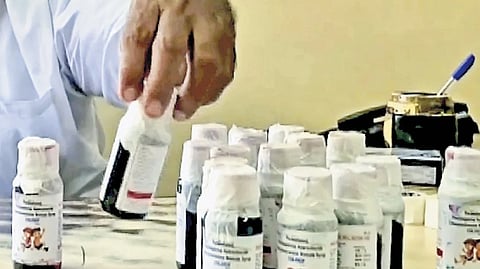

CHENNAI: Routine inspections were not conducted at Sresan Pharmaceutical unit in Kancheepuram, the manufacturer of the Coldrif cough syrup linked to the deaths of children in Madhya Pradesh, officials said.
The unit, which had been operating for over 40 years, may have paid renewal licence fee online, and the officials would have issued the license without physical verification, an official source said. The state drug control department has now started inspecting over 300 drug manufacturing units across the state.
Drug inspectors TNIE spoke to said there are around 350 pharmaceutical manufacturing units across the state, in addition to over 300 blood banks and 100 medical devices and cosmetics units. These units should be routinely inspected only by the senior drug inspectors (SDI). However, there are only 14 sanctioned SDIs in the state.
Among 14 sanctioned senior DIs, four are posted at the intelligence wing of the state drug control department at the DMS campus, leaving only 10 senior DIs on the field. In Kancheepuram alone, there are around 50 pharmaceutical manufacturing units.
“There are 120 drug inspectors in the state; the government must also increase these posts for conducting and testing drugs regularly,” said a drug inspector. “The government should sanction more senior DIs posts to strengthen the surveillance.”
The Sresan pharmaceutical unit alone violated various Good Manufacturing Practices (GMP). The officials noticed several non-compliance of Schedule M and Schedule L1 of Drugs Rules, 1945 at the manufacturing unit. They noticed 39 critical violations and 325 major violations at the unit only after the deaths of children.
The unit also lacked key testing equipment such as gas chromatography, essential to detect impurities in raw materials.
The officials said the major violation that affected the product was the usage of food grade propylene glycol instead of pharma grade propylene glycol, a solvent. Only pharma grade propylene glycol is allowed under the Drugs and Cosmetics Act. In case of food grade propylene glycol, diethylene glycol (DEG) has to be removed.
In pharma grade, the DEG impurity in propylene glycol would have already been processed and removed, so it’s safe. The product should have been tested before and after manufacturing for the impurity; lack of surveillance led to overlooking these violations, officials said.
