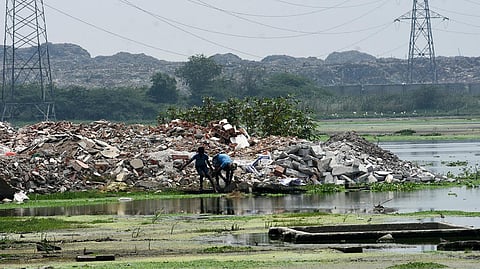

CHENNAI: The Tamil Nadu State Wetland Authority (TNSWA) has told the Madras High Court that the much-debated 1-km “zone of influence” around the Pallikaranai marsh cannot be treated as a fixed buffer.
It has also said that the final extent can be determined only through a scientific exercise under the Wetlands Rules, 2017.
In a status report filed before the court, Srinivas R Reddy, member secretary of the TNSWA, said the zone of influence is “not a fixed or uniform area” but varies from wetland to wetland depending on hydrology, topography, drainage patterns and adjoining land use.
The authority argued that the extent of the zone must be delineated using scientific methods, including digital elevation models and field verification.
Though the matter was listed on Friday, it did not come up for hearing and has now been posted for Wednesday.
The authority also clarified that the 1-km zone shown in the draft Integrated Management Plan (IMP), prepared by Care Earth Trust before Pallikaranai was designated a Ramsar site in April 2022, was merely “indicative in nature”.
According to the affidavit, the draft report was submitted before the National Green Tribunal (NGT) only to place on record the administrative steps being taken to protect the marshland.
The draft IMP envisaged the zone of influence as multiple buffer zones at 250-metre intervals, divided into eight directional segments. The mapped buffers extended up to 1 km around the marsh.
However, the Wetland Authority pointed out that the same report had cautioned against adopting a conventional buffer model for Pallikaranai.
Quoting the draft plan, it told the High Court that “both the buffer model and directional model to delineate the zone of influence have been rendered fallacious in view of the intense built-up area abutting the marsh”.
It added that hydrological influences were largely limited to sheet flows, as many connecting channels had been converted for other land uses.
The authority said that after Pallikaranai received Ramsar status in 2022, the National Centre for Sustainable Coastal Management (NCSCM) was tasked with preparing a revised management plan in accordance with the Wetlands (Conservation and Management) Rules, 2017.
The stand marks a shift from affidavits filed before the NGT in 2025. In its July 2025 submission, the Wetland Authority had referred to the Care Earth report, stating that a “general zone of influence of 1 km” had been demarcated around the marsh using the directional and buffer models.
At the same time, it maintained that, given the presence of patta lands and heavy urbanisation, “it would be prudent” to delineate the zone based on inlet and outlet channels and satellite wetlands that significantly influence the marsh’s ecology.
The NGT subsequently accepted the need for a revised management plan and directed authorities to expedite its preparation.
In its September 2025 judgment, however, the tribunal observed that projects within one kilometre of the marsh boundary fell within the zone of influence and restrained authorities from granting approvals that could alter the character of the wetland until the plan was finalised.
Care Earth co-founder Jayashree Vencatesan told TNIE: “I am not competent to comment on whether the blanket ban was right or wrong. What is important is protecting the numerous satellite wetlands and the hydrological system that sustains Pallikaranai. If we compromise these ecosystems with further built-up development, the damage would be irreversible.”
For its part, the Chennai Metropolitan Development Authority (CMDA) has maintained that restrictions around Pallikaranai cannot be incorporated into the city’s third master plan without precise survey numbers and approved guidelines from the Wetland Authority.
In its counter before the High Court, the CMDA argued that the petitions challenging its October 2025 circular effectively question the NGT’s order prohibiting approvals within the one-kilometre zone pending completion of the revised management plan.
