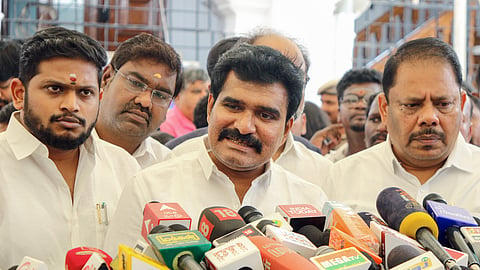

Tamil Nadu Minister R Nirmal Kumar has accused the DMK of attempting to hijack and politicise the ongoing student protests against NEET.
Addressing reporters in Chennai, Kumar said a state law alone could not override NEET regulations and reiterated the ruling TVK government's stand against the entrance examination.
"The Tamil Nadu government cannot bypass NEET simply by passing a state law, as central laws cannot be overridden that way. Our stand has been clear from the beginning-we do not want NEET," the state minister for Energy Resources and Law said.
He dismissed the political rhetoric surrounding the issue, calling the resignation demands and legislative moves mere "eyewash" that would do little to help students.
Targeting the DMK's role in the recent protests, Kumar alleged that party workers were trying to hijack the student-led agitation.
"The DMK is entering student movements to hijack them, which is a cheap political act. Students themselves chased away DMK workers who turned up wearing party-branded T-shirts. They must stop such disgraceful activities immediately," he alleged.
Kumar took a swipe at the Leader of the Opposition in the Assembly, Udhayanidhi Stalin, advising him to introspect before projecting himself as a major political leader.
He wondered whether DMK leaders truly accepted Udhayanidhi's leadership or believed he had the credibility to lead the party founded by C N Annadurai. "Before trying to hijack protests organised by others, he should first evaluate his own standing within the party," he added.
Kumar also briefly touched upon the Cauvery River water dispute, saying political leaders should understand the facts surrounding inter-state issues before making public statements.
Tamil Nadu Chief Minister C Joseph Vijay has proposed bilateral talks with his Karnataka counterpart to find an amicable solution to the long-standing Cauvery water-sharing dispute. He is scheduled to visit Bengaluru on August 3 for talks with Karnataka Chief Minister DK Shivakumar, having sought an appointment that the latter has agreed to.
(With inputs from PTI)
