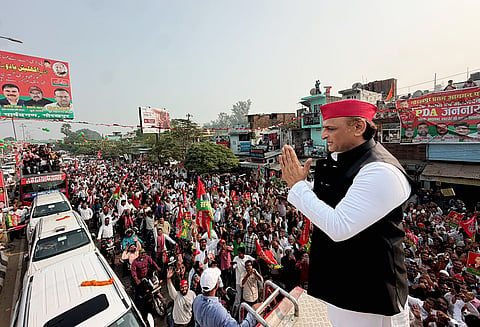

LUCKNOW: On the 87th birth anniversary of Samajwadi Party founder Mulayam Singh Yadav on November 22, party president Akhilesh Yadav paid tribute to his father by recalling the socialist principles, political values and lessons in relationship-building that shaped his political journey. But beyond the tributes, the occasion also offered a glimpse into how Akhilesh is seeking to bring Mulayam's political legacy back to the centre of the SP's strategy ahead of the 2027 Uttar Pradesh Assembly elections.
Addressing party leaders and workers at the SP headquarters in Lucknow, Akhilesh spoke about his father's ability to stand by people during difficult times, maintain relationships across political differences and bring different sections of society together. He also referred to messages from some of Mulayam's old associates who had not remained in regular contact with the party.
"The hallmark of Netaji's personality was that he never abandoned anyone in their time of need," Akhilesh recalled, underlining his father's approach towards relationships and political engagement.
The reference to old associates assumes significance as the SP prepares for another electoral contest in Uttar Pradesh. With the party seeking to consolidate its traditional support base while expanding its PDA (Pichhda, Dalit, Alpsankhyak) coalition, Mulayam's political legacy could become an important part of Akhilesh's attempt to strengthen the organisation and reconnect with leaders and communities associated with the party's formative years.
Reconnecting with Mulayam's political network
Mulayam Singh Yadav's political journey was built around a network of grassroots leaders, socialist activists, backward-class representatives and political associates across Uttar Pradesh. His ability to maintain relationships with leaders from different backgrounds helped the SP establish a strong political presence across several regions.
For Akhilesh, the challenge is to preserve that political network while expanding the party's appeal among younger voters and communities that the SP is seeking to bring into its PDA framework.
The SP's political positioning has evolved considerably since Akhilesh took charge of the party. While Mulayam's politics was closely associated with the socialist movement and the mobilisation of backward classes, Akhilesh has sought to expand the coalition by bringing Dalits and minorities into a broader political framework.
The question ahead of 2027 is whether the party can combine these two approaches — the organisational legacy of Mulayam and the expanded social coalition being pursued by Akhilesh.
Welfare initiatives become part of the legacy pitch
Akhilesh's announcements on Mulayam's birth anniversary also brought several initiatives associated with the previous SP government back into the political conversation.
He promised that the Yash Bharti Samman would be reinstated if the SP returned to power in 2027, with the monthly honorarium for recipients increased from Rs 50,000 to Rs 1 lakh. The award recognises personalities from Uttar Pradesh for their contributions in fields including literature, art, culture, sports and public service.
Akhilesh also distributed laptops to meritorious students and reiterated the importance of technology-driven education. He criticised the present government's education initiatives and raised concerns about the condition of government schools and institutions. He also promised to reopen around 27,000 primary schools that he alleged had been closed, if the SP formed the next government.
These announcements indicate that the party is attempting to connect Mulayam's legacy not merely with political symbolism but also with specific policy initiatives that can become part of its 2027 electoral agenda.
Can the socialist legacy strengthen the PDA strategy?
Political observers believe that the relationship between Mulayam's traditional political base and Akhilesh's expanded social coalition will be an important factor in determining the SP's electoral prospects.
The party has been attempting to position PDA as its central political framework, seeking to consolidate backward classes, Dalits and minorities. However, the challenge will be to ensure that this expansion does not come at the cost of its traditional organisational base.
Dr Shashikant Pandey, Head of the Department of Political Science at Dr Bhimrao Ambedkar University, Lucknow, said, [Proposed quote for approval]: "Mulayam Singh Yadav had built his political strength through a social coalition rooted in socialist politics, backward-class mobilisation and grassroots relationships. Akhilesh Yadav is attempting to expand that political foundation through the PDA framework by bringing Dalits and minorities into a broader coalition. The challenge for the Samajwadi Party ahead of 2027 will be to maintain its traditional support base while making this expanded social alliance electorally sustainable."
He added that invoking Mulayam's legacy could also help Akhilesh reconnect with the party's older generation of leaders and workers while giving its present political narrative an ideological foundation. The SP will also have to demonstrate that its appeal extends beyond its established support base through effective district-level organisation, stronger local leadership and a wider network of workers.
As the party prepares for the 2027 elections, Mulayam's legacy is likely to remain an important part of its political messaging. For Akhilesh, the larger task is to translate that legacy into organisational unity, wider social representation and an electoral coalition capable of challenging the BJP in Uttar Pradesh.
