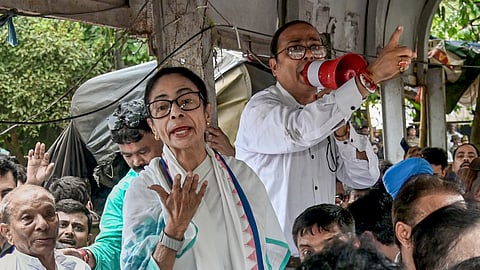

Cracks have begun to emerge within the rebel TMC camp barely a day after 58 MLAs seized control of the party's legislature wing, with several legislators pushing back against suggestions that Mamata Banerjee be relegated to an advisory role.
According to a PTI report, at a meeting of the dissident bloc led by newly recognised Leader of Opposition Ritabrata Banerjee on Thursday, multiple MLAs asserted that Mamata Banerjee must continue as the party's supreme leader, exposing tensions within a rebellion that has so far sought to distinguish opposition to Abhishek Banerjee from loyalty to the TMC founder.
The unease surfaced after Ritabrata Banerjee proposed on Wednesday that Mamata Banerjee serve as the "chief adviser" to the reconstituted legislature party. While the suggestion was widely seen as an attempt to reassure party workers that the revolt was not aimed at the former chief minister, sections of the rebel camp appeared uncomfortable with any arrangement that could be interpreted as diminishing her authority.
"We were told that the party would continue under Mamata Banerjee's leadership. She is not merely an adviser. We want the party to function under her leadership," rebel MLA Gulshan Mullick said after the meeting.
Mullick went a step further, warning that some legislators could reconsider their association with the rebel bloc if Mamata Banerjee's status was diluted.
"If Mamata Banerjee is not accepted as the supreme leader, then we will have to think whether we should remain in this bloc or not," the Panchla MLA said.
His remarks highlight the delicate position confronting the dissidents. The rebellion was launched in Mamata Banerjee's name, with supporters repeatedly insisting that their objections were directed at the growing influence of her nephew, Abhishek Banerjee, rather than at the party supremo herself. Yet the movement now faces difficult questions about what role Mamata Banerjee would play in any new power structure that emerges from the upheaval.
Another rebel legislator, Sitai MLA Sangeeta Roy Basunia, echoed the demand for Mamata Banerjee to retain undisputed authority.
"Mamata Banerjee is our supreme leader and will remain so. She cannot be an adviser. She is our leader," Basunia said.
Throughout the revolt, the dissidents have sought to present themselves not as challengers to Mamata Banerjee's leadership but as defenders of the party's original ideals. They have framed their campaign as a corrective measure against the concentration of power around Abhishek Banerjee rather than a revolt against the leader who founded the Trinamool Congress in 1998 and led it to power in 2011.
That distinction was reflected in the communication sent to the Assembly Speaker, where the rebels continued to recognise Mamata Banerjee as chairperson of the party while rejecting Abhishek Banerjee's authority over the legislature wing.
For the dissidents, separating loyalty to Mamata Banerjee from opposition to Abhishek Banerjee has become the central political justification for their movement. It has also helped shield them from allegations that they are attempting to dismantle the party's founding leadership structure.
Apart from discussing organisational matters, Thursday's meeting also focused on constituency-level concerns, pending legal cases involving party workers and administrative issues affecting various districts.
Mullick said the legislators had decided to form a committee to engage with the state government and senior officials on these matters.
"We discussed problems faced by people in our constituencies, court cases and police excesses. A team has been formed which will speak to the chief minister and the DGP on these matters," he said.
The latest developments come against the backdrop of mounting turmoil within the TMC following its election defeat to the BJP and the unprecedented split in its legislature wing.
The crisis reached a dramatic turning point on Wednesday when 58 MLAs took control of the legislature party, elected expelled leader Ritabrata Banerjee as Leader of Opposition and secured recognition from the Assembly Speaker. The move triggered what is widely regarded as the most serious internal crisis in the party's 28-year history.
Beyond the immediate power struggle, the rebellion has exposed a growing disconnect between the party organisation and its elected representatives, raising broader questions about leadership, succession and the future trajectory of a party that has dominated Bengal politics for more than a decade.
It is also the first time since the Trinamool Congress was founded that such a large group of its legislators has openly challenged the authority of the party's central leadership while simultaneously claiming to be the true custodians of its political legacy.
Whether the dissidents can maintain the distinction between opposing Abhishek Banerjee and remaining loyal to Mamata Banerjee is likely to determine the future course of the rebellion. As they seek to build a new leadership arrangement after their dramatic takeover of the legislature party, the line between pressure movement and outright split appears increasingly difficult to sustain.
(With inputs from PTI)
