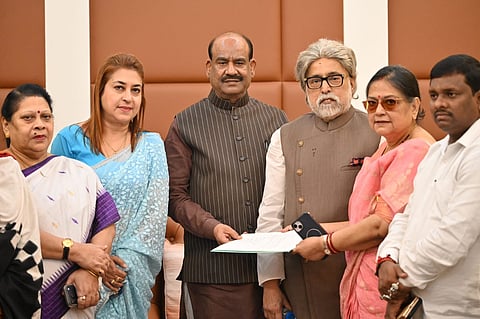

NEW DELHI: Claiming the support of 20 of the 28 Lok Sabha MPs of the Trinamool Congress, the party’s rebel lawmakers met Lok Sabha Speaker Om Birla on Sunday, and said that they had merged with a regional outfit, the Nationalist Citizens Party of India, and sought recognition as a separate bloc in the House.
Earlier, TMC parliamentary party leader Abhishek Banerjee wrote to the Speaker, urging that no recognition, status, or facilities be granted to any group claiming to be a separate faction of the party.
The letter was submitted to the Speaker by MPs Kirti Azad and Sagarika Ghose on Sunday evening.
Speaking to reporters after meeting with the Speaker, rebel MP Sudip Bandyopadhyay said the faction has merged with the regional outfit NCPI. “It is a regional party. We have merged with it.” When asked if they claim to be the real TMC, he said it would be decided in court.
TMC MP Kakoli Ghosh Dastidar said, “We 20 MPs, who were elected from the AITC, have met the Speaker and given him a letter urging him to allow us to sit as a separate bloc. And these 20 MPs, who constitute more than two-thirds of the TMC's strength, have merged with the NCPI. We will support the NDA under the leadership of PM Modi,” she said.
Before meeting Birla, the dissident camp, including Saayoni Ghosh, Mala Roy, Satabdi Roy, and Arup Chakraborty, huddled together at the residence of Union Minister Bhupendra Yadav, with Kakoli Ghosh claiming they had 22 MPs on their side.
In his letter to Speaker Birla, Abhishek Banerjee contended that any merger claim would require both a merger of the political party and the support of two-thirds of legislators, and that satisfying only one of these conditions would not be sufficient under the law.
Substantiating the claim, constitutional expert and former Lok Sabha secretary general P D T Achary told TNIE that a merger can only take place between two parties- the original political party and another entity.
“So long as the MPs continue to be members of TMC, only the political party can merge with another party. That’s the law, the MPs cannot escape the law whether they merge with any other party,” said Achary.
Citing the Supreme Court’s 2023 ruling in Subhash Desai v. Principal Secretary, Governor of Maharashtra, Banerjee said in his letter that no member or set of members can, by their own volition, carve out a parallel "group" or "faction" of the same party and claim independent recognition within the House.
“The defence of a 'split' stands abrogated. The SC held that the omission of Paragraph 3 of the Tenth Schedule by the Constitution 91st Act, 2003 has the effect that the defence of a 'split' is no longer available to members facing proceedings under the Tenth Schedule. The law therefore does not recognise the splintering of a political party into competing groups as a permissible event; it treats such conduct, instead, through the lens of Disqualification,” he said.
The political party and not the legislative party is supreme, he said. “The SC held that it is the political party, and not the legislature party, that appoints the Whip and the Leader of the party in the House, and that the direction to vote in a particular manner, or to abstain, is issued by the political party and not the legislature party. It follows that no breakaway set of members may appoint their own Leader or Whip, or seek recognition as a distinct entity, in derogation of the authority of the political party,” he argued.
