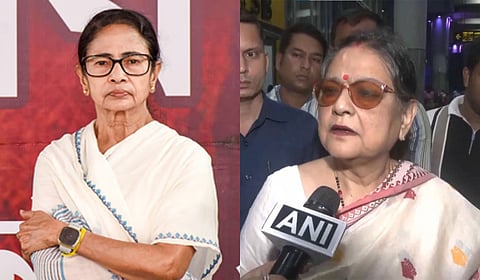

NEW DELHI: The rebel faction of Trinamool Congress (TMC) Lok Sabha MPs could face constitutional hurdles if they attempt to gain recognition as a separate bloc in Parliament, said constitutional expert and former Lok Sabha secretary general PDT Achary, asserting that the anti-defection law does not allow for the creation of a separate bloc within a party.
On Friday, a purported letter addressed to Lok Sabha Speaker Om Birla, containing the names and signatures of 19 TMC Lok Sabha MPs, was widely circulated, sparking speculation of a Maharashtra-style split within the TMC seeking recognition independent of the Mamata Banerjee-led party.
Speaking to TNIE, Achary said the dissidents’ strategy is legally untenable under the Constitution's Tenth Schedule.
"There is no provision in the anti-defection law for treating a section of MPs as a separate group merely because they constitute two-thirds of a legislative party.
"The 91st Constitutional Amendment in 2003 deleted the clause that allowed exemption from disqualification if a rebel group claimed one-third of the party’s strength. That provision was removed to prevent the breaking up of parties," he said.
Achary added that the law only protects members in the case of a merger with another political party, subject to constitutional conditions. "The number of MPs is irrelevant. Even if they constitute two-thirds or more, the original party must formally merge with another party," he said.
While the controversy is expected to eventually come before Speaker Om Birla, Achary said the Lok Sabha Speaker has no role at this stage in deciding the faction's status.
Achary pointed out that the anti-defection law does not recognise such a split. "For members to avoid disqualification, there must be a valid merger involving the original party and another entity, which the Speaker would need to verify," he said.
Achary added that even if the rebel group appointed someone as their leader, it would be considered illegal. "Only the original party can designate its leader. In this case, only Mamata Banerjee has that authority. The Speaker’s role comes into play only if Mamata seeks the disqualification of the rebels," he said.
He further pointed out that the Election Commission (EC) has the authority to determine which faction is the legitimate political party and to allocate party names and symbols.
Even if the rebels approach the Election Commission to stake claim as the 'real TMC', the Supreme Court's 2023 ruling in Subhash Desai vs Principal Secretary, Governor of Maharashtra, makes clear that legislative majority alone does not determine the authentic party, said Achary.
"The SC has ruled that the EC must assess both the organisational strength and the legislative strength (the strength of elected MLAs/MPs) before deciding," said Achary. The Maharashtra case is different from TMC’s current situation, he said.
"In Maharashtra, the party itself split, not just the legislature party. The original party is bigger than the Legislature Party. Both the Shinde and Thackeray factions went to the Election Commission. The Election Commission recognised the Shinde faction as the real party. TMC’s current scenario is different, involving only the legislature party,” he said.
The breakaway group of TMC MPs includes Kakoli Ghosh Dastidar, Satabdi Roy, Bapi Haldar, Sharmila Sarkar, Prasun Bandyopadhyay, Jagadish Barma Basunia, Asit Kumar Mal, Arup Chakraborty, Rachna Banerjee, Saayoni Ghosh, Khalilur Rahaman, Abu Taher Khan, Yusuf Pathan, Mitali Bag, Mala Roy, Kalipada Soren, Deepak Adhikari, June Malia, and Partha Bhowmick.
