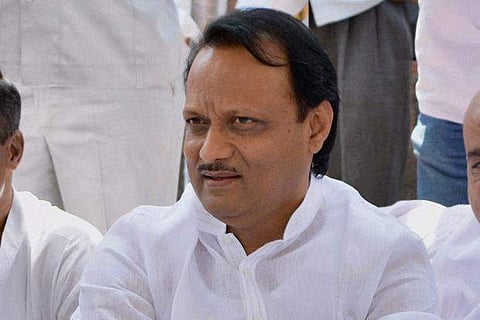

Ajit Pawar appears to be a man in a hurry. At 63, he reckons it’s time he gets to the top. No longer can number two positions satiate his will to power. The deputy party chief, deputy chief minister—all that elicits a strange ennui in him. Been there, done that...the present is only a passing moment.
His father Anantrao Pawar, who passed away while Ajit was in his late teens, used to work for renowned filmmaker V Shantaram. But his own life bent towards politics rather than the arts. For tutelage, he got the best in the business—uncle and role model Sharad Pawar.
Now 83, Pawar Sr had then just become Maharashtra’s youngest chief minister at age 38. He handheld the nephew through his apprenticeship, and Ajit grew to become the director of cooperative sugar mills, then chairman of the Pune District Cooperative Bank and finally, in 1991, the elected MP from Baramati even as his uncle took charge of the Defence Ministry in the PV Narasimha Rao government.

Over the years, uncle and nephew came to exhibit different personas. But that difference was a thin veneer. If politics makes strange bedfellows, both have readily acquiesced in that. One created a coalition of unusual suspects—his Nationalist Congress Party (NCP) coaxed even the Congress into a partnership with Bal Thackeray’s son, Uddhav. The other has now joined hands with the Bharatiya Janata Party. The irony is only that they have fallen apart in following the same credo.
Pawar Sr had broken off from the Congress and formed the Nationalist Congress Party in 1999. Its very existence was founded on retaining tactical flexibility and higher bargaining power within the fluid template of coalition politics. Now, in that same spirit, Ajit has challenged his uncle’s grip over the party and claimed its leadership. Pawar seemed to have had an inkling about his nephew’s intentions but lulled everyone, perhaps even himself, into believing it wouldn’t happen. But it did, on June 30, heralding a set of events that threaten to unravel a whole national alternative, just months before the general election.
As a public figure, Ajit exhibits a duality. He can be gruff and crude in self-injurious ways. In 2013, he ridiculed a two-month-long protest by a farmer who was demanding dam water for his parched land. “There is this person from Solapur, sitting on hunger strike for 55 days, demanding that water be released from the dam. But where are we going to get water from? Should we urinate in the reservoir? We are not getting water to drink, even urine is not coming easily,” Ajit had joked at a rally near Pune. He apologised profusely the next day, but the redemption was never as complete as the infamy.
And he was no novice. Even before his present stint, he has been deputy CM on six different occasions: once under Vilasrao Deshmukh, twice under Ashok Chavan, then stints under Prithviraj Chavan and Uddhav Thackeray and once for a mere 80 hours under Devendra Fadnavis. He is now a deputy to Eknath Shinde, who was his junior in the Uddhav Thackeray government. But Ajit also respects time like perhaps no one in Maharashtra: he is available for people from 7 am to 10 pm without fail. If Ajit Pawar gives an appointment, he never misses it even by seconds.
Time is what was hanging heavy, finally. His uncle is sometimes derided as the perennial prime minister-in-waiting, for whom now it seems too late. Ajit feels he too is getting old and could fall shy of the chief minister’s post if he did not try something bold. The Supriya Sule factor sharpened his anxiety. His cousin's sister and her coterie had started dominating intra-party affairs, so much so that Ajit was unable to appoint district and taluka presidents.
His immediate family was another key reason behind his mutiny. His 33-year-old foreign-returned son, Parth Pawar, had lost badly in the 2019 Lok Sabha election from Mawal against the Shiv Sena. Meanwhile, another grand-nephew of Pawar Sr, Rohit Pawar, had been successful in his very first foray—getting elected as MLA from Parner—and had become a shadow of Sharad Pawar. Many futures, then, had to be secured. With space for him beginning to shrink, the path he has chosen was the only option before him.