
I arrived in Mumbai for my first job in 1983. Me and a fellow trainee, a namesake - Sandeep Beri, now a senior advocate in Delhi - were assigned chummery accommodation. Sandeep was very amused to hear our Maharashtrian lady cook refer to potatoes as Batata. Both of us thought she was mispronouncing potato till we discovered (Batata) Vada Pav. But it still took me many years to learn that just as Pao for bread, batata is the Portuguese word for Potato that the people on India's West Coast had happily appropriated. Like many other vegetables the potato was brought to India not by the British but the Portuguese via Goa.
The spud was not so common in Britain as well. It was brought by the Spanish from its native Peru and for a long time it remained an exotic vegetable. So much so, KC Achaya writes in his Historical Dictionary of Indian Foods that when Warren Hastings was presented a "basket of potatoes" circa 1780 "he invited his council to dine with him and partake of the unusual gift". However, certainly the mashed potato, which was later adopted in myriad forms by the people of the then Bengal Presidency - be it as Aloo Bhate in West Bengal, Aloo Chokha in Bihar or Aloo Bhorta in Bangladesh. The Aloo in Kolkata Phuchka (a Bihari invention actually) is really cold chokha with some tamarind paste, green chillies, Kabuli chana, red chilli and jeera powder thrown in sans onion and garlic.
Everyone has their favourite Aloo preparation. I like to typically classify Aloo dishes into three categories - mashed, bhajis and curries. "Aloo Bhaja'' or fried potatoes in various forms - whether as juliennes, rounds or finely chopped almost like shavings (jhuri aloo bhaja) are largely eastern India specialties and can only be enjoyed when fried in mustard oil. Wafers and Chips (or fries as they are called now) are not Indic recipes and hence out of scope for this article. However, the fine art of making finger chips is fast becoming extinct with the onslaught of pre-packaged frozen extruded ready to fry variants that all clubs and restaurants are falling for. That is partly because people do not have the time and patience to cut, clean, de-starch, blanch and double fry the chips and, also, that right quality of potatoes (the large Russet potato equivalent) is not easy to source.

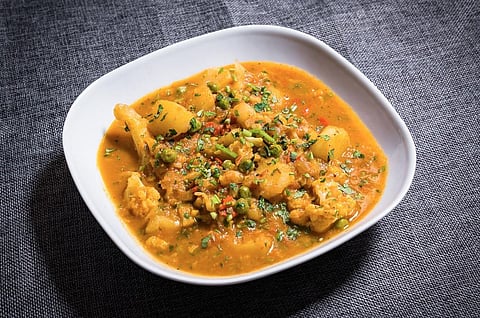
When it comes to curries there is nothing to beat the light Uttar Pradesh kind of aloo rassa that goes with Puris and Kachoris. But for more refined variants one has to go to Kashmiri homes who take Aloo Dum to a different level of sophistication. Given half a chance the Punjabis roll any vegetable inside a bread just as Marwaris stuff everything into Kachoris. But the Punjabi Aloo Paratha, I think combines the best of mashed potato - chokha or bharta - with roti.
I have mixed feelings about Rajasthani Aloo Kachoris. Some shops in Jaipur make good Aloo Kachoris but I remain partial about Pyaz or traditional Dal Kachoris. The Aloo Tikki takes it a step forward and I would suspect was invented as a winter snack to provide that extra calorie on a cold afternoon. One may call it our variant of potato patties.
Delhi's BTW (Bittu Tikki Wala) has done a good job in stepping up the game for Tikkis just as Goli Vada Pav tried with Batata Vada. But they are both yet to cross the Rubicon for taking it pan-India or global like Dosa.
Of course, the Gujarati contribution to the Potato universe is Pav Bhaji. Arguably, the best Pav Bhaji in the world is available at Sardar Pav Bhaji at Tardeo, Mumbai. They add almost equal quantities of butter to the mashed potato, which must be a physician's horror. interestingly, it is owned not by a Sikh Punjabi but Nissar Ansari whose father was Sardar Ansari.
When it comes to Bhajis - I think it is mostly south of Vindhyas. In terms of character, the potato mixture inside a Vada Pav and the masala of a masala dosa is largely of the same genre as the Maharashtrian Batatyachi bhaji. The Kerala Potato Roast is a spicier Malayali cousin of Aloo Jeera but I prefer diced potatoes lightly fried with amchur, roasted jeera, powder red chillies and a touch of turmeric (onion, ginger and garlic if you insist). But that is not roast potato. The closest to that - we can get is Bharela Aloo (not cooked in a gravy but dry) with a light touch of jeera and other spices on top. The Aloo Chat or its Kolkata equivalent Aloo Kabuli (because it has Kabuli Chana in it and tossed in turmeric sauce) are great to go with drinks.
The Indian equivalent of jacket potato is of course the Tandoori Aloo. However, I draw a line at Chilli potatoes introduced at some Chinese restaurants. Thankfully I have not spotted Manchurian potatoes yet.
Talk to a Bengali and life cannot be complete without Aloo Posto (poppy seeds). This was the deadliest concoction created by the British (as they controlled the opium trade and also introduced potatoes in Bengal) to subjugate the race. May be the writer Amitava Ghosh will add a chapter to that in his next edition of his book - Smokes and Ashes.
The Bengali variant of Aloo-Gobi cooked with minimal spices - just some kalonji, ginger and hing to be had with Luchi (roughly Puris made of Maida or refined flour) is the inspiration for the subzi filling of the Bengali Singara (Samosa - also made with Maida with a thin and soft crust). But made even without the cauliflower - as a dry gravy with the same recipe it also makes a great breakfast dish or to be carried in lunch boxes with chapatis or parathas.
That must bring us to the story of how Wajid Ali Shah's cook added Aloo to his Biryani to economise on the meat, as the Nawab was close to penury then. But personally I do not buy that story because Aloo was hardly a poor man's food in those days. The other day while ordering Biryani from Kolkata's famous Shiraz restaurant I found they have now introduced an Aloo Biryani. I got some for my Bihari vegetarian Jeeves. He found it excellent but suspected that they had simply taken the Mutton of the regular Biryani, hence it tasted so good.
The one and only Lalu Prasad Yadav famously said "Jab tak samosa mein rahega aloo, tab tak Bihar mein rahega Lalu ''. Wajid Ali Shah is long gone and may not have had similar illusions of immortality. However, the Aloo in Kolkata Biryani has stayed on. Moral of the story is colonial masters, emperors and politicians may come and go but Aloo (potato) will go on forever having inveigled its way into our lives.
Read all food columns by Sandip Ghose here
(Sandip Ghose is an author and current affairs commentator. He tweets @SandipGhose.)