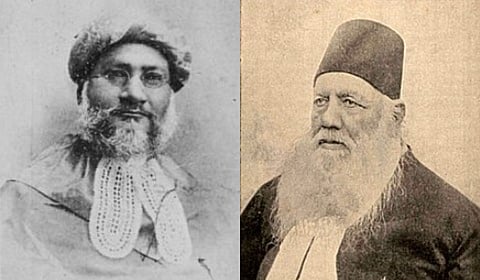

The month of October hosts the birthdays of two remarkable Indian Muslims -- Badruddin Tyabji's birthday falls on October 10 and Sir Syed Ahmad Khan's on October 17. Sir Syed's birthday is usually well celebrated by the Aligarh Muslim University community worldwide. But Tyabji's birthday passes comparatively unnoticed.
The two embody two contrasting outlooks of Indian Muslims which are lingering in today's scenario too. Sir Syed presented an ideology of separateness of the Muslims from the Indian mainstream whereas Tyabji pushed a philosophy of integration with the mainstream. Both these streams of thought emerged among the Indian Muslims during the darkest hours of the post-1857 days and survive to this day.
As far as the approach of the colonial Indian Muslim community towards the British Raj and the emerging Indian National Congress was concerned, Sir Syed and his Aligarh Movement took a reclusive communal stance. The political course of this stream culminated in the formation of the All India Muslim League, the Two-Nation Theory, and the tragic Partition of India. The opposite secular camp, led by Tyabji, vehemently advocated for the active participation of the Muslims in the freedom movement along with their co-patriots. They were the forerunners of the so-called 'National Muslims'. Their progeny included Moulana Abul Kalam Azad, Moulana Hussain Ahmed Madani, Saifuddin Kichlu etc.
As the protagonist of this school, Tyabji clarified his stand: "I have always been of the opinion that in regard to political questions at large, the Mussalmans should make a common cause with the fellow countrymen of other creeds and persuasions and I cannot help deprecating any disunity between ourselves and the Hindus or Parsis. On this ground, I have highly regretted the abstention of the Mussalman of Calcutta from the National Congress held both in Bombay and Calcutta."
Sir Syed's response to Tyabji's proposition was quite shocking. He wrote to Tyabji on 24 January 1888: "I do not understand what the words 'National Congress' mean. Is it supposed that the different castes and creeds living in India belong to one nation or can become a nation, and their aims and aspirations be one and the same? I think it is quite impossible and when it is impossible there can be no such thing as a National Congress, nor can it be of equal benefit to all peoples." Unfortunately, a lion's share of the Muslim elite subscribed to Sir Syed's isolationist view, ignoring Tyabji's pragmatic one, and disregarding the innate danger involved in doing so.
Early bird of secularism
Tyabji served the nation in his capacities as a lawyer, social reformer, educationist, judge of the Bombay High Court, and the third president of the Indian National Congress. He believed that cultural and religious diversities were no bar to united action of advancing the common cause of the country. He spread the concept of secularism and pluralism at a time when these terms had little currency in the political discourse.
The 'Triumvirate' of Tyabji, Phiroz Shah Mehta and Kashinath Trimbak Telang played a remarkable role in Bombay politics. This Triumvirate represented a united front of three major communities i.e. Hindu, Muslim and Parsee in Bombay. Badruddin Tyabji categorically declared: "We are happily accustomed to a diversity of races and creeds and nationalities working together in harmony for the common weal…" The Triumvirate organized an outfit called the Bombay Presidency Association to ventilate public opinion.
Tyabji was associated with the Indian National Congress from its inception. He exhorted Indian Muslims to join the Indian National Congress in contrast to the separatist attitude of Sir Syed. The latter expressed his apprehension about the Indian National Congress in the Lucknow session of the Mohammedan Education Conference in 1887: "They want to copy the British House of Lords and the House of Commons. Now let us imagine the Viceroy's Council made in this matter. Let us suppose that all the Muslim electors vote for a Muslim member and how count many votes a Muslim member will have and how many the Hindu will. It is certain that Hindu members will have four times as many because their population is four times as numerous. Therefore, we can prove by mathematics that there will be four votes for the Hindu to every one vote for the Muslim. And now how can the Muslim guard his interests? It would be like a game of dice, in which one man had four dice and the other only one."
Tyabji in a letter to Sir Syed, dated 18th February 1888, clarified his stance: "My policy, therefore, would be act from within rather than from without. I would say to all Mussalmans act with your Hindu fellow subjects in all matters in which you are agreed but oppose them as strongly as you can if they bring forward any proposition that you deem prejudicial to yourselves."
Cosmopolitan leader
He countered the Muslim touch-me-notism expounded by Sir Syed and wrote a letter to Sir Syed explaining his position. He wrote in his letter: "In my view the Congress in nothing more…than an assembly of educated people from all parts of India and representing all races and creeds, met together for discussions of only such questions as may be generally admitted to concern the whole of India at large."
In contrast to Tyabji's cosmopolitan outlook, Sir Syed held a parochial and elitist worldview.
"Himself possessing the Raj's ear, he was not keen on the masses obtaining it. 'Adult franchise', 'open competition for jobs', and 'one-man-one-vote’, phrases that were beginning to be heard, made him uneasy. They made sense in an educated and homogeneous nation but India was neither. Indians possessed neither the maturity nor the unity that democracy demanded. In India, it would lead to rule by the lower class and to Hindu rule [Sir Syed thought]," writes Rajmohan Gandhi in his Understanding the Muslim Mind.
Like the Biblical Moses, whose people had many reservations about their leader, Tyabji desperately sought to synchronize the Indian Muslim community with the emerging political ecology. The major contribution of Tyabji was their integration with the nascent Indian National Movement on the political front and imbibing the values of the Indian Renaissance on the cultural front. The first aspect, he proposed, through participation in the Indian National Congress, and the second through the propagation of modern education (Tyabji set up the Anjuman-i-Islam in 1874 to propagate modern education among Muslims).
The ideals of Tyabji -- pluralism, secularism, and communal co-existence -- are more relevant for today's India and Indian Muslims. Some Muslim politicians like Asaduddin Owaisi of the All India Majlis-e-Itehadul Muslimeen advocate political separateness to counter the majoritarian menace. But it would help only to aggravate the Muslim predicament. As Sir Syed's separateness attitude culminated in the catastrophic Partition, Owaisi's separateness politics is also the recipe for building a Great Wall of Psychological Partition. Hence the Hobson's choice for the Indian Muslims today is to rally around secularism as espoused by Tyabji in the 19th century and to integrate with the mainstream.
(Faisal C.K. is Deputy Law Secretary to the Government of Kerala. Views are personal. Email: faisal.chelengara10@gmail.com)
