
"I nearly escaped the jaws of death a few days ago when a Shahed landed near my apartment," a friend from Kyiv texted me, barely two weeks after I left the city. Her message was not unusual.
In today's Ukraine, people have learned to identify the threat not by sight, but by sound. They know the whirring of a reconnaissance quadcopter, the low growl of a Russian Orlan-10, or the menacing chainsaw-like buzz of the Iranian-origin Shahed kamikaze drone. The sky tells its own story every night and Ukrainians have learned to read it for survival.
Almost four years into the full-scale invasion, one unmistakable transformation defines this war: its high-tech, drone-driven nature. To use a cliché, it was described as the weapon of David in the battle between David vs Goliath. Drones are no longer the preserve of militaries alone; they are part of everyday vocabulary.
The residents of Kyiv can distinguish which direction a loitering munition is coming from. Residents instinctively move away from windows when they hear the now-familiar mechanical hum overhead.
I became particularly interested in the subject because nearly six months ago, my own native region was pulled into the shadow of drone warfare. From May 7 to May 10 evening, in the tense days following the 2025 Pahalgam terrorist attack, India and Pakistan exchanged drones across the border. For four nights, sleep became impossible for many of us who had a direct or indirect connection with the border areas.
Most of the damage occurred after the drones were shot down, when high-velocity debris fell and struck the surrounding buildings. I knew a few families whose rooftops were torn open, whose windows were shattered and whose children woke in terror at sounds they could not comprehend.
And yet, to be precise, what unfolded was not drone warfare in the true sense as it was merely a glimpse, a faint and unsettling preview of what the future may hold. Luckily, no one was injured or died as a result of the drones.
The big Ukraine clarification
As Prime Minister Modi reportedly prepares to welcome the Ukrainian President Zelenskyy to India, following President Putin's visit, Kyiv has conveyed a message to New Delhi with striking clarity. I was told in Kyiv by a senior official in the Ukraine military investment portfolio, who knew the exact details, categorically: no Ukrainian drone has ever been supplied to Pakistan.
"Like many countries, including Pakistan, Islamabad had sent a letter of intent in earlier years to buy UAV technology and this is where the matter stands." But the official insisted that the conversations never led to any export, transfer, or co-production. In their telling, at no point did Ukraine's drone industry, or its political leadership, authorise the sale of military-grade UAVs to Pakistan.
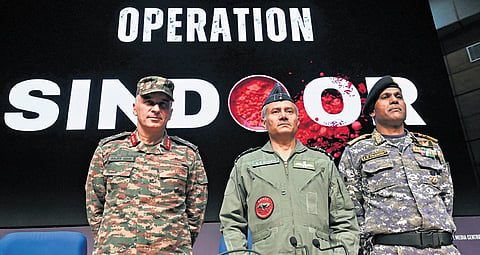
This assertion becomes particularly important, especially in light of reports during Operation Sindoor alleging that Pakistani forces were being supplied with drones originating from Ukraine. This claim has circulated but remained difficult to independently verify.
The assurance helps put into perspective the complexities of a defence industry that, especially after 2022, has become one of the world's most scrutinised. It is a fact that the Ukrainian battlefield experience has ignited global interest, as drones have arguably emerged as the single most transformative instrument of warfare in the Russia–Ukraine conflict. For countries like India, where drone production is expanding rapidly in the private-public space, the implications are particularly significant and need to be factored in.

The rise of the drones
No other weapon system has risen to prominence as swiftly, nor reshaped battlefield calculations as dramatically. With each passing month, refinements in drone technology, from first-person-view kamikaze units to long-range strategic systems, have redrawn the contours of the conflict.
What might have once been a lopsided confrontation, given Russia's overwhelming superiority in tanks, armour and infantry numbers, has been fundamentally altered. For Ukraine, drones, I was told, became not just tools of war but equalisers as innovations that offset traditional disadvantages and, in many instances, turned vulnerability into tactical advantage.
By now, across the world, everyone has seen how tanks without the support of drones are sitting duck targets for cheap drones. But the game is constantly evolving.
What struck me most was not just the machines themselves, but the concepts behind them, the understanding that a remotely-operated device can both eliminate an enemy position and save a wounded comrade without risking another human life.
Ukrainian units now routinely deploy drones to reach injured soldiers trapped under fire; the small machine hovers low, providing cover or creating a diversion until the wounded man can climb on and be pulled to safety. In a war defined by distance and precision, even rescue has become unmanned.
But nothing has transformed the battlefield as dramatically as FPV (First-Person View) kamikaze drones. Piloted through video goggles, they are cheap, fast, and lethally precise. For as little as USD 300–500, an FPV drone can destroy equipment worth millions like a tank, an artillery piece, or an armored vehicle.
Ukraine now manufactures these drones on an industrial scale, producing tens of thousands each month and training specialised drone strike brigades to operate them. And then there are the long-range deep-strike drones, capable of travelling 600–1000 km or more. These are the systems that have shaken assumptions about distance and safety, reaching deep into Russian territory.
Ukrainian ingenuity
If Russia's advantage is industrial mass, Ukraine's answer has been ingenuity. Drone production has multiplied several times over, driven by volunteers, private companies, diaspora support, and a wartime state that views drones as the equaliser.
From small quadcopters costing a few hundred dollars to heavy long-range strike drones capable of hitting refineries inside Russia, Ukraine has built a diverse, layered drone ecosystem.
While Moscow has reportedly carried out missile and drone attacks on Ukraine's power grid and cities in past winters and ahead of this winter, Kyiv has stepped up drone attacks on oil depots, airfields and other targets inside Russia. Entire swarms, sometimes six or seven drones at a time, are launched with the understanding that most will be intercepted. The intent is that even if several are knocked out by air defence, one or two may break through to strike their intended targets.
Drone saturation: Employed during Operation Sindoor too
This logic of saturation is now central to modern warfare.
On November 10, 2024, this became the basis of one of the largest drone assaults on Moscow since the start of the war took place as an estimated 70 drones launched toward the Russian capital.
A similar pattern played out during the India–Pakistan skirmish in May, when both countries deployed surveillance drones to probe and map each other's air-defence readiness. The objective was not merely to gather intelligence but to understand how many systems would be activated, how quickly they would respond, and whether a concentrated wave of drones could penetrate the defensive grid.
In many ways, the Ukrainian-Russian battlefield, high-tech, adaptive, and drone-saturated, offers a glimpse of what future conflicts elsewhere in the world may increasingly resemble.
In the end, from my own sleepless nights during the India–Pakistan drone exchanges to the conversations in Kyiv, one lesson stands out: drones may dominate the skies, but it is human ingenuity and clarity of intention that ultimately define their meaning. From Kyiv's standpoint, that meaning is unmistakable, which is defence, survival, and a refusal to be broken.