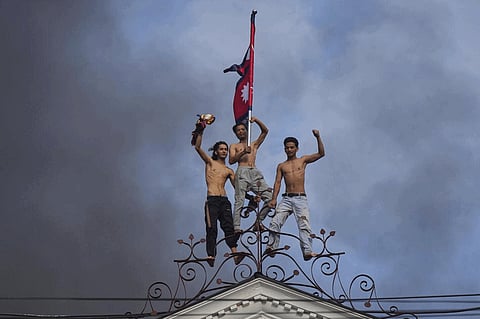

It began as a peaceful protest against the ban on social media platforms. But by the end of Monday, it had become the bloodiest day in Nepal's democratic history since the civil war. At least 19 people, mostly young students, were shot dead on the streets of Kathmandu and other cities. Over a hundred were injured. And by Tuesday, under mounting pressure, Prime Minister KP Sharma Oli had resigned.
Yet this crisis goes far deeper than a botched response to public dissent. What's unfolding in Nepal is a generational reckoning.
Led by Gen Z, these protests are not just about censorship. They are an open revolt against entrenched political privilege, nepotism, and elite impunity. At the center of public fury: the so-called "nepo kids", children of politicians and powerful bureaucrats who flaunt designer fashion, exotic vacations and lavish lifestyles on TikTok and Instagram while the average Nepali youth struggles for jobs, affordable education and above all dignity.
The resignation of Oli, once seen as an immovable strongman, might seem like a victory. But for the country's newly awakened youth, it is just the beginning of a deeper movement to reclaim the republic from those who have long treated Nepal as their inherited fiefdom.
What began with an authoritarian ban on social media to stifle dissent spiralled out of control quickly. By Monday morning, tens of thousands, mainly students in school uniforms and with college IDs around their necks, marched from Maitighar to New Baneshwor. Their chants were peaceful, even nostalgic, echoing the anthems of past revolutions: "Gaun gaun bata utha, basti basti bata utha" (Rise up from every village, rise up from every town). But what greeted them was not dialogue or efforts at de-escalation. It was tear gas, rubber bullets and, eventually, live ammunition. Most of the young victims were shot in the head or chest, according to medical sources as quoted by various media outlets.
The massacre drew immediate comparisons to the darkest days of Nepal's past. But this time, it was not a monarch or some foreign force pulling the trigger. It was a democratically elected government.
Oli's government tried to deflect blame, suggesting "infiltrators" were behind the violence. The nation wasn't buying it. Public anger swelled as reports emerged that the police had been poorly deployed and woefully unprepared despite the protests being pre-sanctioned. Three ministers, including Pradeep Yadav, resigned in protest and Yadav openly declared his support for the youth.
While the immediate cause of the protests was the social media blackout, the underlying resentment has been brewing for years. Young Nepalis, particularly those born after the 2006 peace agreement, have come of age in a country plagued by corruption, nepotism and a deeply dysfunctional political system. The children of elite politicians, meanwhile, have lived a different reality altogether.
These "nepo kids"—many of whom have never held jobs, yet drive foreign cars and vacation in the Maldives—have become symbols of everything that’s wrong with Nepal's post-conflict democracy. Their lives, showcased unapologetically online, stand in stark contrast to the majority of youth who are forced to seek low-wage work abroad or face political interference even in universities.
The grievances don't stop with Instagram. Nepal's premier academic institution, Tribhuvan University (TU), has been hollowed out by political partisanship. Appointments at TU from department heads to vice-chancellor have been dictated not by merit but by political quotas. Student unions, originally formed to fight autocracy, now serve as proxies for political parties, paralysing campus life with lockouts, strikes, and demands for permanent jobs for party-affiliated lecturers.
As one recent analysis noted, the very institutions that were supposed to uplift young Nepalis have become battlegrounds for political spoils. The result: a generation robbed not only of opportunities but also of trust in the system.
The frustration runs deep. These protests, say youth leaders, are not about one party or Prime Minister. "We are not fighting Oli," one university student said, "we are fighting Oli-ism—the system that rewards loyalty over competence, wealth over work, and silence over truth."
Oli's tenure had long been marked by authoritarian tendencies. From his attempts to dissolve parliament in 2020 and 2021 to his dismissal of public opinion during the pandemic, he has often appeared more as a despot than a democrat. His downfall this week is not just the fall of a man—but a damning indictment of an entire political culture that enabled him.
The challenge ahead, however, is monumental. Oli's resignation may momentarily appease the public, but the larger question remains: who will replace him, and will they be any different?
Nepal’s youth, having now tasted the bitter price of protest, are unlikely to settle for anything less than a sweeping change. This is no longer a protest about censorship or even nepotism. It is, as many of them have articulated, a fight for the soul of the nation.
As Nepal mourns its slain children in school and college uniform, there is a palpable sense that the country has crossed a point of no return. The killings have transformed a generation of passive digital natives into active political agents. The social media blackout backfired spectacularly, turning online outrage into real-world resistance. And the movement is far from over.
Across TikTok and Instagram—now reinstated—young Nepalis are posting tributes to the fallen. Names, faces, and stories are being shared with hashtags like #JusticeFor19, #NepoKidsExposed, and #EnoughIsEnough. The digital resistance has reawakened—and this time, it's angrier, smarter, and more organised.
For the country's political elites, the message is clear: this is not a momentary rebellion. It is the emergence of a new political force—youth-driven, digitally connected, and deeply committed to justice.
Whether Nepal's democracy can survive this reckoning depends not only on who fills Oli's shoes, but whether the system itself is willing to reform. Or be replaced for the better.
The protesters who braved rubber bullets and real ones alike are not asking for handouts, they are demanding what is rightfully theirs: dignity, opportunity and accountability. The rage on the streets is not just raw emotion. It is driven by purpose. And no resignation, unless it's followed by real change, can contain it.
