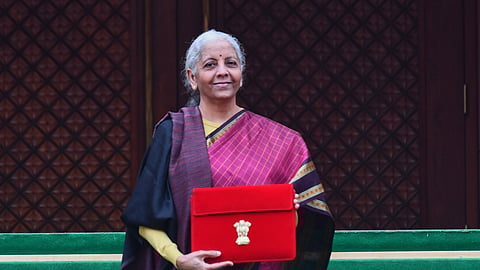

They say number 9s are superheroes for good causes.
Befittingly, Finance Minister Nirmala Sitharaman's ninth consecutive budget is armed to the teeth to turn around the wheels of global misfortunes rightly focusing on rare earths, minerals, semiconductors, nuclear power, manufacturing and importantly, indigenisation.
'Time is indeed flowing in a strange way these days', and trouble is sloshing around in spades; luck, not so much.
There's heightened macroeconomic uncertainty, geopolitical fragmentation, volatile financial markets, fragile currency and commodity price swings, besides trade, war, inflation and interest-rate concerns. It's as if Yama, the King of Hell, is busy digging a series of bear traps.
Luckily for India, domestic growth is holding up, even though the rupee, and foreign capital flows are plumbing new lows. And as the Economic Survey stressed, trade is no longer reciprocal, markets no longer neutral and supply chains are instruments of state power. So economies fear adjusting in fits and starts to this new reality.
New direction, no crowd pleasers
It's in this spirit-sinking environment that Budget 2027 arrived with a new direction —become resilient economically and diplomatically, reinforce manufacturing with thrust on exports (that surprisingly includes taking even Ayurveda global), forge trade partnerships to widen markets, avoid fiscal recklessness amid looming global debt bubble and above all create jobs and improve livelihoods.
Needless to say, such a task needs monumental efforts, and perhaps replicating humanity's desperate reach for the divine, Sitharaman launched a choose-your-own-path budget that has no crowd-pleasers, is less to do with giveaways and gifts, but more about prioritising macroeconomic stability over everything else. She even announced some market and taxpayer-dispiriting moves, dutifully reminding us that happiness and sorrow alternate in one's life.
Unlike its previous editions, Budget 2027 strategically shifts focus on the less-glamorous and long-ignored sectors like mining, textiles, engineering goods, chemicals, and renewables, which will now be the backbone of a new manufacturing and trade strategy. This shift will strengthen the domestic economy and absorb external shocks at the same time. But like in the past, the government's capital expenditure continues to inject the economic glucose, along with mindful expenditure rationalisation.
If defence got the much-needed heat and sweat with a near 22% increase in capital outlay at Rs 2.19 lakh crore amid a worsening geopolitical environment, public capital expenditure saw a full-hearted sweep with a 10% increase from Rs 11.2 lakh crore in FY26 to Rs 12.2 lakh crore in FY27. However, taxpayers' expectations of further cuts in personal income taxes and capital gains tax remain a pinkie promise. Expectations were high that Sitharaman will at least send a goosefeather from afar to boost morale and sentiment, but it all came to naught.
Big-hearted, do-gooder Budget
As for fiscal consolidation, fiscal deficit will no longer be a figure of fear for investors with the government adopting a brand new debt-to-GDP as the new anchor, giving strength and safety to numbers.
The debt-to-GDP target is set at 50% by FY31, and 55.6% in FY27, though the debut feature failed to deliver its punch for markets. Fiscal deficit is pegged at 4.3% for FY27 down from 4.4% in FY26 making for a neat and tidy stopping point. Sitharaman's sums may arithmetically seem sound, but they aren't as easy as counting one-two-three given the prevailing global financial turmoil.
There are concerns about quality of growth, private investment remains sluggish, employment generation is punching below its weight, and then there are high tariffs and geopolitical tensions. Importantly, capital outflows will likely continue as higher rates in advanced nations and the allure of AI-led tech stocks is pulling capital away.
Given the backdrop, optimists see Budget 2027 as all that and a bag of crisps, while critics dismiss it as chicken feathers and garlic skins—not worth focusing on.
Markets, unmindful of the big picture, remained miffed as equities fell like autumn leaves. Ideally, a market-friendly fiscal deficit and debt reduction plan should enthuse investors, but the Sunday-special trading window saw Sensex crashing over 1,500 points, while Nifty shed more than 600 points, despite the specific mention of AI this-and-that.
Still, the Rs 53-lakh crore big-hearted, do-gooder Budget 2027 emerged in full orchestra like Beethoven's Ninth Symphony—the greatest of all time. If the celestial soundscape Ode to Joy is a realisation of the limitless possibilities, this budget is all about finding order in chaos, and stability over spectacle to offer much more than soup and shelter for an aspirational new India.
Striking a careful balance
Coming to allocations, Budget 2027 tried to carefully balance between welfare spending and asset creation. Total revenue receipts were pegged at Rs 35.33 lakh crore, of which net tax proceeds are estimated at Rs 28.66 lakh crore. Gross market borrowings are projected at Rs 17.2 lakh crore, while net borrowing is pegged at Rs 11.7 lakh crore. Primary deficit is estimated at 0.7% of GDP in FY27, down from 0.8% in FY26.
As Sitharaman's previous budgets have shown, if there's no infrastructure, then you're doing it wrong. She rolled out several measures to boost infrastructure in tier-2 and tier-3 cities, building seven high-speed rail corridors and ensuring a special emphasis on urban infra.
Manufacturing got a second wind with Sitharaman zeroing on seven sectors including bio-pharma, semiconductors, and others besides regenerating legacy industries to ensure long-term stability and security. If bio-pharma saw a Rs 10,000 crore allocation, the India semiconductor mission saw a marginal increase to Rs 40,000 crore.
To reduce import dependency, Budget 2027 announced custom-made measures for mining, rare earths, minerals and chemicals, capital goods, high-precision components manufacturing, including production of lifts, tunnel boring equipment, firefighting equipment, container manufacturing ecosystem and so on.
Helpfully, the labour-intensive textile sector got its due with the government announcing setting up of mega textile parks, besides giving a generous lift to the national handloom programme to strengthen exports of khadi and jute to benefit weavers, and villagers.
MSMEs too rated a specific mention, like in all budgets, with Sitharaman announcing equity support of Rs 10,000 crore to create future SME champions besides increasing existing allocations and liquidity support to micro enterprises.
No real surprises on the tax front
Coming to tax proposals, expectations ahead of the Budget were like a flavourful buffet—from doing away with STT completely, to reducing short and long-term capital gains tax, joint taxation for married couples, introduction of 30% tax slab from Rs 30 lakh onwards, tax-free income of Rs 17 lakh, up from Rs 12 lakh, adding 80C, 80D in the new personal income tax regime, special tax rates for FIIs and so on.
But Sitharaman offered no surprises to an audience that was after many. Her limited measures, including an unwanted increase in STT on futures and options and a huge penalty on income misreporting sent taxpayers' hopes and expectations straight to an airless graveyard.
The good news though is, the new income tax bill will be notified soon, besides other small incentives like tax buybacks on capital gains for non-promoters, reduction of TCS on overseas tour packages, healthcare and education, tax exemption on motor insurance, removal of TDS on sale of property for NRIs, a one-time disclosure for foreign income or assets acquired up to Rs 1 crore, and others.
Lastly, simplifying tax filing, Sitharaman revised tax filing deadlines to March instead of December, while introducing tax holiday for entities offering cloud services to Indian consumers till 2047.
Clear message
Allocations to agriculture remained minimal, lacking in exuberance and enthusiasm. Likewise, allocations towards healthcare, education, rural development were all sizzle and no steak.
There's a growing chorus to increase healthcare expenditure from the current 1.5% of GDP to 2.5%, education budget from 4% to 6%, defence from 2% to 3%, but with no new tax-raising measures, Sitharaman was perhaps forced to stick to annual trendline increases.
Exports of goods and services now make up about 21.6% of GDP and grew by 5.9% in the first half of FY26. Interestingly, services exports have been cushioning against volatility in goods exports caused by tariff uncertainty. So Budget 2027 rightly renewed emphasis on the services sector and set a target to emerge as global leader in services with a 10% share by 2047.
In all, Budget 2027 is made up of a great number of small measures and a small number of great ones.
The message is clear. India will stand ready for the onslaught. By building a resilient domestic economy, securing its borders and creating a thriving industrial and services sector rather than waiting for trade breakthroughs.
It's not a budget to cover four corners of the earth searching for prosperity, but to withstand a world full of thrills and terrors.
