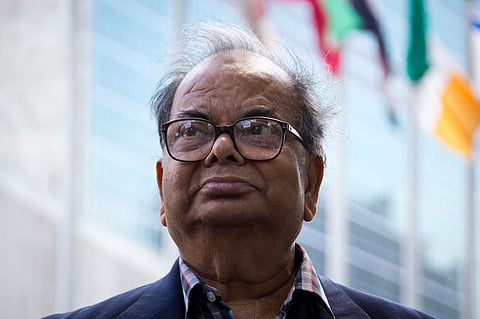

On Friday afternoon, as the light filtered in through an indifferent sky, I came upon a Facebook post by renowned translator Arunava Sinha. It was brief, almost restrained, the way news of departures often is in our times. Mani Shankar Mukherjee, whom the world of letters knows simply as Sankar, was no more. He was 92. The post carried no drama, only the weight of fact. And yet, in that quiet announcement, an entire era of Bengali literature seemed to turn a page and close it.
Sankar belonged to a generation that did not merely write stories but inhabited them. Born on 7 December 1933 in Hindmotor in Bengal, he grew up in a world that was still rearranging itself after the long shadow of colonial rule. His father died when he was young. The boy who might have drifted into anonymity instead entered the Calcutta High Court as a clerk to Noel Frederick Barwell, the last English barrister of the Raj. From that apprenticeship in the corridors of law and empire, he found not only livelihood but material. Out of those years emerged his first book, Kato Ajanare, a memoir that was already infused with the keen observation and moral curiosity that would become his signature.
The Hotel that became a city
But it was in 1962, with the publication of Chowringhee, that Sankar inscribed his name permanently upon the city and upon Indian literature. If there are novels that capture a place so fully that the geography seems to breathe through the pages, then Chowringhee is one such work. Set within the fictional Shahjahan Hotel on Calcutta's most storied avenue, it created a theatre of human longing and compromise. The hotel lobby became a crossroads of ambition, betrayal, desire, and loneliness. The bellboys and the managers, the dancers and the executives, the hopeful and the fallen all found space within its architecture.
The city was not a backdrop in Sankar's writing. It was pulse and temperature. The Calcutta of Chowringhee was postcolonial yet still haunted by the ghosts of empire. It was aspirational and exhausted, seductive and cruel. In the glitter of chandeliers and the hush of corridors, Sankar traced the fragile negotiations that ordinary people undertake to survive.
Translation as remembrance
The novel's afterlife has been as remarkable as its first reception. It was adapted into a Bengali film in 1968 and became part of popular memory. Decades later, Arunava Sinha translated it into English, at Sankar's own urging when a French edition was being contemplated.
That translation, published in 2007, carried the world of Shahjahan Hotel to readers far beyond Bengal. It is a testament to the durability of Sankar's vision that the novel travelled so seamlessly across languages.
When I read Sinha's post today, I could not help but think of how translation becomes an act of remembrance. It keeps the rooms lit long after the original lamps have dimmed.
The moral tremors of modernity
Sankar's engagement with the moral tremors of urban life did not end with Chowringhee.
In Seemabaddha and Jana Aranya, he continued to examine the uneasy compact between ambition and ethics in a rapidly modernising society. These works drew the attention of Satyajit Ray, who adapted them into films that form part of his Calcutta Trilogy. That a filmmaker of Ray's sensibility found in Sankar's fiction a cinematic pulse speaks to the layered realism of his prose. The office desk, the ledger, the street corner, the tired face at the end of a long day all found their place in his sentences.
Between the sacred and the secular
Yet Sankar was never content to remain confined within the urban labyrinth. He also turned his gaze toward the spiritual inheritances of Bengal. His works on Swami Vivekananda and Ramakrishna Paramahamsa sought to recover the human beneath the halo. He approached these figures not as distant icons but as individuals wrestling with doubt and revelation. In doing so, he bridged the material and the metaphysical, reminding readers that the sacred and the profane often share the same ground.
Recognition came, though never in a manner that seemed to inflate his persona. In 2021, he received the Sahitya Akademi Award for his autobiographical work Eka Eka Ekashi. It was a fitting honour for a writer who had spent a lifetime chronicling the solitary negotiations of the self. Awards are, at best, markers of consensus. Sankar's true accolade lay in the persistence of his readership.
Across languages, across cities
What makes Sankar endure is not merely his craft but his compassion.
He wrote of people who stood at thresholds. They were neither heroes nor villains. They were clerks and receptionists, dreamers and drifters, caught in the small heroics of daily survival. In their struggles, readers recognised something of their own.
The reach of his work extended beyond Bengali. Chowringhee travelled into Hindi and other Indian languages. There is an account, often recalled in literary circles, that the acclaimed Hindi and Maithili writer Rajkamal Choudhary translated it into Hindi under the title Chourangi. Whether encountered in Bangla or in Hindi, the story retained its central ache.
Choudhary himself was a writer unafraid of urban disquiet, and the kinship between the two authors feels less accidental than inevitable. When a novel crosses into another language, it is because it carries within it a recognisable truth.
The city as a promise and trap
Sankar's prose did not announce itself with flamboyance. It moved with quiet assurance. There was an almost journalistic clarity to his descriptions, but beneath that clarity lay a deep moral unease. He was attentive to the ways in which systems shape individuals, how economic aspiration can erode ethical ground, how loneliness persists even in crowded rooms. In this, he stands alongside other chroniclers of modern India who understood that the city is both promise and trap.
As news of his passing circulates, one returns to the image of the Shahjahan Hotel. Its corridors are perhaps dimmer today. The receptionist's desk waits. The elevator hums. Somewhere in those fictional spaces, characters still argue, still hope, still fail. That is the paradox of literature. The creator departs, but the created remain.
The quiet authority of observation
Sankar was not a polemicist. He did not sermonise. He observed. In observing, he allowed readers to arrive at their own reckonings. His writing trusted the intelligence of its audience. It did not simplify the world. It acknowledged its complexity and invited us to dwell within it.
There is something distinctly Bengali about his sensibility, yet something unmistakably Indian about his concerns. He captured the tremors of a society negotiating modernity, grappling with the residue of colonial structures, and forging new identities. His characters inhabit a space between inherited values and emergent desires. That tension continues to define us.
The doors that remain ajar
Today, as tributes gather and memories are shared, one is reminded that literature is also a form of civic memory. It records not only events but atmospheres. Sankar recorded the atmosphere of a city and a time with uncommon fidelity. Through him, we understand a slice of Kolkata that might otherwise have faded into nostalgia.
It is tempting to speak of loss in grand terms. Yet perhaps the more fitting response is quieter. To return to Chowringhee. To reopen Seemabaddha. To read again the passages where a character pauses at a window and wonders about the shape of his own life. In those moments, Sankar lives.
When I think back to that brief Facebook post this morning, I am struck by how our knowledge of death now arrives through digital scrolls. Yet the work of mourning remains analog. It happens in memory, in rereading, in the gentle acknowledgement that a voice which once narrated our confusions has fallen silent.
Mani Shankar Mukherjee leaves behind not merely a bibliography but a sensibility. He taught us to look closely at the everyday and to recognise its drama. He reminded us that within the lobby of a hotel or the desk of an office lies the epic of ordinary existence.
In the end, the keeper of Chowringhee has checked out of his own narrative. But the doors he opened remain ajar. Through them, generations will continue to walk, curious and unsettled, seeking in his pages the reflection of their own unfinished stories.
(The author writes on society, literature, and the arts, reflecting on the shared histories and cultures of South Asia.)
