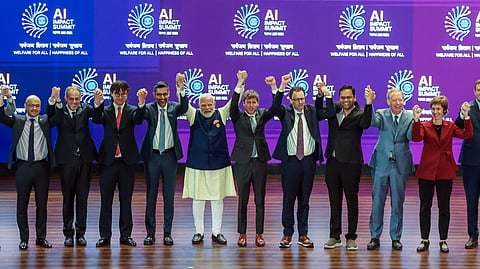

So, the India AI Impact Summit has wrapped up, and Delhi can collectively exhale into its polluted air. The five-day spectacle at Bharat Mandapam—the first major global AI gathering in the Global South—has left behind a trail of investment pledges, political mud-slinging, stolen gadgets, and at least one very embarrassed university that could not distinguish between "Make in India" and "Made in China".
The event ended up becoming a heady mix of substance, glitches, robo-drama and political mud-slinging that, at times, felt more like India's AI Kumbh Mela, staged by the marketing department of our republic without keeping the execution unit in the loop.
The Good: First, let's give credit where it's due. Behind the circus, the melee and chaos, some genuinely impressive things happened at the summit.
First, the numbers are truly staggering.
Union IT Minister Ashwini Vaishnaw announced with the glee of a kid discovering a new toy shop has opened in the neighbourhood, that investment pledges have crossed USD 270 billion. That's the kind of money that makes me want to learn Python to put in my resume. Of course, promises are not projects yet. But they could be.
Next, the final visitor count to the summit that stood at half a million. Of course, you expect that from India, yet it's impressive, especially that with 2.5 lakh students participating, it set a Guinness World Record.
So what if the QR codes weren't working in some places, and some passes had the generic lorem ipsum text behind them? We have a certificate saying we're the best at gathering students in one place.
Prime Minister Modi unveiled the "MANAV Vision" for AI. And why not, because nothing says cutting-edge technology like a good old acronym. So what if it's full form (go, Google it) sound like someone asked ChatGPT to make an acronym that covered all the buzzwords, and used an AI text-humaniser service to try and make it sound human.
The Indian Army showed it's taken over AI developments where the free market has faltered. It had a sleep-detection system for drivers and X-Face, a facial recognition system that can identify you even if you've grown a beard, donned sunglasses, and are trying very hard to look like someone else. Creepy? Slightly. Impressive? Absolutely.
And 91 countries have signed the final declaration. Now that is something really impressive.
The Bad: Now, let's talk about the elephant in the room, or rather, the elephants queuing outside because the Digi Yatra system couldn't handle the load. No, I am not fat-shaming you, dear delegates. But weighty or thin, everyone had to walk over a kilometre on one of the days to catch their ride, thanks to bad management.
That poverty of planning began on day one, which was less "global AI summit" and more "survival of the fittest," literally, as delegates reported standing in queues for hours.
Irony dug itself a deeper grave when attendees discovered that, at a summit celebrating India's digital payment revolution, the food counters accepted only cash. Don't squint your eyes, you read that right, that at an event where ministers gave speeches about UPI transforming India, which is absolutely right, hungry delegates were desperately searching for ATMs like it was Y2K.
Of course, social media was abuzz with stories of good-old mismanagement at a new-age fest. Some even compiled a list of prohibited items into the fair: no bags, no car keys, no laptops, no earbuds, no food, no water, and of course, sharp objects, perhaps including sharp and bold questions during panel discussions. Leave your dignity behind if you want to enter the world of AI.
And another irony: the internet, the very soul of AI, was patchy at best. Maybe this was the GoI hinting that we much prefer edge-AI, rather than AI as SaaS, or shall I say the present bahu, over the patchy saas. But the most unfortunate human had to be Dhananjay Yadav from NeoSapiens, who had the misfortune of discovering that his company's wearables had been stolen from within a "high-security zone". AI wearables getting stolen at an AI summit? Let's not even bring irony into the picture anymore because the ones who finally found them were some good old cops doing some old-age sleuthing.
Naturally, the opposition in India panned it, with Karnataka Minister Priyank Kharge calling it a "PR stunt" where builders, innovators, and inventors were invited only to be thrown out when the Prime Minister showed up for his photo opportunity. His father, Mallikarjun Kharge, added that the event, which could have been a "showpiece," turned into "utter chaos" due to “rank mismanagement,” leaving exhibitors without food and water.
The Ugly: What is an international summit without the ugly bits thrown into the mix. And this one had its bit, none more eye-grabbing and laughter-inducing than Galgotias University's robotic dog, "Orion."
The university showed this four-legged marvel as its own creation. The only problem was the internet, glitchy as it was at the event. Eagle-eyed internet sleuths didn't take long to figure out that this Orion fella was nothing but a Chinese robot from its company, Unitree, available for purchase online by anyone with a credit card and zero expectations of after-sales service.
When I was a kid, we had this joke about the Chinese, the Russian and the American showing off their cool tech only for the Indian to laser print 'Made in India'. That was purana-Bharat of the 1980s. That the naya-Bharat hasn't changed much became the trending topic of the Mandapam, leading the organisers to throw them out. Wonder if their loyal robot dog barked, or if it ran straight off to China, sniffing its master's footprints.
The other ugly spectacle was organised by the opposition Congress party. Members of Youth Congress staged a "shirtless protest" at Bharat Mandapam, displaying slogans calling the Prime Minister "compromised". My response was 'meh', but a female friend's comment was, to me, gold: "The opposition should remember to choose men with good physiques if you're to throw them shirtless under the bus." Touche.
Another ugly note was struck by Bill Gates, who pulled himself out of a keynote address after his name surfaced in the Epstein Files. Perhaps the synecdoche of the event was perfect because it is AI, specifically Grok AI, that, within weeks prior, had been used to create nonconsensual deepfake nudes of millions of women and girls, including children.
The Verdict: A Very Indian Success: In a sense, the India AI Impact Summit (India's own AI Kumbh Mela if you will) was then a sort of microcosm of modern India itself: ambitious, chaotic, occasionally brilliant, frequently frustrating, yet never for a moment boring.
The government is calling it a "grand success", while the opposition lampoons it as a disaster. The truth, as always, lies somewhere in between, perhaps still standing in line in one of those endless queues we saw outside Bharat Mandapam.
Yet, USD 270 billion in investment pledges is not pocket change. Global leaders did show up, even if a few refused to hold hands publicly. Indian startups might struggle with the red tape of bureaucracy, but they did get visibility. The "MANAV Vision" gave every politician in the Mandapam something they could all agree on beyond political wranglings. These are real achievements that shouldn't be brushed off, no matter how many logistical hiccups that intertwined themselves with them.
That said, we must also acknowledge that the hiccups weren't minor. In a week when the world's biggest tech news turned out to be not our AI Summit but Chinese robots dancing on stage, if we cannot pull off simple logistics, how will we compete with the world?
When international delegates can't pay for food because the cashless society suddenly went cash-only, when innovators can't access their own booths because of security sweeps, when products get stolen from "high-security zones": these don’t remain footnotes but become fundamental failures that will undercut the message, and in the long run will pull the nation down. If we can’t get the old basics right, how can we pull off the newest tech in the country?
Perhaps that's the true lesson from the India AI Impact Summit 2026. We may get the fanciest algorithms, the most impressive robots, and the most inspiring acronyms everyone nods to. But if people can't get food, water, or working internet; if queues stretch for hours; if a star attraction turns out to be a Chinese import with an Indian name, then it is a problem that demands all of us to roll up our sleeves and get to work.
So, was it a success? We’ll know in a year. If that is, we remember to ask how many of those investment pledges materialised, how many of the quarter-million students enrolled in Python classes, and how many truly foundational AI models we develop and startups we fund to build India’s AI future.
Until then, the 2026 edition will be remembered as the year India threw a giant AI party, invited the world, made some important announcements, tripped over a robotic dog, and finally walked away with both bragging rights and bruises. Which, in its own way, is perfectly on‑brand.
Jai Hind. And please, next time: enable UPI at the food court.
