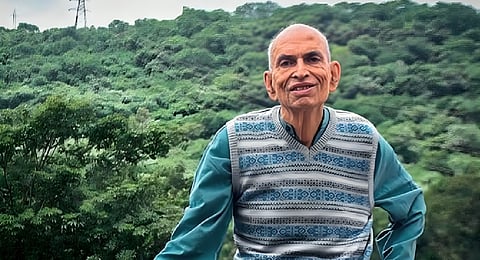

Seventy-nine-year-old VS Vijayan is lost in reflections less than a day after the great ecologist Madhav Gadgil passed away aged 83.
Vijayan, the founding Director of the Salim Ali Centre for Ornithology and Natural History and a noted ecologist himself, had first met Gadgil at the Indian Institute of Science in 1975.
What began as a professional acquaintance blossomed into a lifelong intellectual companionship, extending far beyond laboratories and classrooms into the forests of Bandipur and Wayanad.
The early field journeys the duo made, Vijayan recalls, revealed Gadgil not merely as a scientist, but as a deeply committed and principled human being.
"Madhav (Gadgil) never softened the truth to make it acceptable," Vijayan says about their almost 51-year-long association. "He believed that honesty itself was a form of responsibility."
For Vijayan, that unwavering honesty was not just a personal trait but the foundation on which the great ecologist built his life—as a scientist, a thinker, and a human being who refused to let conviction bend under pressure.
Gadgil was also, according to Vijayan, a powerful presenter—clear, direct, and uncompromising in expression—never diluting his words or thoughts.
A habit that stood out was his insistence on maintaining a daily diary, meticulously recording observations. This practice, Vijayan notes, gave Gadgil an exceptional sense of accuracy in both thought and action.
At the core of Gadgil's philosophy was a firm belief that development must take place with the wholehearted involvement of people. This approach was not merely theoretical; it was visibly reflected in the Gadgil Committee Report. He consistently argued that development should never lead to environmental destruction and that people's consent and participation were essential for any sustainable progress.
A simple human being who always had the well-being of humanity at heart, Gadgil spoke fearlessly, regardless of whether his words were welcomed or criticised. Vijayan observes that once people truly understood what Gadgil stood for, his ideas became difficult to dismiss.
Though he was often criticised for discussing complex ecological issues at the village level, Gadgil stood firm in his belief that grassroots people participation was the foundation of meaningful development. He was also quick and thoughtful in his responses to criticism.
Gadgil repeatedly stressed that scientists must analyse independently and should never allow external influences to shape their thinking. "He was not an activist," Vijayan points out, "but his ideologies and philosophies truly matter today."
Vijayan also recalls a moment of disagreement between them.
Gadgil once criticised the famous ornithologist Salim Ali, someone whom Vijayan deeply admired. The disagreement, though uncomfortable, remains memorable for Vijayan as an example of Gadgil's intellectual honesty and his refusal to compromise on his beliefs, even at the cost of personal disagreement with a friend.
"I learned honesty from him," Vijayan underlines. "Even after his death, we must stand by his thoughts."
Vijayan also shared a memorable instance to underline how Gadgil always remained the ultimate gentleman.
He recalls how when the Kasturirangan Report reflected a different stance from what had emerged during Gadgil's discussions with the former ISRO chief, the great man chose to remain silent instead of venting his anger.
Vijayan acknowledges the void Gadgil, whom he calls a great leader, leaves behind. Yet, he finds hope in the vast community of students and followers the great ecologist leaves behind.
When asked to sum up his friend, Vijayan chooses his words with care and tenderness. "An extremely lovable person with ideas and approaches that could never be diluted by pressure or influence," he says, adding that even nature will be echoing his passing away as "a big loss."
