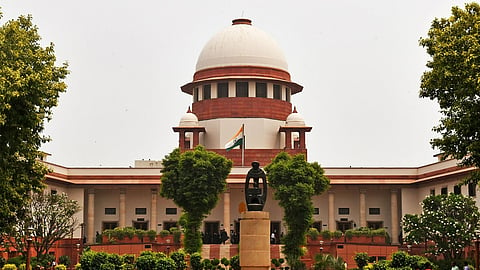

The Supreme Court is often described as the sentinel on the qui vive, guarding constitutional morality against executive excess and private greed. Yet, during a recent hearing in a land dispute involving the Yamuna Expressway Industrial Development Authority and a private real-estate developer, the court turned the lens inward—towards society itself.
Justice Dipankar Datta, speaking from a Bench headed by Chief Justice Surya Kant, made a striking observation: modern litigation in India is increasingly driven by four primal impulses—hinsa (violence), lobha (greed), kama (desire), and krodha (anger). The Chief Justice concurred, adding that public officials were often “hand in glove” with private builders in subverting land laws. The dispute relates to the levy of charges on sub- leases of land that were allegedly executed without obtaining prior approval from the authority, raising concerns about violations of land laws and regulatory norms.
At one level, the remarks may appear rhetorical. At another, they expose the moral anatomy of India’s litigation crisis—a docket burdened not merely by numbers, but by the erosion of ethical restraint in both governance and citizenship.
Mirror of moral breakdown
Justice Datta’s candid admission—that courts cannot issue a mandamus commanding citizens to abstain from greed or violence—captures a deeper truth: law can regulate conduct, but it cannot manufacture virtue. India’s courts are inundated with disputes arising from land acquisition, infrastructure projects, real-estate speculation, and regulatory arbitrage.
Many do not stem from genuine legal uncertainty, but from deliberate transgression—forged documents, manipulated zoning norms, collusive approvals, and strategic litigation designed to delay, exhaust, or legitimise illegality. When lobha becomes normalised, litigation ceases to be a search for justice and turns into an extension of desire by procedural means. This diagnosis is not new. More than a century ago, Mahatma Gandhi arrived at a similarly unsettling conclusion.
In Law and Lawyers, a later-day anthology of Gandhi’s writings on jurisprudence and the legal profession, Gandhi advances a moral critique of legal practice that remains not only strikingly relevant but profoundly unsettling even today. Though trained as a barrister, he grew deeply sceptical of adversarial litigation, warning that lawyers often “encourage quarrels” rather than resolve them, and that legal victories frequently deepen social wounds instead of healing them.
Gandhiji once lamented the delirium of modern civilization in words that feel uncannily contemporary: “The councillors want their fares and extras, the ministers their salaries, the lawyers their fees, the suitors their decrees, the parents such education for their boys as would give them status in the present life, the millionaires want facilities for multiplying their millions and the rest their unmanly peace. The whole revolves beautifully round the central corporation. It is a giddy dance from which no one cares to free himself and so, as the speed increases, the exhilaration is the greater. But it is a death dance and the exhilaration is induced by the rapid heartbeat of a patient who is about to expire.”
For Gandhi, this collective frenzy was not merely economic or political; it was a moral delirium that steadily nourished the four diabolical impulses of hinsa, lobha, kama and krodha.
For Gandhi, justice lay not in triumph, but in reconciliation. Litigation driven by lobha or krodha was a betrayal of both law and society. Courts, he believed, were meant to restore harmony, not reward cunning. Justice Datta’s four triggers echo this diagnosis with precision. Hinsa manifests not only in physical violence, but in coercive dispossession. Kama fuels speculative accumulation. Lobha corrodes public institutions. Krodha sustains cycles of retaliatory litigation. Together, they convert law into a battleground rather than a shared moral framework.
Law without solidarity
Chief Justice Surya Kant’s observation about collusion between officials and private builders reveals another layer of the crisis: the collapse of ethical boundaries within the state itself. When regulators become facilitators of law-breaking, law loses its normative authority. Courts are then forced into an impossible role—repairing systemic wrongdoing case by case, after the damage is done.
Justice Datta’s remark that courts have “no control over citizens” is not judicial retreat, but institutional realism. Constitutional courts can invalidate illegality and impose penalties, but they cannot substitute for a culture of restraint—what Gandhi called swaraj in its deepest sense: not merely self-government, but self-mastery. A society excessively dependent on courts, Gandhi warned, has already failed morally. Excessive litigation is not evidence of legal vitality, but of ethical decay.
This moral failure also finds expression in modern public law theory. Writing in early twentieth-century France, jurist Léon Duguit rejected the idea that law derives authority from sovereign command. For him, law was legitimate only insofar as it sustained social solidarity—the web of interdependence that binds individuals into collective life. Rights, Duguit argued, were not absolute entitlements, but social functions. When individuals—or the state—invoked law to advance narrow self-interest, law became instrumental rather than normative.
Read through this lens, Justice Datta’s four triggers mark not merely personal vice, but a collapse of law’s social function. Lobha turns property into speculation. Kama converts entitlement into accumulation. Krodha weaponises procedure. Hinsa ruptures cooperation altogether. Litigation proliferates because law is no longer experienced as a shared moral commitment, but as a tactical device.
Duguit would have recognised this pathology instantly. A society that treats courts as arenas for private desire rather than institutions for social coordination inevitably overloads them. The crisis, then, is not merely of adjudication, but of law’s lost social function. Justice Datta’s observation that courts cannot control citizens echoes Duguit’s central warning: law cannot compel solidarity where society has abandoned it. Courts may correct violations after the fact, but they cannot generate the ethical cohesion on which legality itself depends.
Stoic wisdom
Here, Gandhi’s scepticism finds a philosophical ally across centuries. Marcus Aurelius, the Stoic emperor-philosopher, warned in his Meditations: "All rational beings have to put with each other if they want to be kind and fair and live in harmony. Bear in mind that many have fallen out with others, caused suspicion, hatred, and conflict. But today, many of these people are already in their graves and are nothing more than dust. Life is short; stop getting angry".
Stoicism rests on a demanding ethic: self-mastery precedes social harmony. External rules matter, but inner discipline matters more. This insight aligns with Gandhi’s insistence that courts cannot repair what conscience refuses to restrain—and with Justice Datta’s recognition that law cannot command virtue.
The challenge before India, then, is not merely judicial reform, but moral renewal. Procedural efficiency and digitization are necessary, but insufficient. What are equally required are ethical governance, responsible citizenship, and professional integrity within the Bar.
Gandhi believed the finest lawyers were those who helped clients avoid litigation altogether. Justice Datta’s remarks suggest that the Supreme Court, too, recognizes the limits of adjudication in the face of unchecked human impulses.
In the end, the question is not how many cases courts can dispose of, but how many disputes society can prevent by restraining its darker instincts. Until lobha is tempered by accountability, kama by reason, krodha by empathy, and hinsa by moral authority, dockets will remain crowded — and justice, elusive.
The court has spoken. What it now calls for is not merely legal compliance, but philosophical introspection — a return to a shared wisdom, from Gandhi to Marcus Aurelius, that law may restrain wrongdoing, but only self-restraint can prevent it.
(The author is Deputy Law Secretary to the government of Kerala)
