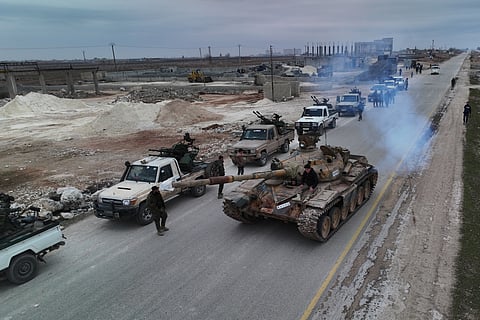

In early January this year, the Syrian city of Aleppo descended into violence. Predominantly Kurdish neighbourhoods in the northern city, home to Kurdish inhabitants for centuries, were decimated by forces of the Syrian interim government and the Islamic State, sending some 150,000 civilians, from the 500,000 strong community, fleeing for safety.
Syria is being sucked back into a bloody vortex of violence amid a resounding silence in the Arab world and other world capitals.
Not only did the January 6 attack shatter a fragile peace, in place since the Bashar Al Assad regime was overthrown by the Hay’at Tahrir Al Sham militia in December 2024, it now calls into question whether the Kurdish plan to integrate into the Syrian polity will ever come to fruition. It also raises the spectre of Turkey, prime mover behind the attacks on the Kurds, emerging as the powerhouse in the Middle East, challenging the writ of the Saudis and Iran as a fragmented Syria adds to the churn, becoming the epicentre of renewed conflict in the region.
The bigger question is whether Washington, caught in the Ukraine and Venezuela vortex, on skid row in icy Greenland, bent on edging the Palestinians out of Gaza, and working with Israel on regime change in Iran, is distracted?
Or, are we seeing a deliberate and major US re-ordering of the region by empowering a once well-known protégé of the Islamic State in Syria and backing Turkey's bid to end the writ of the Kurdish-led Democratic Autonomous Administration of North and East Syria (DAANES) in the Kurdish enclave of Rojava as part of Turkish President Erdogan’s long-term plan to recreate the Ottoman empire?
Why has the US played along? What should have set the alarm bells ringing was US President Donald Trump rolling out the red carpet for Syrian President Ahmed Al Sharaa at the White House. Were the Kurds -- whose Syrian Democratic Forces, the multi-ethnic defence forces of the Kurdish-led DAANES, had fought Daesh with US backing and support until very recently -- blindsided by Al Sharaa? Clearly, this is a Syria playing to a US-Turkish playbook, even as it ends any hopes the Kurds had of integrating their autonomous administration into a Syrian state and, for that matter, in Turkey.
Why has the Trump administration been unabashed in its support of the Syrian interim government, knowing full well that SIG is, in part, an IS offshoot? Syrian President Ahmed Al Sharaa, who hails from the Golan, is a protégé of the Islamic State’s Abu Bakr al Baghdadi. Known by his nom de guerre Abu Mohammed Al Jolani, with known links to the Islamic State, he was plucked out of relative obscurity and presented to the world as the man of the moment.
Curiously, even the IS attack in December 2025 claiming the lives of two US soldiers and their American translator, which predated the Aleppo assault, garnered no reaction from the White House. Instead, SIG President Ahmed al-Sharaa’s promise of Syria's participation in the international anti-IS coalition when he visited the White House was given more credence than the situation on the ground, where IS units have repeatedly attacked the Kurdish Syrian Democratic Forces (SDF).
Kurdish survivors of the Aleppo attack have flagged Al Sharaa’s involvement, saying they were up against the Islamic State militia, openly sporting Daesh’s flags and insignia, while fighting alongside SIG. Bangin Heleb, a resident of the Sheikh Makhsood neighborhood in Aleppo, and a member of the local Internal Security Forces, told reporters that he recognised many of the fighters and IS tactics.
Did Abdullah Öcalan, the Kurdish leader kept captive on Imrali island since 1999 by Turkey, who has long warned of the ramifications of the US’ Greater Middle East Project, see the escalation in Syria -- and Turkey -- coming?
Ocalan’s New Year’s message on December 30 laid out the main goal of the March 10 MoU between Turkey and the Kurds as setting up “a democratic political model in which the people can govern themselves collectively” and the importance of Turkey “facilitating a constructive and dialogue-oriented role”.
But the January 6 onslaught by Al Sharaa’s SIG on the Kurdish community in the Sheikh Makhsood and Ashrafiyah neighbourhoods in Aleppo put paid to the MoU. The ceasefire declared on January 9 failed multiple times, with some 250 Kurdish civilians abducted by SIG, as fighting escalated. Within Syria, it’s not just the Kurds who are being systematically targeted by IS but minority Alawites and Druze as well.
Kurdish insiders say that the attack on their people in North and East Syria was co-ordinated by the US, Israel and Turkey. They have raised the Turkish military’s “escalatory role in its destabilisation of Syria”. They point to the Turkish Ministry of Defence’s public declaration of support for SIG, the open deployment of Turkish drones during the assault by SIG, and Turkish control of SIG units during the Aleppo attack. The fact that the present Syrian National Army was set up and trained by the Turks is an open secret, said one insider. It leaves no room for a rapprochement, he said, warning that it also underscores the potential to cause instability far beyond Syria's borders -- in particular, within Turkey.
The Kurdish population in Turkey had taken to the streets in Istanbul and Kurdish dominant cities in eastern Turkey, fearful of a repeat of the Islamic State’s attack on the Kurdish city of Kobane in northern Syria in 2014, which triggered the Kurdish uprising in Turkey.
In addition, Turkish adventurism in Syria has now raised a serious question mark over whether the Kurdish leader Abdulah Ocalan can arrive at a deal with the Turkish President Recep Tayyip Erdogan on his own freedom as many had hoped, and whether the Kurds in Turkey will be able to move forward with their plans to create a legitimate political space in the Turkish polity.
Interestingly, Turkey’s open support for the Islamic State through 2014-2019, which helped the jihadist group take control of northern and central Syria, with Rakka as the capital, is no secret. It was a move that gave IS a secure base to operate from, leading to the mushrooming of IS terror training camps. In recent weeks, the number of recruits has swelled in their tens of thousands -- all with access to Turkish medical care, armed and fed by the Turkish military and its secret service. Whether the Kurdish forces YPJ (People’s Protection units) and YPG (Women’s Protection Units), which gave IS a run for its money as it sought to rebuild the Islamic Caliphate, can continue the good fight now that they no longer have US support is open to question.
Why did Damascus up the ante now? Was it to scupper ongoing talks between DAANES -- established by the Kurdish, Arab, Syriac, Turkmen and Armenian population of Syria’s Northeast in 2018 -- and SIG on a political-military integration?
Thus far, US Special Envoy for Syria Tom Barrack has been the prime mover and shaker behind the DAANES-SIG negotiations taking place in the Jordanian capital Amman, Damascus and Syria’s Northeast. He’s been in Erbil in Iraq and in the Turkish capital Istanbul for multiple meetings since the March 10 deal was signed last year. He’s also worked in tandem with the Trump administration, the State Department and the Pentagon, signalling that Washington was driving the rapprochement. As recently as January 4, SDF officials were in Damascus for talks on the implementation of the March 10, 2025 MoU signed by the two sides.
Turkey, it must be said, did get called out by the UK government which imposed sanctions on Istanbul in December for 'horrific violence against the civilian population in Syria'. But the US, post January, has said little, even as Al Sharaa’s IS-led forces are steadily gaining ground. Multiple ceasefires have been declared and broken by SIG forces since January 10. This included a 14-point agreement and ceasefire signed by Al-Shaara and SDF’s Mazloum Abdi on January 18. Now, SIG forces have pushed SDF out of areas west of the Euphrates. They have crossed the Euphrates and control the oil-rich Deir-ez Zor, the city of Shaddadi, Ain Isa and Rakka. Thousands of IS fighters have been released from prisons. US troops stationed nearby did not intervene despite SDF’s calls for assistance.
DAANES declared a state of emergency on January 18 and called on all its citizens to take up arms. Leading Kurdish politicians from the North-East of Syria have warned of genocide against the three million Kurds in the country. Heavy fighting continues in areas east of the Euphrates, especially around the cities of Kobane, Heseke and Cilaxa.
A meeting between al-Shaara and representatives from DAANES and SDF reportedly took place in Damascus on January 19 and again on January 27.
Sources told this reporter that SIG’s Aleppo attacks came within hours of a meeting between Israeli and Syrian representatives in Paris on January 6 where the Turkish Foreign Minister Hakan Fidan was present, and an agreement had been reached for a cessation of hostilities by Israel, U.S. and Turkey in Syria. But it stood for little. It was as ineffectual as the meeting on January 4, when the US brought together representatives of SIG and SDF in Damascus. Both sides were close to signing an agreement, said the insider, until the Syrian Foreign Minister Asaad Al Shaibani backed out. Two days later, on January 6, Kurdish neighborhoods in Aleppo faced hellfire.
Curiously, Russia, a major player during the Assad regime, which gave refuge to Bashaar al Assad and continues to maintain a presence in Syria, has seen President Vladimir Putin hosting Al Sharaa in Moscow on January 28, saying he welcomed the efforts by SIG to unify Syria.
Kurdish insiders do concede that without the US’ initial support, Syria risked instability and implosion. But they also say that the envoy’s promise at the time of “a new Syria – a unified nation in which all communities, including Arab, Kurdish, Druze, Christian, Alawite, Turkmen, Assyrian, and others are treated with respect and dignity and afforded meaningful participation in governance and security institutions” now rings hollow.
More so, in the face of SIG’s attacks and the empowering of a known IS leader of the likes of Ahmed al-Shaara, which, the Kurds believe, puts the region at risk.
The US game plan, say insiders, is to have a Syria under a pliant Al Sharaa that will block Iran from re-establishing its control over the country that under Bashar Al Assad had been a key supply line to Hezbollah in Lebanon and a threat to Israel. The US needs a Syria that is hostile towards Iran. Al-Shaara has done just that, promising the US that he will cut off all supply routes for Iranian proxies like Hezbollah. He has demonstrated his readiness to eliminate Islamists within his ranks who have transnational aspirations like establishing the Caliphate and Islamic Ummah.
He has promised to fight against IS. While that remains to be seen, given the growing IS presence in the recent Aleppo flare-up, he has made several key concessions. He has not challenged the Israeli occupation of large parts of South Syria, while accepting the annexation of Hatay by Turkey (which the Assad regime had never accepted), opening Syria's economy to Western, Turkish and Gulf investors, and critically, acceding to the setting up of US military bases in Syria that will be used to target Iran.
But while Turkey may have played along for now, agreeing to end the fighting in Aleppo after an agreement brokered by the US saw Syria’s Internal Security Forces withdraw from the two Kurdish neighborhoods, North and East Syria and its Kurdish populace remain tense. To them, it is now all too clear that the US has few compunctions over a fragmentation of the country that could see Israel assert military control over South Syria even as Turkey takes control of the north.
With negotiations on the MoU of 10 March all but over, Syria could be engulfed in a dangerous spiral of violence. An all-out war between the SDF and the SIG, which seems inevitable, could ultimately lead to the fragmentation of Syria, with the country's Alawites and Druze also turning against SIG. If Turkey, driven by its aspirations to recreate the Ottoman Empire of old, emerges as the overarching power in the Middle East with its writ unchallenged, it could mean the long-term destabilisation of Syria with catastrophic consequences for the rest of West Asia.
'Turkey wants a genocide of the Kurds'
With the Kurdish people facing a return to the unrelenting attacks on their homes in Syria, a Kurdish observer who requested anonymity agreed to answer some key questions on what was behind Turkey’s move to unleash a new round of violence after months of negotiations with Kurdish leaders had given their beleaguered people the hope that they would finally be given a place in Syria and Turkey’s social and political landscape.
Where does the attack on Kurdish neighbourhoods in Syria’s Aleppo leave Turkey?
Turkey's ambition goes even further: it wants the Hayat Tahrir Al Sham (HTS) and IS to carry out a genocide against the Kurds of Syria, thus de-populating large parts of the North and East of the country. The model for this is the small area of Afrin which was occupied by Turkey in 2018. After the occupation, the number of local Kurdish residents fell from 90% to 20%. Those who stayed are faced with daily repressions, a ban of their language and an almost complete lack of political and cultural rights. Turkey rejects the idea of Kurds becoming equal citizens in a democratic, decentralized and pluralistic Syria. It also rejects such a status for the Alawites and Druze of the country.
What does this mean for the Kurdish enclave of Rojava?
The Kurds in Syria are today faced with the threat of becoming completely politically excluded from the future Syria and of becoming victims of systematic demographic change and genocide. The three million Kurds of the country have now largely been confined to the geographic limits of Rojava. 150,000 Kurds were forced to leave their homes in Aleppo, Rakka, Taqba and Deir ez-Zor in the last few weeks alone. Many more remain in these areas and are subjected to torture, oppression and daily murderous attacks.
Rojava will now defend itself with all the resources it has. Thousands of Kurds from Iraq, Turkey, Iran and the diaspora have already joined the self-defence forces YPG and YPJ in Rojava. A group of more than 100 ‘internationalists’ from Europe is currently on the way to Rojava and there are many more travelling individually. Preparations for a comprehensive war to defend Rojava against HTS and IS are therefore ongoing. At the same time, DAANES representatives have repeatedly stressed in recent days that they are willing to negotiate an integration with Damascus.
Are Kurdish aspirations for a legitimate political voice in Turkey still possible?
The political process between the Kurds and the Turkish state is in great danger. Every day, there are huge demonstrations in Kurdish cities in East Turkey, but also in major cities like Istanbul. The police has reacted with brutal violence and many arrests. The Kurds everywhere are very aware of Turkey's leading role in the current attacks on Rojava. Thus, the Kurds especially in Turkey have called on the government and state to stop their attacks on Rojava, establish peaceful and respectful relations with Syria and commit seriously to the talks with the Kurdish people's leader Abdullah Öcalan.
Statements by government officials and government-aligned journalists in recent days show that Turkey will try to create the impression that the political process continues. It will try to enforce its one-sided goals on the Kurds of Turkey and portray this as a solution to the Kurdish issue. Turkey's parliament will pass laws without involving the Kurdish demands. The Kurds will not accept this. Turkey will then portray this as a rejection of peace and solution by the PKK and claim that it has made peace with the Kurdish people. Thus Turkey will try to gain international support for its continuing oppression of the Kurds while claiming to have solved the issue.
The only way to avoid the continuation of this long-term conflict is for Turkey's government and state to recommit to the efforts of finding a solution acceptable to the Kurdish population of Turkey and to broader civil society in Turkey.
Is Erbil in Iraq strong enough to withstand any attacks?
It is very likely that Iraq will be destabilized in the near future too as parts of the US-Israeli efforts to weaken Iran. This poses huge threats for the Kurdistan Region of Iraq (KRI). The KRI is aware of this and has thus been helping Rojava in recent weeks. The Kurds of South Kurdistan/KRI see the defense of Rojava as a defense of South Kurdistan. This especially includes the Ezidi population of Shengal in North-West Iraq.
The spirit of national unity among the Kurds is today stronger than ever. The defence of Rojava, but also of South Kurdistan will be shouldered by the Kurds from all four parts of Kurdistan and the diaspora. The Kurds have the political horizon, organizational strength and military experience to successfully defend themselves against the heavy attacks in 2026.
