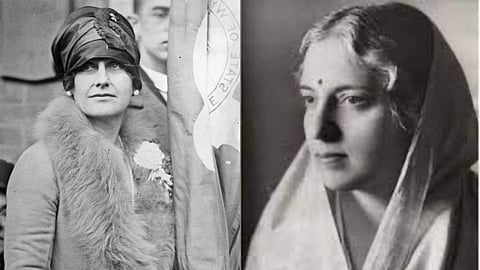

International Women’s Day is frequently framed in the vocabulary of struggle—and rightly so. The march toward parity has demanded resistance, reform, and a singular resilience. In the popular imagination, the feminist movement is a series of hard-won concessions wrenched from a reluctant patriarchy. This narrative of primordial friction finds its roots in the ancient Jewish myth of Lilith, the purported first wife of Adam. According to midrashic tradition, Lilith was created from the same dust as Adam, making her his absolute equal. However, when she refused to take a subordinate position, the resulting deadlock led to her departure from Eden and her casting as a demonized figure of the wilderness.
The Lilith myth serves as the archetypal "rupture"—a cautionary tale suggesting that equality and partnership are mutually exclusive, and that the only path to autonomy is through total exile or antagonism. Yet, history preserves a parallel, restorative truth: that women and men, working in partnership rather than perpetual rivalry, have together reconfigured the public sphere. We often mistake progress for a series of individual conquests, forgetting that the bedrock of human civilization is not competition, but a sophisticated, cross-gender synergy.
This collaborative instinct finds its most profound philosophical grounding in the work of the naturalist and social theorist Peter Kropotkin. Challenging the "social Darwinism" of his era, which emphasized "survival of the fittest" as a ruthless zero-sum game, Kropotkin argued in Mutual Aid: A Factor of Evolution that the most successful species were those that practiced cooperation. He observed: "In the practice of mutual aid... we find the positive and undoubted origin of our ethical conceptions; and we can affirm that in the ethical progress of man, mutual support—not mutual struggle—has had the leading part."
When applied to the history of gender, Kropotkin’s thesis suggests that the elevation of women’s status is not merely a "victory" over men, but a civilizational advancement achieved through mutual support. The dramatic political ascents of Nellie Tayloe Ross in the American West and Nellie Sengupta in colonial India offer a profound illustration of this evolution. They move us past the Lilithian rupture, demonstrating that when the artificial barriers of gender antagonism are lowered, the resulting partnership creates a "mutual aid" that benefits the entire body politic.
Wyoming, 1925
The sudden passing of Governor William Bradford Ross in 1924 left the state of Wyoming in a state of mourning and political flux. The American frontier prided itself on a brand of rugged individualism—a "Wild West" ethos that viewed the executive office as an exclusively masculine redoubt. Yet, amidst the grief, a radical proposition emerged from the Democratic Party: his widow, Nellie Tayloe Ross, should contest the special election to complete his term.
Skeptics dismissed the move as "sentimental politics," a mere play for the sympathy vote. However, supporters sensed the stirring of history. The campaign unfolded under a national microscope; America had only recently ratified the Nineteenth Amendment in 1920. The question was no longer whether a woman could vote, but whether she could govern. Could authority wear a different face?
When the ballots were counted in early 1925, Nellie Ross had won decisively, becoming the first woman elected as Governor in United States history. Her victory was less a spectacle and more a transformation of the frontier’s social contract. While marriage had introduced her to the public stage, her leadership was sustained by a steely personal competence. She did not govern as a grieving placeholder; she became a deliberate policymaker who championed bank tax reforms and child labor laws.
In Ross’s case, partnership had opened the door, but merit ensured she remained within the halls of power. Her relationship with her husband was not a shadow that obscured her; it was the training ground where her political consciousness was honed through shared intellectual life. Her election proved that the electorate was ready to trust a woman’s executive judgment, provided the path was paved by a collaborative legacy.
Calcutta, 1933
Across the ocean in colonial India, the stakes were of a different, more perilous order. By the early 1930s, the Indian National Congress was under siege. Its top tier of leadership was frequently incarcerated, and its assemblies were proscribed under draconian ordinances. British authorities sought to stifle the independence movement by removing its most vocal architects from the public square.
Among those targeted was the "Lion of Bengal," Deshapriya J.M. Sengupta. A Cambridge-educated lawyer, J.M. Sengupta had abandoned a lucrative legal practice to join the non-cooperation movement. His frequent incarcerations had already tested the mettle of his household, but his final arrest and subsequent death in custody in 1933 created a leadership vacuum the British hoped would break the spirit of the Bengal Congress.
Instead, it catalyzed a transition from domestic partnership to political vanguardism. Nellie Sengupta (born Edith Ellen Gray in Cambridge) had followed her husband to India, embracing his culture and his cause with a ferocity that matched his own. In the volatile atmosphere of 1933, she was elected President of the 47th session of the Congress in Calcutta.
The symbolism was electrifying: an English-born woman, standing at the helm of an Indian resistance movement against her own country's empire. Her election was a masterstroke of political "mutual aid." By placing her at the helm, the Congress signaled that the movement was not a collection of individuals who could be imprisoned, but a shared consciousness that crossed both gender and geography.
The drama reached its zenith when, while attempting to deliver her presidential address in defiance of a colonial ban, she was arrested. Here, the Kropotkinite ideal was etched in iron: she did not merely replace her husband; she validated his life’s work by assuming his risks. If partnership had drawn her into the Indian cause, it was the crucible of his arrest and her own conviction that made the cause indissolubly her own.
The Radical Counter-Narrative
These episodes inevitably invite a critique from more radical strands of feminist thought. Lesbian feminism, particularly as articulated by thinkers like Adrienne Rich, has long viewed the institution of marriage through a lens of skepticism. Rich argued that heterosexuality is not a "natural" choice but a structural tool designed to redirect female energy toward the preservation of male-dominated hierarchies.
From this perspective, the "Two Nellies" might be seen as exceptions who succeeded despite the domestic sphere. A radical critique would argue that by gaining power through their husbands' names, they reinforced the idea that women’s political legitimacy is derivative.
However, the lives of Ross and Sengupta offer a pragmatic alternative to the necessity of total institutional rupture. If lesbian feminism emphasizes the "woman-identified woman," the legacies of the Nellies suggest a "civic-identified partnership." They demonstrate that the mutual aid Kropotkin observed in nature can be replicated within the very institutions often dismissed as oppressive. By transmuting the private bond of marriage into a public platform for justice, they did not merely decorate the existing structure; they renovated it from within.
Partnership as a Democratic Principle
The enduring lesson of the "Two Nellies" is not that traditional institutions are flawless, but that they are reformable. If marriage and family have historically harbored inequality, they have also nurtured the very leadership that eventually dismantled those inequalities. In the modern context, where political discourse is often fractured by identity-based antagonism, the model of partnership offers a stabilizing path forward.
Gender justice need not be framed as a state of permanent confrontation. Humanity prospers most fully when equality is rooted in reciprocity. Antagonism may ignite the spark of reform, but it is partnership that sustains the engine of civilization. The "Two Nellies" did not view their husbands as rivals to be overcome, but as comrades in a shared project of nation-building.
As we mark International Women’s Day, the legacies of Nellie Ross and Nellie Sengupta remind us that history does not always advance through rupture. Often, it moves forward when relationships become platforms for courage, and when doors opened by companionship lead to the corridors of public responsibility. Partnership, not antagonism, was the quiet force behind these two extraordinary lives. It remains a lesson worth remembering.
(The author is Deputy Law Secretary to the Government of Kerala. Views are personal.)
