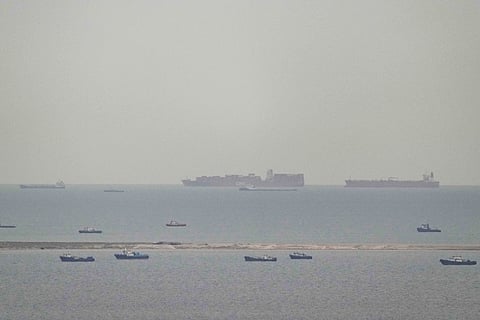

Iran has been unable to open the Strait of Hormuz to wider shipping traffic as it cannot locate all of the naval mines it laid in the waterway and lacks the capability to remove them, according to US officials cited by The New York Times.
According to The New York Times article, the issue is one of the reasons Iran has not been able to increase traffic through the strait in response to Trump administration calls. It also comes as a potential complication ahead of peace talks between Iranian negotiators and a US delegation led by Vice President J D Vance in Pakistan this weekend, the report said.
Iran reportedly deployed small boats to lay mines in the Strait of Hormuz last month, shortly after the United States and Israel began their war against the country. The mines, along with threats of drone and missile strikes, reduced the flow of oil tankers and other vessels through the waterway to a trickle, pushing up global energy prices and giving Tehran leverage in the conflict, according to US officials cited in the report.
Iran, however, has kept a limited route open through the strait, allowing vessels that pay a toll to pass.
Iran’s Islamic Revolutionary Guard Corps (IRGC) has also issued warnings that ships risk striking sea mines, while semiofficial Iranian outlets have published navigation charts indicating safe passage routes.
According to U.S. officials cited by The New York Times, these routes remain limited because the mines were laid in a haphazard manner. It is unclear whether Iran maintained complete records of where all mines were placed, and in some cases, the mines may have drifted from their original positions.
The report further noted that mine removal remains a complex challenge, as clearing naval mines is significantly more difficult than deploying them. The U.S. military itself has limited mine-clearing capability and relies primarily on littoral combat ships equipped for mine-sweeping operations.
Iran, too, is not known to possess the capability to rapidly remove the mines it has deployed, including those it placed during the recent escalation, the officials said.
The development underscores growing maritime risks in the Strait of Hormuz, a critical global energy chokepoint.
