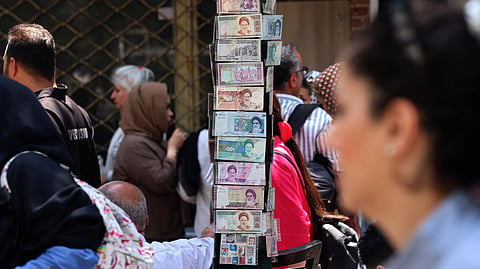

TEHRAN: Mahzad Azari has to choose between food and transportation, between learning English and new eyeglasses, as five months of war with the United States take a financial toll on Iranians.
Azari, who works at a small shop in Tehran, says she has put off normal purchases and little pleasures such as visiting a cafe, with soaring prices, slowing business and months of conflict squeezing household budgets.
"I have to cut back on one thing in order to afford something else," the 21-year-old told AFP.
"If I use Snapp (a ride-hailing app) one day, I won't be able to afford lunch that day... If I replace the lenses of my glasses, I can't go to my class."
For many Iranians, such trade-offs have become a daily reality to navigate Iran's worsening economy, battered by decades of international sanctions and further pressured by the US-Israeli war that erupted on February 28.
Davood, 23, a vegetable and fruit vendor, says he has cut back on holidays and meeting friends at weekends as he can no longer afford them.
"Sometimes we used to go to northern Iran with friends... we can't really go anywhere anymore," he told AFP at his shop in northern Tehran.
For Fahimeh, who works two jobs, going out to eat has become a luxury out of reach.
"Before the war, I used to enjoy going to watch a movie or dining out, or getting some Italian takeaway, but since then it has become all about survival," the 29-year-old said.
Cost of resilience
Hopes for a return to normalcy and economic recovery have been briefly raised with each diplomatic development in the war, including an April 8 ceasefire and the signing of a June 17 framework for peace talks.
But each proved short-lived, with the fighting returning and spreading further across the Middle East.
"Whenever there's a ceasefire, the market starts to pick up a little, then they announce that there's going to be a war, or they hit somewhere, and it's the same old story all over again," Azari said.
Officials in Iran have invoked the "resistance economy" strategy, which was first promoted by late supreme leader Ali Khamenei in 2010 to reduce dependence on the outside world.
Iran's new supreme leader Mojtaba Khamenei in a written message in May called on lawmakers to enact legislation to support the resistance economy and alleviate economic pressure.
"Iran's economy has adapted itself to numerous crises and has developed a capacity to become resilient," said Tehran-based economist Behnam Samadi.
"But this resilience has not been free."
According to Samadi, households have borne the cost through declining purchasing power, businesses through rising operating costs, and the government through increased public spending aimed at keeping the economy afloat.
Inflation reached 66 percent in the year ending July 22, up from 46 percent in the year ending February 19, while the Iranian rial has plunged to 1.88 million against the US dollar, compared with 1.65 million before the conflict.
The Iranian economy has for years been hampered by chronic inflation and currency depreciation, largely due to international sanctions imposed on the country.
"The main question is how long this resilience can last," Samadi said.
'Very difficult'
One way businesses across Tehran have responded to the hardships has been to expand instalment payment schemes to cover everything from groceries to medical bills.
Samadi says instalment plans help companies improve cash flow and households spread their costs, but they are not a solution and are merely a "time-buying" tactic.
"People's standard of living is significantly declining" as incomes barely cover the essentials, he said.
Even as businesses expand such schemes, many Iranians say bigger purchases are increasingly hard to finance.
"Whatever dreams we had -- wanting to buy a house, wanting to buy a car -- are getting further and further out of reach every day," said Amir Reza, a 23-year-old handyman.
"We've been reduced to just getting through our daily lives."
For Ehsan, a grocery vendor in Tehran, the strain is visible from the shopping baskets of his customers.
"People's tables keep getting smaller and smaller," he said, describing dwindling sales of even basic food items.
Azari says she wishes she could stop following the news and return to enjoying the little things that she once took for granted.
"It's become very difficult," she said.
