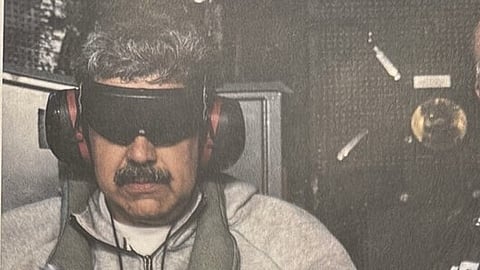

The United States hit Venezuela with a "large-scale strike" early Saturday and said its president had been captured and flown out of the country after months of intense pressure on Nicolás Maduro's government — an extraordinary nighttime operation announced by President Donald Trump on social media hours after the attack.
Trump posted a photo Saturday of Venezuelan leader Nicolas Maduro in custody on a US naval ship and wearing both a blindfold and handcuffs.
"Nicolas Maduro on board the USS Iwo Jima," Trump wrote on his Truth Social platform, along with a picture showing Maduro hours after he was snatched by US forces.
The Venezuelan leader had on what appeared to be noise-canceling ear muffs and grey Nike-branded sweatpants and jacket.
Following the attack, Trump said in an interview that the United States will be making decisions on what is next for Venezuela after capturing the Latin American country's president and flying him out of the country.
"We'll be involved in it very much as to who will govern the country," Trump said.
"We can't take a chance in letting somebody else run and just take over what he left, or left off," Trump said in an interview with Fox News hours after the capture.
He further added that the daring raid by US special forces showed that Washington was "not going to be pushed around."
Meanwhile, Venezuelan ruling party leader Nahum Fernandez told the Associated Press that Nicolas Maduro and his wife were at their home within the Ft. Tiuna military installation when they were captured.
"That's where they bombed," he said.
"And, there, they carried out what we could call a kidnapping of the president and the first lady of the country."
Trump added that Maduro and his wife are aboard a US warship and will face prosecution in New York.
The legal authority for the strike, and whether Trump consulted Congress beforehand, was not immediately clear. The stunning American military action, which plucked a nation's sitting leader from office, echoed the U.S. invasion of Panama that led to the surrender and seizure of its leader, Manuel Antonio Noriega, in 1990 - exactly 36 years ago Saturday.
Ministry of External Affairs (MEA) issued an advisory urging Indian nationals to avoid all non-essential travel to Venezuela in view of recent developments in the country.
The MEA further advised Indians currently in Venezuela to exercise extreme caution, restrict their movements, and remain in regular contact with the Embassy of India in Caracas.
Indian nationals can contact the embassy via email at cons.caracas@mea.gov.in or through the emergency phone number +58-412-9584288, which is also available for WhatsApp calls.
Russia’s Foreign Ministry condemned what it called a U.S. “act of armed aggression” against Venezuela in a statement posted on its Telegram channel Saturday. “Venezuela must be guaranteed the right to determine its own destiny without any destructive, let alone military, outside intervention,” the statement said.
EU foreign policy chief Kaja Kallas wrote on X that she had spoken with U.S. Secretary of State Marco Rubio and the EU ambassador in Caracas. “The EU has repeatedly stated that Mr Maduro lacks legitimacy and has defended a peaceful transition. Under all circumstances, the principles of international law and the UN Charter must be respected. We call for restraint.”
U.S. Attorney General Pam Bondi said Maduro and his wife, Cilia Flores, would face charges after an indictment in New York. Bondi vowed in a social media post that the couple would "soon face the full wrath of American justice on American soil in American courts."
Maduro and other Venezuelan officials were indicted in 2020 on "narco-terrorism" conspiracy charges, but it was not previously known that his wife had been and it wasn't clear if Bondi was referring to a new indictment. The details of the allegations against Flores were not immediately known.
Early Saturday, multiple explosions rang out and low-flying aircraft swept through the Venezuelan capital, as Maduro's government accused the United States of attacking civilian and military installations, calling it an "imperialist attack" and urging citizens to take to the streets.
With Maduro's whereabouts not known, the vice president, Delcy Rodríguez, would take power under Venezuelan law. There was no confirmation that had happened, though she did issue a statement after the strike.
"We do not know the whereabouts of President Nicolás Maduro and First Lady Cilia Flores," Rodríguez said. "We demand proof of life."
Maduro, Trump said, "has been, along with his wife, captured and flown out of the Country. This operation was done in conjunction with U.S. Law Enforcement." He set a news conference for later Saturday morning.
The attack itself lasted less than 30 minutes and the explosions, at least seven blasts, sent people rushing into the streets, while others took to social media to report what they'd seen and heard. Some Venezuelan civilians and members of the military were killed, according to Rodríguez, the vice president, without giving a number.
It was not known if there more actions ahead, though Trump said in his post that the strikes were carried out "successfully".
Sen. Mike Lee, R-Utah, posted on X that Secretary of State Marco Rubio had briefed him on the strike and said that Maduro "has been arrested by U.S. personnel to stand trial on criminal charges in the United States."
The White House did not immediately respond to queries on where Maduro and his wife were being flown to.
Maduro last appeared on state television Friday while meeting with a delegation of Chinese officials in Caracas.
The strike came after the Trump administration spent months increasing pressure on the Venezuelan leader, including a major buildup of American forces in the waters off South America and attacks on boats in the eastern Pacific and Caribbean accused of carrying drugs. Last week, the CIA was behind a drone strike at a docking area believed to have been used by Venezuelan drug cartels — the first known direct operation on Venezuelan soil since the U.S. began strikes in September.
As of Friday, the number of known boat strikes was 35 and the number of people killed at least 115, according to the Trump administration. Trump said that the U.S. is engaged in an "armed conflict" with drug cartels and has justified the boat strikes as a necessary to stem the flow of drugs into the U.S.
Maduro has decried the U.S. military operations as a thinly veiled effort to oust him from power.
Some streets in Caracas fill up
Venezuela's government responded to the attack with a call to action: "People to the streets!"
Armed people and uniformed members of a civilian militia headed into the streets of a Caracas neighborhood long considered a stronghold of the ruling party. As daylight broke, some people rallied and yelled "Bring back Maduro!" while holding posters of the leader.
In other areas of the city, the streets remained empty hours after the attack. Parts of the city remained without power, but vehicles moved freely.
Video obtained from Caracas and an unidentified coastal city showed tracers and smoke clouding the landscape as repeated muted explosions illuminated the night sky. Other footage showed cars passing on a highway as blasts illuminated the hills behind them. The videos were verified by The Associated Press.
Smoke was seen rising from the hangar of a military base in Caracas, while another military installation in the capital was without power.
"The whole ground shook. This is horrible. We heard explosions and planes," said Carmen Hidalgo, a 21-year-old office worker, her voice trembling. She was walking briskly with two relatives in Caracas, returning from a birthday party. "We felt like the air was hitting us."
The Venezuelan government's statement said that Maduro had "ordered all national defense plans to be implemented" and declared a state of emergency that gives him the power to suspend people's rights and expand the role of the armed forces.
The website of the U.S. Embassy in Venezuela, a post that has been closed since 2019, issued a warning to American citizens in the country, saying it was "aware of reports of explosions in and around Caracas."
"U.S. citizens in Venezuela should shelter in place," the warning said.
Reactions begin to emerge
Inquiries to the Pentagon and U.S. Southern Command since Trump's social media post went unanswered. The FAA warned all commercial and private U.S. pilots that the airspace over Venezuela and the small island nation of Curacao, just off the coast of the country, was off limits "due to safety-of-flight risks associated with ongoing military activity."
The Armed Services committees in both houses of Congress, which have jurisdiction over military matters, have not been notified by the administration of any actions, according to a person familiar with the matter and granted anonymity to discuss it.
Lawmakers from both political parties in Congress have raised deep reservations and flat out objections to the U.S. attacks on boats suspected of drug smuggling on boats near the Venezuelan coast and Congress has not specifically approved an authorization for the use of military force for such operations in the region.
Deputy Secretary of State Christopher Landau said the military action and seizure of Maduro marks "a new dawn for Venezuela," saying that "the tyrant is gone." He posted on X hours after the strike. His boss, Rubio, reposted a post from July that said Maduro "is NOT the President of Venezuela and his regime is NOT the legitimate government."
Cuba, a supporter of the Maduro government and a longtime adversary of the United States, called for the international community to respond to what president Miguel Díaz-Canel Bermúdez called "the criminal attack."
"Our zone of peace is being brutally assaulted," he said on X. Iran's Foreign Ministry also condemned the strikes.
President Javier Milei of Argentina praised the claim by his close ally, Trump, that Maduro had been captured with a political slogan he often deploys to celebrate right-wing advances: "Long live freedom, dammit!"
