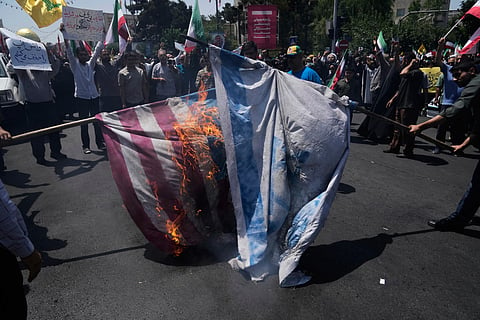

Iran's parliament speaker on Monday warned US President Donald Trump of an "unforgettable lesson" in case Tehran is attacked after Washington's repeated threats of military intervention amid the anti-government protests in the country.
Addressing a huge rally of pro-government protesters at Tehran Square, Mohammad Bagher Ghalibaf claimed the Islamic Republic is fighting a "war against terrorists."
Iran is fighting a "four-front war," he said, listing economic war, psychological war, "military war" with the United States and Israel and "today a war against terrorists."
"The great Iranian nation has never allowed the enemy to achieve its goals," he said, flanked by the slogans "Death to Israel, Death to America" in Persian, and vowing the Iranian military would teach US President Donald Trump "an unforgettable lesson" in case of a new attack.
Iran witnessed mass counter-protests where thousands of Iranians filled a major square in central Tehran on Monday to support the Islamic Republic and mourn the security forces killed during the protests, state television pictures showed.
People brandishing the Islamic Republic's flag packed the capital's Enghelab (Revolution) Square as prayers were read for victims of what the government has termed "riots."
Similar rallies were also underway in other cities after a call by President Masoud Pezeshkian, according to the images.
Iran's foreign minister earlier today said that the country is ready for both war and negotiation after repeated threats of military intervention from Trump.
"The Islamic Republic of Iran is not seeking war but is fully prepared for war," Foreign Minister Abbas Araghchi told a conference of foreign ambassadors in Tehran broadcast by state television.
"We are also ready for negotiations but these negotiations should be fair, with equal rights and based on mutual respect."
Foreign ministry spokesman Esmaeil Baghaei said a channel of communication is open between Araghchi and Trump's special envoy for the Middle East Steve Witkoff despite the lack of diplomatic relations.
"Messages are exchanged whenever necessary," he said, noting that while the United States has no diplomatic presence in Iran, its interests are represented by the Swiss embassy.
Meanwhile, the foreign minister of Oman, which has on occasion acted as a mediator, met Araghchi in Tehran on Saturday.
Trump, who has threatened new military action after the US backed Israel's 12-day war against Iran in June, said Tehran had indicated its willingness to talk.
"The leaders of Iran called" yesterday, Trump told reporters aboard Air Force One, adding that "a meeting is being set up... They want to negotiate".
He added, however, that "we may have to act before a meeting."
Responding to the protests, Iranian President Masoud Pezeshkian on Sunday vowed to address the mounting economic grievances in the country while also urging the protesters to prevent "rioters" and "terrorist elements" from wreaking havoc.
Speaking to IRIB broadcaster, Pezeshkian alleged that Israel and the US were masterminding the destabilisation in the country, saying that "the same people that struck this country" during Israel’s 12-day war in June were "trying to escalate these unrests with regard to the economic discussion."
"They have trained some people inside and outside the country; they have bought in some terrorists from outside,” Pezeshkian told the state television, claiming the perpetrators had attacked a bazaar in the city of Rasht and set “mosques on fire."
He said the government had heard the protesters’ concerns and would solve their problems "by any means necessary."
Over two weeks of protests initially sparked by economic grievances have turned into one of the biggest challenges yet to the Ayatollah Ali Khamenei-led regime that has ruled Iran since the 1979 Islamic revolution.
In a sign of the severity of the crisis, the authorities have imposed an internet blackout that has now lasted more than three-and-a-half days and that activists say is aimed at masking the extent of the deadly crackdown.
Iran's state television has reported the death of over 109 security personnel in the protests, while activists based outside the country have reported the killing of over 500 protesters.
(With inputs from AFP, AP)
