
BRUSSELS: The European Union appeared poised Thursday to sanction Iran's paramilitary Revolutionary Guard over Tehran's deadly crackdown on nationwide protests, further squeezing the Islamic Republic as it worries over a threat by US President Donald Trump to potentially launch a military strike against it.
America has moved the USS Abraham Lincoln and several guided-missile destroyers into the Mideast, which can be used to launch attacks from the sea. Iran has kept up its own threats as well, saying it could launch a preemptive strike or broadly target the Mideast, including American military bases and Israel.
It remains unclear what Trump will decide about using force, though he has threatened to use it in response to the killing of peaceful demonstrators and over possible mass executions. At least 6,373 people have been killed in the protests, activists said.
But the move by Europe, long considered, will put new pressure on Iran as its economy already struggles under the weight of international sanctions. Its rial currency fell to a record low of 1.6 million to $1 on Thursday. Economic woes had sparked the protests that broadened into challenging the theocracy before the crackdown.
EU 'likely' to sanction the Guard
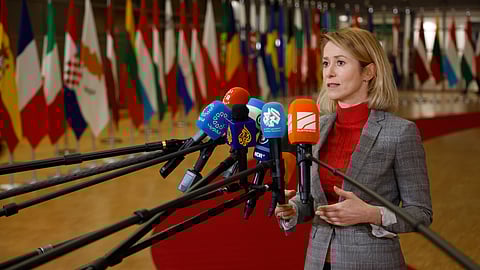
The EU's top diplomat, Kaja Kallas, told journalists it was "likely" the sanctions would be put in place.
"This will put them on the same footing with al-Qaida, Hamas, Daesh," Kallas said, using an Arabic acronym for the Islamic State group.
"If you act as a terrorist, you should also be treated as a terrorist."
Iran had no immediate comment, but it has been criticizing Europe in recent days as it considered the move, which follows the U.S. earlier sanctioning the Guard.
By EU law, sanctions require unanimity across the bloc's 27 nations. That's at times hindered Brussels' ability to flex its economic clout to crack down on Russia over its invasion of Ukraine.
For Iran, France had objected to listing the Guard as a terrorist organization over fears it would endanger French citizens detained in Iran, as well as diplomatic missions, which provide some of the few communication channels between the Islamic Republic and Europe and its allies. However, the office of President Emmanuel Macron on Wednesday signaled Paris backed the decision.
French Foreign Minister Jean-Noël Barrot said Thursday before the Foreign Affairs Council in Brussels that France supports more sanctions in Iran and the listing "because there can be no impunity for the crimes committed."
"In Iran, the unbearable repression that has engulfed the peaceful revolt of the Iranian people cannot go unanswered," he said.
Guard key to crackdown
The Guard was born from Iran's 1979 Islamic Revolution as a force meant to protect its Shiite cleric-overseen government and later enshrined in its constitution. It operated parallel to the country's regular armed forces, growing in prominence and power during a long and ruinous war with Iraq in the 1980s. Though it faced possible disbandment after the war, Supreme Leader Ayatollah Ali Khamenei granted it powers to expand into private enterprise, allowing it to thrive.
The Guard's all-volunteer Basij force likely was key in putting down the demonstrations, starting in earnest from Jan. 8, when authorities cut off the global internet for the nation of 85 million people. Videos that have emerged from Iran via Starlink satellite dishes and other means show men likely belonging to its forces shooting and beating protesters.
Sanctioning the Guard, however, would be complicated. Iranian men once reaching the age of 18 are required to do as much as two years of military service and many find themselves conscripted into the Guard despite their own politics.
Death toll slowly rises
On Wednesday, the US-based Human Rights Activists News Agency, which has been accurate in multiple rounds of unrest in Iran, claimed that the violence killed at least 6,373 people, with many more feared dead. Its count included at least 5,993 protesters, 214 government-affiliated forces, 113 children and 53 civilians who weren't demonstrating. More than 42,450 have been arrested, it added.
The group verifies each death and arrest with a network of activists on the ground in Iran. The Associated Press has been unable to independently assess the death toll given that authorities cut off the internet and disrupted calls into the Islamic Republic. That communication cutoff also has slowed the full scale of the crackdown from being revealed.
Iran's government as of Jan. 21 put the death toll at a far lower 3,117, saying 2,427 were civilians and security forces, and labeled the rest "terrorists." In the past, Iran's theocracy has undercounted or not reported fatalities from unrest.
That death toll exceeds that of any other round of protest or unrest in Iran in decades, and recalls the chaos surrounding the 1979 Islamic Revolution.
