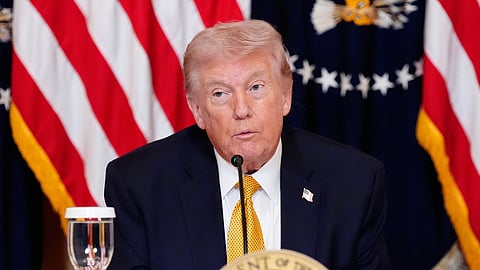

US President Donald Trump criticised Washington's allies on Monday for their lukewarm response to his call to help protect shipping in the Strait of Hormuz during the US war against Iran.
Trump called for more "enthusiasm" from other countries, as he said he believed France and Britain would somewhat reluctantly get involved.
"We strongly encourage the other nations to get involved with us and get involved quickly and with great enthusiasm," Trump told reporters during an event at the White House.
"The level of enthusiasm matters to me."
Trump said a number of countries that he did not name had committed to help secure the waterway, a critical choke point for the global oil trade, but lashed out at others who were not "enthusiastic."
"For 40 years, we're protecting you, and you don't want to get involved," Trump said.
NATO and other Western allies pushed back earlier on Trump's demand at the weekend that the alliance help reopen the Strait of Hormuz, which Iran has effectively closed. They warned that NATO must not become involved in it, as they weighed whether to agree to his call to send warships to help shore up security in the Persian Gulf.
UK Prime Minister Keir Starmer insisted Britain “will not be drawn into the wider war,” and said British troops should only be sent into action that is legal and has “a proper thought-through plan.” But his country is considering other forms of help in conjunction with allies.
German Chancellor Friedrich Merz said that “NATO is a defensive alliance, not an interventionist one. And that is precisely why NATO has no business being involved here.” He said he hopes that NATO allies “will treat one another with the necessary respect within the alliance.”
Merz agreed that “this Iranian regime must come to an end,” but he said that "based on all the experience we have gained in previous years and decades, bombing it into submission is, in all likelihood, not the right approach.”
During lengthy remarks at a meeting with the hand-picked board of Washington's Kennedy Center, which Trump has renamed after himself, Trump had only partial praise for the leaders of Britain and France.
"On a scale of zero to 10, I'd say he's been an eight," Trump said when asked about a call with French President Emmanuel Macron.
"Not perfect -- but it's France."
Trump added of Macron that "I think he's going to help" -- and said he also believed Britain would be involved in a Hormuz mission.
In an interview with the Financial Times, Trump also warned that “if there’s no response or if it’s a negative response, I think it will be very bad for the future of NATO.”
At a meeting in Brussels, where European Union foreign ministers gathered to discuss Trump's demand, German Foreign Minister Johann Wadephul said it's important for the US and Israel to define “when they consider the military aims of their deployment to have been reached.”
“We need more clarity here,” Wadephul told reporters.
Estonian Foreign Minister Margus Tsahkna said that US allies in Europe want to understand Trump’s “strategic goals. What will be the plan?”
Polish Foreign Minister Radek Sikorski invited the Trump administration to go through the proper channels. “If there is a request via NATO, we will of course out of respect and sympathy for our American allies consider it very carefully,” he said.
Sikorski made a reference to Article 4 of NATO's founding treaty, which allies can invoke if they believe their territory or security is under threat.
Still, EU foreign policy chief Kaja Kallas said that “it is in our interest to keep the Strait of Hormuz open."
Kallas had urged the 27 member countries to expand the EU's Operation Aspides naval mission to protect shipping in the Red Sea up into the Persian Gulf. But after chairing the meeting, she said there had been “no appetite” to boost its mandate.
But Kallas said the EU would closely monitor threats to maritime security also in the Red Sea, where Aspides operates with three warships. “The risk that the Houthis get involved is real. So we must remain vigilant,” she said.
'Oldest ally'
But the US leader was harsher about Prime Minister Keir Starmer, who has previously faced stinging criticism from Trump over Britain's refusal to send an aircraft carrier to the region.
"I was not happy with the UK. I think they'll be involved, yeah, maybe. But they should be involved enthusiastically," Trump said.
"I said... 'You're our oldest ally, and we spend a lot of money on, you know, NATO and all of these things to protect you.'"
Starmer said earlier that London was working with allies to craft a "viable" plan to reopen the strategic waterway but ruled out a NATO mission.
Trump meanwhile insisted that Iran itself was a "paper tiger" after two weeks of joint US-Israeli airstrikes, adding that Washington was unclear whom it could negotiate with in Tehran.
"We don't know... if he's dead or not," Trump said when asked about the condition of Iran's new supreme leader Mojtaba Khamenei.
"A lot of people are saying that he's badly disfigured. They're saying that he lost his leg -- one leg -- and he's, you know, been hurt very badly. Other people are saying he's dead. Nobody's saying he's 100 percent healthy," he said.
"We don't know who we're dealing with" in Iran, Trump said. "We don't know who their leader is."
