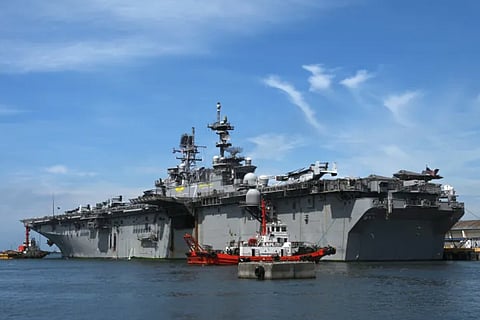

At least one US Navy warship carrying more than 2,000 Marines is on its way to the Middle East, signaling an additional military buildup in the region and fueling speculation about the possible deployment of American ground forces into Iran, according to a report by USA Today.
According to the reprot, satellite images showed the USS Tripoli, an America-class amphibious assault ship, along with two escort vessels, travelling southwest across the South China Sea on March 15. The warship was spotted near Singapore a day later, and it is reportedly currently navigating the southern Indian Ocean, close to Indian waters, as it heads toward the Middle East. It remains unclear whether the two escort ships accompanying the Tripoli will continue with the amphibious assault ship or detach along the route.
The Tripoli is carrying personnel from the 31st Marine Expeditionary Unit, a rapid-response force of approximately 2,200 Marines and Navy sailors based in Okinawa, Japan. The MEU contains both ground and aerial combat units, allowing it to respond to a wide spectrum of operational requirements. An MEU is composed of four elements. The command element serves as the headquarters for the unit and allows a single command structure to coordinate all ground, aviation, and combat service forces. The ground combat element is built around a Marine infantry battalion and is reinforced with tanks, artillery, amphibious vehicles, engineers, and reconnaissance assets.
The air combat element consists of a helicopter squadron that includes transport helicopters of various types and attack helicopters, jets, air defense teams, and ground support personnel. Finally, the logistics combat element provides critical support to the MEU, including medical and dental assistance, motor transport, supply, equipment maintenance, and coordination for amphibious landings.
The 31st MEU is capable of executing a wide range of missions. These include peacekeeping operations, humanitarian aid and disaster relief, security operations, noncombatant evacuation operations, reinforcement operations, amphibious raids and assaults, tactical deception operations, airfield and port seizures, show-of-force operations, reconnaissance and surveillance, and the seizure and recovery of offshore energy facilities. The versatility of the MEU allows it to operate across land, sea, and air simultaneously, providing the United States with a rapid-response capability in the region without the immediate commitment of large-scale ground forces.
It could take as long as two weeks for the Marine unit to be fully in position once it reaches the Middle East. The Tripoli is expected to join the USS Gerald R. Ford and USS Abraham Lincoln carrier strike groups, which have already participated in US attacks on Iran. The USS Gerald R. Ford is scheduled to travell to Souda Bay, Crete, for repars after a laundry room fire on March 12. Though it resembles an aircraft carrier, the Tripoli is an amphibious assault ship capable of carrying dozens of aircraft, including F-35 fighter jets, MV-22 Osprey tilt-rotor helicopters, and MH-60S Seahawk helicopters. The ship measures approximately 844 feet in length, compared with the 1,106-foot Gerald R. Ford, currently the largest warship in the world.
US President Trump had addressed the deployment on March 19, denying that the United States was sending troops to the Middle East, even as the Tripoli was en route. When reporters asked whether he intended to put more US troops in the region, Trump said, “I’m not putting troops anywhere. If I were, I certainly wouldn’t tell you. But I’m not putting troops.”
According to USA Today, Trump has discussed using ground troops for specific strategic purposes but has ruled out a large-scale invasion. The Pentagon has not officially disclosed how many US service members are actively involved in the Iran conflict, although news reports have estimated that between 40,000 and 50,000 troops are already deployed to support ongoing operations.
Despite these denials, military analysts say the deployment of the Tripoli and its Marine unit is a visible signal of US readiness and operational flexibility. While the presence of a fully equipped MEU does not necessarily indicate that troops will be sent into the interior of Iran, it demonstrates the capability to respond rapidly to developments in the region, including the protection of critical sea lanes and strategic chokepoints such as the Strait of Hormuz.
Observers also note that the 31st MEU’s versatility, combined with its ability to carry both ground and aerial combat units, allows the United States to maintain a forward posture and a deterrent presence without committing to a direct ground invasion.
USA Today adds that, public sentiment in the United States adds an additional layer of complexity. A Quinnipiac University poll conducted on March 9 found that 74 percent of registered voters opposed sending troops into Iran, while only 20 percent supported such a move. Analysts warn that any expansion of ground operations could influence public opinion further and intensify domestic scrutiny of the war.
As the USS Tripoli continues its transit across the Indian Ocean toward the Middle East, its movements are being closely monitored by regional and global observers. The deployment highlights the delicate balance the United States seeks to maintain: demonstrating military capability and readiness while avoiding the escalation that a large-scale ground invasion would entail.
The Tripoli’s presence, along with its accompanying MEU, signals that the Iran conflict may enter a new and potentially more complex phase in the coming weeks, with the United States positioning itself to respond to threats across maritime, coastal, and potentially land-based theatres.
