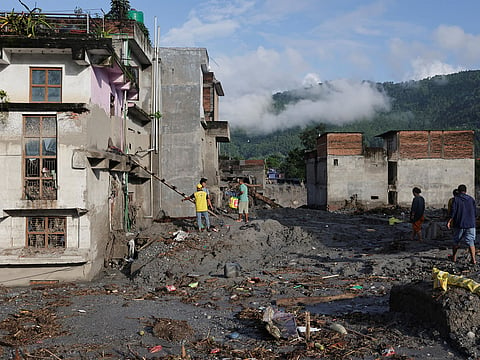

The death toll due to the devastating flash floods in Nepal rose to 1,344 on Saturday as more bodies were recovered from the affected areas while thousands remain missing, police said.
Rescue teams continued to search for around 4,900 people who remain missing.
Of the total bodies recovered so far, 758 were adults, 85 were children and 501 were recovered with body parts missing, officials said, attributing the condition of the bodies to prolonged exposure to water and the weight of debris.
The flash floods, triggered by an ice-rock avalanche near the Nepal-Tibet border on August 26, devastated towns and villages in northern and central Nepal. The Bhotekoshi River, which flows south from the Himalayan border region, carried the floodwaters downstream, sweeping away homes, vehicles, roads and bridges and damaging hydropower projects.
The disaster also killed at least 21 people on the Chinese side, while more than 500 people remain missing in Tibet, according to Chinese media reports.
In Nepal, around 360 bodies have been recovered in Chitwan district alone -- the highest among all districts. Other districts from which bodies were recovered include Rasuwa, Nuwakot, Dhading, Gorkha, Tanahun, Nawalparasi East and Nawalparasi West.
So far, 1,030 bodies have been temporarily buried after required procedures, including DNA collection, were completed.
Authorities continued to monitor water levels in several rivers, including the Koshi, Narayani, Bagmati, Karnali, Mahakali, Kankai, Kamal, Kamala, Babai, Eastern Rapti and Western Rapti, while joint rescue teams led by the Nepal Army continued search and rescue operations for the eleventh day.
The number of missing people was estimated at 4,898. The missing include more than 600 children in Rasuwa and Nuwakot districts, officials said.
More than 13,000 people have been rescued so far, according to Nepal’s National Disaster Risk Reduction and Management Authority.
Major rescue operations were underway at hydropower projects in flood-affected districts, where hundreds of men are believed to be trapped in tunnels.
On Friday, two men were rescued alive from a tunnel at the Trishuli 3A hydropower project. They were identified as Kabir Maharjan, 45, a mechanical supervisor on the project, and Sanjay Sah, 30, a foreman, according to the Public Relations Directorate of the Nepal Army.
Also, an Indian tunnel rescue team, who are continuing to work alongside the Nepalese Army, has made a temporary track inside the Chilime tunnel in flood-hit Rasuwa district to allow more heavy equipment to reach the affected areas, authorities said on Saturday.
The Indian tunnel rescue team, who are continuing to work alongside with Nepalese Army have made a temporary track inside the Chilime tunnel in flood-hit Rasuwa district to allow more heavy equipment to reach the affected areas, authorities said on Saturday.
The teams also dug deeper on Friday to drain out water, which was hampering the rescue operations.
"The Indian tunnel rescue team, working alongside the Nepali Army, dug deeper into the Chilime tunnel yesterday, draining out water. A temporary track is also being made to allow more heavy equipment to reach the tunnel, and doctors with the team held a health camp for the local community," Indian Ambassador to Nepal Naveen Srivastava said in a post on X on Saturday.
India has deployed specialised teams to assist Nepal following the devastating flash floods of August 26, which swept through northern and central parts of the country, killing 1,344 people, leaving thousands missing and destroying homes, roads and bridges and hydropower projects.
Expert teams from India and China are assisting Nepal's rescue teams in tracing workers and employees who have remained unaccounted for at various hydropower project sites since the disaster, with many believed to be trapped inside tunnels.
At least 900 workers are missing from a dozen hydropower projects in Nepal, with about 500 believed to be inside tunnels, officials said.
The Chilime hydropower project site is located near Syabrubesi village in the Rasuwa district, which was severely affected by the devastating flash floods in Nepal on August 26.
According to a report presented by the National Disaster Risk Reduction and Management Authority (NDRRMA) on Friday, the devastating flash floods have affected more than 32,000 people and damaged roads, bridges, schools and healthcare facilities.
(With inputs from PTI)
