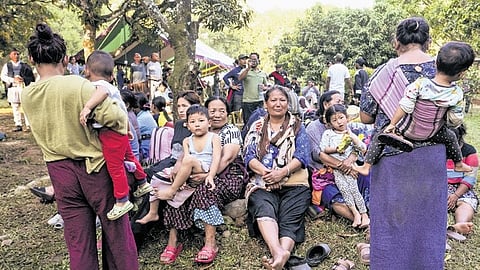

KATHMANDU: The Nepal floods took away Sharmila Shrestha's home and separated her from her baby for days.
Now, reunited at a crowded shelter, she can do little more than helplessly watch her toddler eating the same food as the adults because there is nothing else.
Her 14-month-old daughter sleeps with her on the floor of a classroom in northwest Kathmandu, alongside her sister-in-law's 18-month-old son.
There is no baby food for either child.
"They aren't giving any special food for babies. We are forced to feed that same heavy adult food to the small child," Shrestha was quoted as saying by The Kathmandu Post newspaper on Sunday.
The 33-year-old mother had walked for six hours through the hills to find her daughter after the floods separated them for two or three days.
"I only want a decent, proper place to stay. That would bring some peace of mind," she said.
For mothers like Shrestha, the August 26 flash floods in Nepal have created a crisis within a crisis, one unfolding not in the rising waters but in crowded shelters, around feeding times, on classroom floors and along treacherous roads leading to hospitals.
Babies are hungry. Mothers are struggling to breastfeed.
Pregnant women worry about reaching a hospital if something goes wrong.
And in shelters filled with hundreds of displaced people, even the most basic requirement of motherhood, a quiet, private place to feed and comfort a child, can feel like a luxury.
At Trishuli, Pariyar, a mother three months into breastfeeding her newborn, fled her home on August 26 as floodwaters surged.
Now she nurses her baby in a shelter, along the Bhotekoshi-Trishuli corridor, shared with dozens of strangers, with men smoking nearby and the smell of alcohol lingering in the air.
"We are all in the same place, so it is difficult. There is cigarette smoke, the smell of alcohol, and the baby cannot sleep," Pariyar, who likes to be identified by only her last name, said.
Her breast milk supply has fallen since the floods.
She has tried formula, but it appears to upset the baby's stomach, leaving the infant crying even more after feeding, the Post reported.
"If there was a safe place, and the baby could get her vaccinations here, that would be better. We are not getting food on time either. We are not getting enough to eat," Pariyar said Her request is painfully modest.
"A separate space." A place that treats nursing mothers as something other than one more body in a crowded hall.
Across the flood-hit districts of Rasuwa, Nuwakot and Dhading, thousands of women are facing similar vulnerabilities.
The United Nations Population Fund (UNFPA) estimates that around 4,430 pregnant women are living across 15 municipalities in the three districts.
The figure is a humanitarian planning estimate based on an affected population of about 310,000, rather than a headcount of individually identified women.
Based on the estimate, around 492 births could be expected in the following month, with roughly 74 women potentially requiring emergency obstetric care.
But for many, the question is not simply when they will give birth.
It is whether they can reach help when they need it.
At Trishuli Hospital, the district-level hospital serving the area, nine deliveries have been conducted since the floods, while pregnant women continue to arrive with fever, reduced fetal movement and urinary tract infections.
"Because of the floods, our service delivery has become very difficult," says Basanti Pancha, who heads the maternity department.
Electricity is unreliable, forcing staff to run a generator for surgeries and sterilise instruments in small batches by hand.
"Previously, Kathmandu was just a two-hour road trip away. Now, by road, nobody knows how many hours it will take because of the landslides," Pancha said.
The hospital has no advanced neonatal unit for babies who may suddenly need intensive care.
"Pregnancy itself brings a lot of natural anxiety, stress and doubt about what will happen. But the floods have added a layer of extra stress on these women," Pancha said.
At Chandrawati Secondary School in central Nepal, more than 1,000 displaced people are packed into a holding centre, including over 500 women.
"Everyone is in the same place," says Rekha Shrestha, executive director of women's rights organisation WOREC.
There are not enough sanitary pads for menstruating adolescents.
In one distribution, women were given a single pad and told it should last three or four days, she said.
"Pregnant women and postpartum mothers have special needs. There is no private space to bathe, to dry clothes, to breastfeed. That privacy is not an extra service in a disaster response. It's a necessity," said Rekha, whose organisation has begun creating female-friendly spaces.
According to aid workers, all evacuated women are being folded into a relief system built around a single, generic idea of what a displaced person needs, which rarely is for a breastfeeding or postpartum mother, their privacy, or an infant's need for anything softer than the staple dal bhat.
"This is very difficult for us," Pariyar said.
