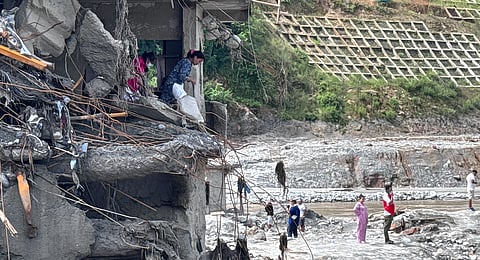

RASUWA: With thousands feared dead or missing and large parts of Nuwakot and Rasuwa buried under mud and debris following the August 26 flash floods, Nepal is confronting a second emergency in the form of a looming health crisis.
Keeping survivors safe is becoming a challenge as drinking-water systems have completely collapsed, sanitation infrastructure has been destroyed and access to healthcare disrupted.
Teams from the World Health Organisation (WHO) Nepal and Ministry of Health and Family Welfare are visiting temporary holding and shelter centres to check survivors for signs of disease spread.
Authorities have also begun regular testing of drinking-water sources for E. coli, an indicator of faecal contamination. “Basically, we are doing regular monitoring, E. coli tests,” a WHO official said.
The government is using portable water-testing kits, with support from WHO and UNICEF, as WASH (Water, Sanitation and Hygiene) interventions are expanded across affected areas.
Speaking to TNIE, Tsering Gurung, Communication Officer at WHO Nepal said, the organisation is working closely with the Government of Nepal, through the Ministry of Health and Food Safety, to assess emerging health needs and coordinate the health sector response to this emergency.
Within hours of the disaster, WHO supported the dispatch of emergency medical supplies to affected areas at the request of the government. Based on identified needs, WHO has also provided infection prevention and control supplies to support response efforts and reduce the risk of disease outbreaks, Gurung said.
WHO personnel have also been deployed to affected areas to provide technical support for disease surveillance, health facility assessments, and information management. Teams are also supporting frontline responders through orientations on infection prevention and control (IPC) measures and other priority public health interventions.
In addition, WHO is supporting efforts to restore essential health services and ensure continuity of care for people living with noncommunicable diseases and mental health conditions.
The water crisis is particularly serious in Nuwakot and Rasuwa because settlements depend on a network of mountain rivers and streams.
The Bhote Koshi and Trishuli are the principal river systems through the districts, fed by tributaries including the Salankhu and Falakhu.
Further downstream, the Trishuli joins the Narayani system before entering India as the Gandak. Here, drinking-water pipelines feeding thousands of people have been completely destroyed.

In Bidur Municipality, the biggest local body in Nuwakot, the main drinking-water system serving nearly 6,000 households has been damaged. Around 7-8 km of pipelines have been destroyed, while about 20 smaller water-lifting schemes serving scattered settlements have also been affected.
“The Salakhu connection has been completely disconnected. But we have an alternative source from the Tadi River. We are lifting water from there, and the drinking-water committee is working on it,” said Rajan Shrestha, mayor, Bidur Municipality to TNIE.
The municipality says the Tadi source was not affected like the Trishuli and is currently safe. But the alternative does not solve the problem for communities stranded higher in the valleys.
Natural springs remain in some locations, but residents say they are insufficient. In settlements including Manegaun, Kimtangtol, Betrawati, Bhaise and Tupsche, damaged roads have made tanker supplies difficult.
The distinction between having water and having safe drinking water is now critical. Residents said some streams could provide enough water for washing, but not enough reliable water for drinking.
Floodwater can carry sewage, human and animal waste, chemicals and decaying organic matter into springs, streams, storage tanks and damaged pipelines. The presence of bodies and decomposing material beneath debris makes contamination harder to assess.
At temporary shelters, displaced people are living in crowded conditions with inadequate toilets. At one school being used as a shelter, more than 150 people are staying on the premises, with around 30 people in a single room and only two toilets.
The disruption is affecting pregnant women, new mothers, elderly people and patients with chronic illnesses. Many have lost medicines and prescriptions in the flood.
The situation is hard for patients requiring uninterrupted treatment, including tuberculosis patients, officials said.
At Trishuli hospital, daily attendance has fallen sharply from around 700 patients before the disaster to only a handful. Hospital officials say the decline does not mean people are healthier; many simply cannot reach the hospital because roads have been cut.
The threat of severe infections like diarrhoea, swine flu and other viral diseases is looming large.