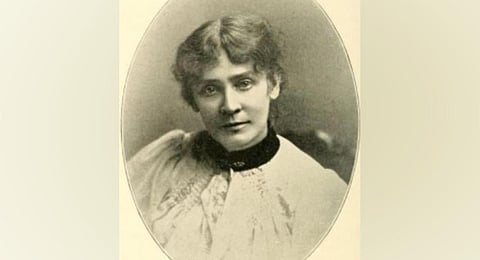

The greenhouse effect is the most ‘heated’ topic in today’s world, but travelling back to 1856, when it hadn’t exactly taken a firm place in the list of environmental issues, young Eunice Newton Foote discovered that carbon dioxide traps the heat of the Sun. Born on July 17, 1819, Eunice was an American scientist and inventor.
Though physicist John Tyndall is credited with the discovery of the ‘greenhouse effect’, it was Eunice who conducted a series of experiments to prove it. In 1856, she demonstrated an experiment in her home laboratory.
She placed glass cylinders filled with oxygen, carbon dioxide, hydrogen, and moist and dry air, each with a thermometer inside. Placing the cylinders under the Sun, she recorded how each of the gases warmed up. The cylinder full of carbon dioxide heated up more than the others.
Thus, she concluded that more CO2 in the atmosphere resulted in a warmer planet. The results were put down in a paper titled “Circumstances affecting the heat of the Sun’s rays”.
It was presented at the American Association for the Advancement of Science in 1856 and was the first record of physics by a female scientist. Just because she was a woman, Eunice was not permitted to read her paper. It was read on her behalf by her professor.
Her work was summarised in The Annual of Scientific Discovery in 1857, but those who read her results did not see how to make use of it in day-to-day life. In 1859, Tyndall conducted experiments along similar lines, attaining fame as the father of climate science.
It was Elizabeth Wagner Reed, a geneticist and women studies scholar, who recognised Eunice’s work. In 1992, in her book American Women in Science Before the Civil War, she asserted that Eunice had first demonstrated the greenhouse effect. Thus, Eunice’s name and work were retraced in the pages of history.
