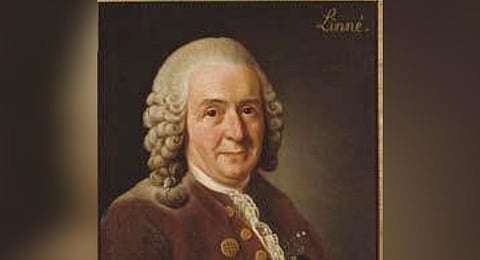

The essential scientific practice of naming and classifying natural organisms owes its roots to the vision and work of Swedish biologist and physician Carl Linnaeus.
Born to a curate named Nils Ingemarsson (later Linnaeus) in Rashult, Sweden, on May 23, 1707, Carl Linnaeus went on to receive much of his education at Uppsala University. Despite his church duties, Nils made time to nourish his hobby of botany, passing on the same love for the natural sciences to his son.
Very early in life, Linnaeus seemed to have developed a liking for plants and flowers, spending a lot of his time in the countryside, looking for botanical specimens. Following a meeting with Johan Rothman, a doctor and botanist, Linnaeus’ interest in botany, along with medicine, only grew. By age 17, Linnaeus was well-acquainted with the existing botanical literature and went on to classify plants according to Tournefort’s system. He also learnt about the sexual reproduction of plants, and in 1729, wrote a thesis –Praeludia Sponsaliorum Plantarum, on plant sexual reproduction. During 1735-38, he lived abroad, where he studied, lectured and researched.
The first edition of his seminal work, Systema Naturae, was published in 1735 in the Netherlands. It popularised the concept of binomial nomenclature, which uses two Latin names to name living organisms. In the 1740s, Linnaeus travelled throughout Sweden to find and classify plants and animals. Through the 1750s-60s, he continued to collect and classify animals, plants, and minerals, while publishing several volumes of his work. The tenth edition of this book (1758) is considered the starting point of zoological nomenclature. Linnaeus’ Systema Naturae has had a massive impact on science; it was indispensable as a foundation for biological nomenclature, now regulated by the Nomenclature Codes. He passed away on January 10, 1778, etching his name on the living world.
For context, in modern botany and zoology, the abbreviation L. is used to indicate Linnaeus as the authority for a species name. Also, Linnaeus’ remains constitute the type specimen for the species Homo sapiens following the International Code of Zoological Nomenclature, since the sole specimen that he is known to have examined was himself.
