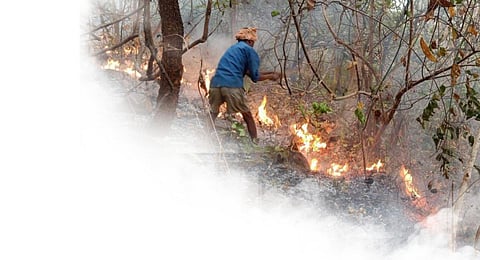

BHUBANESWAR: As the country braces for another forest fire season in January, a pilot study of Indian Council of Forestry Research and Education (ICFRE) Dehradun and other central institutes that have estimated the economic loss due to wildfire at lakhs of rupees per hectare, underlines the need for a robust preventive mechanism to protect Indian forests from the impending summer crisis.
The study ‘Estimation of economic losses in real term per hectare basis due to forest fire in Uttarakhand and Madhya Pradesh’ carried out by the ICFRE in collaboration with the Forest Survey of India (FSI), Govind Ballabh Pant National Institute of Himalayan Environment (GBPNIHE), Wildlife Institute of India (WII) and National Institute of Hydrology (NIH), quantified the tangible and intangible losses due to wildfire in these two states.
Carried out by all the partner bodies separately in 42 forest fire polygons of Uttarakhand and 49 forest fire polygons of Madhya Pradesh, the study estimated economic losses of vegetation and carbon content change, forest produce, wildlife habitat as well as hydrology in the range of Rs 130 to Rs 2,01,663 per hectare (ha). As per the GBPNIHE estimation, the economic loss of forest produce such as fodder, fuel wood, wild edibles and litter fall etc., in a subtropical pine forest of Uttarakhand due to forest fire is a staggering Rs 2,01,633 per hectare for moderate burnt and Rs 1,91,905 per hectare for low burnt forest produce.
The forest produce loss in Himalayan moist temperate forest in the state is even higher at Rs 1,90,024 per hectare for moderate burnt and Rs 2,17,537 per hectare for low burnt. In tropical moist deciduous forest, the loss is Rs 46,824 per hectare for moderate burnt and Rs 26,915 per hectare for low burnt, while in tropical dry deciduous forest it is Rs 1,21,328 per hectare for moderate burnt and Rs 9,595 for low burnt. The loss of forest produce in Madhya Pradesh too ranges between Rs 1,20,825 per hectare and `83,628 per hectare in tropical moist and tropical dry deciduous forests.
Similarly, the ICFRE assessment of loss to carbon pool in Uttarakhand forests, has been pegged at Rs 17,919 per hectare in the event of moderate burnt and Rs 3,179 per hectare in the event of low burnt for the tropical moist deciduous forest. In subtropical pine forest of the Himalayan state, the loss of carbon pool has been estimated to be Rs 23,332 per hectare for moderate burnt and Rs 5,287 per hectare for low burnt, while in the Himalayan moist temperate forest, the damage is Rs 36,126 per hectare for moderate burnt and Rs 684 per hectare for low burnt.
Other institutes have also estimated the loss to wildlife habitat and hydrology in the range of hundreds to thousands of rupees per hectare in these two states. However, experts are of the opinion that this assessment that indicates loss of hundreds of crores in both the states due to wildfire is only the tip of the iceberg. Former Principal Chief Conservator of Forest of Odisha (PCCF), Sandeep Tripathy who led the forest fire task force formed by the Odisha government, said areas across the country, especially those prone to wildfires in the East, South and Central India, should be included in the national fire inventory. Odisha, Andhra Pradesh and Chhattisgarh are among the states prone to forest fires. It would help during the post-fire assessment as it would provide a larger picture of the economic losses India suffers each year due to forest fire, he added.
Keeping in view the pace at which wildfire spreads and causes damage to the forest and wildlife, Tripathy said activities such as creation of fire lines and removal of fire load through controlled burning in vulnerable forests should be completed before the beginning of the forest fire season itself. “This would help in bringing down the wildfire cases to a significant level,” he said. Stating that the country already has a robust satellite based forest fire alert system to send real time updates on fire points to forest divisions, the retired IFS officer underlined that advance planning and suitable distribution of resources — that is apportioning of manpower and machinery — is equally important to check incidents of forest fire.