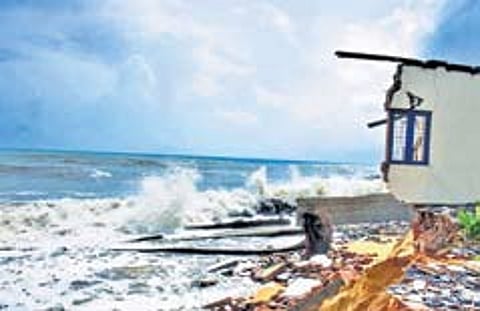

BENGALURU: If the 7,500 km-long coastline gives the country advantage in terms of trade and tourism, it also is a matter of concern because of increasing coastal erosion. Globally, there has been a 20 cm rise in sea level since 1900, which means the sea ingressed into land by as much as 10 metres. Over time, many islands and settlements on land have been lost. Besides, islands that were not even documented are being swallowed by the sea surge.
“There is a lot of administrative failure in maintaining coastal data. Instead of assessing data from 1887 when the first base maps were made or even from 1984 when the government started work on coastal areas, agencies under the government are using data available from 1991 for assessment. This should not be happening,” say experts.
To address sea erosion, government agencies have tried several measures like the building of stone walls in Karnataka. “But it has negative consequences. Stone walls result in the rise in high tides in neighbouring states, prompting them to file objections with the Port Authority of India. The fisheries department has also raised objections as it has affected marine species,” experts said.
To address the problem, the Karnataka forest department and experts have embarked on a large-scale mangrove afforestation drive along the sea shore under the Karnataka-Shore project. While it will take time to produce results, a similar exercise by the National Centre for Coastal Research (NCCR), in Puducherry was successful. NCCR is working to replicate the Pondy model in Andhra Pradesh, Kerala and Tamil Nadu.
“Rock Beach in Puducherry has been recreated after noting a rise in erosion. The harbour was recreated in the southern region and now work is being done in the northern region. Reefs and structures have been added to break the waves reaching the coast,” said a senior NCCR official.
Experts point out that erosion and desilting is rising. The worry is that the silt is accumulating in other locations or even in deep sea, which is contributing to the rise in mean sea level.
“A rise in waves has also been observed in the west coast, especially during monsoons, which is also worrisome as with this erosion is also increasing. Ideally during monsoon, the sea takes the sand and in winter it returns. But due to increased cyclones in November and December, the sand is not returning, which is becoming worrying,” pointed out an NCCR official.
In 2023, the Central government released a report on erosion, where NCCR, which is under the Ministry of Earth Sciences, had stated that 33.6% of the Indian coastline is vulnerable to erosion. In contrast, 26.9% of the coast was growing due to accretion and 39.6% land was stable.
Experts at the National Institute of Oceanography (NIO) said the rise in sea levels and erosion is now changing. In some places erosion ranges up to 3 cm. Work on mapping areas where erosion has impacted land, sea and marine life is being done. The exercise started in March but due to erratic monsoon, not much progress has been made. The NIO is working with the Indian Institute of Tropical Meteorology to remedy the situation.
In the meantime, the Survey of India (SOI) has also undertaken a study to assess land loss. To get the exact geographic coordinates, the SOI has written to the district administrations of the coastal regions seeking details. The SOI stated that the survey is intended to support the acquisition and production of geo-spatial data services, including maps, under the National Geo- Policy 2022 for the updation of island data.
The concern of erosion was also raised in the ongoing Parliament session, where the Union forest and environment ministry replied to a question by Lok Sabha MP Brijesh Chowta, seeking details pertaining to Dakshina Kannada. The ministry said 48.4% of the district’s 36.6 km-long coastline had suffered erosion in the last 30 years. The ministry also said the situation in Karnataka was better when compared to other areas.
Experts point out that large-scale remedial efforts are needed in coordination with other states and agencies. They also quoted the Geophysical Research Letters’ report where it was pointed out that the melting of glaciers and ice caps, excessive drawing of groundwater and the rise in global mean sea level had resulted in a drift of earth’s axis.
“Working in isolation is not the solution. All coastal regions need to work collectively. The entire Indian coastline should be surveyed at the same time and compared during monsoon and post-monsoon. Creating sea walls is not the solution. It costs around Rs 70-80 crore per km. However, work of putting barricades and recreating them like in the case of Puducherry cost Rs 21 crore, which has now escalated to Rs 50 crore. Creating natural barricades is cheaper,” experts said.
