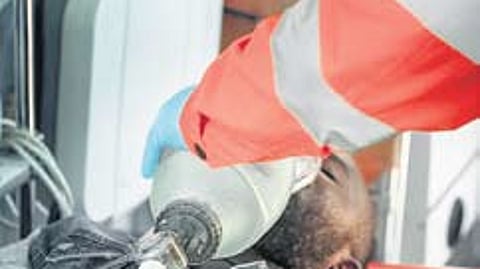

CHENNAI: Care is very crucial for any patient to reduce mortality, say doctors. The Golden Hour management starts the moment a patient lands in a health emergency – like road accident, heart attack, stroke, sepsis, asthma or any life threatening illness.
Pre hospital care is highly specialised nowadays, including advanced medical technology and mobile medical units which includes life saving equipment like defibrillator, ventilator, monitors, infusion pumps, suction apparatus, oxygen cylinders, ECG, glucometer and medications required during transfer of critically-ill patients.
“Paramedics hired in Tamil Nadu are trained to provide immediate and critical care under the guidance and supervision of doctors, either monitored remotely or travelling along with the patient in the ambulance, has improved the care of critically-ill patients before they reach the hospital for actual treatment,” said Dr S Saravana Kumar, president, Society for Emergency Medicine India.
Dr T S Srinath Kumar, Academic Council Chair, Society for Emergency Medicine India said, Emergency Services can be divided into three parts. It starts with the care given to the patient before they reach the hospital, which is given from the home, ambulance or road side.
The second part is in the emergency department where patients are triaged depending on the care they need - they will be taken to a resuscitation zone which is called as red zone, or yellow or green zone where walk-in patients are received.
“The Society for Emergency Medicine India released the document on quality upgrade enabled through space technology ‘Excellence unveiled: A comprehensive guide to quality standards and practices in emergency department - Learnings from ISRO,’ which acts as an implementation tool in emergency department,” said Dr Saravana.
“The first established network of ambulances was started by Apollo group of hospitals with the dedicated number 1066. Later, the first public-private partnership with state governments began with integrated services under the umbrella of 108 with protocol based which saw the change in giving care to the needy,” said Dr Srinath.
The consensus from members of the society for emergency medicine is that patients shifted through advanced life support ambulances had a 20% higher survival rate than patients transported to medical care facilities in other vehicles.
It will not be far away when we can monitor patients remotely and live stream from ambulances with point of care devices.
