
On May 12, 2024, the Earth played host to a spectacular celestial event. People from various swaths of the globe – from the Americas, Australia, Europe, and India – were surprised to see dazzling waves of light permeating the sky. This phenomenon, Aurorae, was seen over multiple locations for the first time. This dancing natural show of light, which is usually restricted to high altitude zones and over the Poles, was spotted over a wider geography. The Aurorae are caused by charged subatomic particles, mostly electrons, smashing against the Earth’s atmosphere.
Originating from the Sun at regular intervals, they are most intense during times of greater solar activity. The Aurorae witnessed by millions of people on May 12 was an outcome of one of the most powerful solar storms in decades. At about 9.56 pm IST on that day, the peak intensity of a solar flare, which emanated from a region of the Sun’s surface called sunspot Region 3664 (ARI3664), as part of a solar storm, struck Earth. This was not a one-off occurrence; the previous few days (especially May 10 and 11) had also seen tremendous solar activity.
Around 1-3 am IST on May 11, a crimson glow lit up the dark sky over Ladakh in a rare stable Auroral red arc event at the Hanle Dark Sky Reserve, in the Himalayas, due to strong solar magnetic storms launched towards Earth. The solar storms or coronal mass ejections (CMEs) were also from AR13664, known to produce several high energy solar flares, some of which travel towards Earth at 800 kmps, according to scientists at the Centre of Excellence in Space Sciences in India (CESSI), Kolkata. Similarly, at 9.30 pm IST on May 10, the first of several CMEs – expulsions of plasma and magnetic fields from the Sun – were reported, according to the National Oceanic and Atmospheric Administration (NOAA)’s Space Weather Prediction Center.
Intense activity
Solar storms are natural phenomena. The Sun is a hub of intense activity. Being our star, its activity has a direct impact/correlation on the planets, moons, and other minor celestial bodies that inhabit the Solar System. Since the dawn of time, Earth has been in the crosshairs of innumerable solar storms, which have the ability to impact basic life.
According to NOAA, solar radiation storms occur when a large-scale magnetic eruption, often causing a coronal mass ejection and associated solar flare, accelerates charged particles in the solar atmosphere to very high velocities. Sometimes, these bursts are so intense that they translate into what is termed a solar storm. In other words, a solar storm is a disturbance on the Sun, which can get released outward across the heliosphere, affecting the entire Solar System, including Earth and its magnetosphere, and is the cause of space weather in the short-term with long-term patterns comprising space climate.
“The most important particles are protons that can get accelerated to large fractions of the speed of light. At these velocities, the protons traverse 150 million km from the Sun to the Earth in just 10’s of minutes or less. When they hit Earth, the fast-moving protons penetrate the magnetosphere that shields Earth from lower energy charged particles. Once inside the magnetosphere, the particles are guided down the magnetic field lines and penetrate into the atmosphere near the North and South poles,” the science body says.
The NOAA uses a standardised system – NOAA Space Weather Scales – to rank and categorise the severity of space weather events, specifically geomagnetic storms. Accordingly, it has categorised solar radiation storms on a scale S1-S5, akin to the scales that measure tornadoes and hurricanes in the Continental United States. NOAA’s scale offers a clear framework to understand the potential impact of celestial disturbances on Earth and its technological infrastructure.
It ranges from 1 (minor) to 5 (extreme) and is based on the effects on power systems, satellite operations and other technological systems, as well as the visibility of aurorae at specific geographical latitudes. “This definition allows multiple injections from flares and interplanetary shocks to be encompassed by a single solar radiation storm. A solar storm can persist from some hours to even days,” the NOAA adds.
By using this scale, NOAA aims to provide clear warnings and timely information to people, ensuring preparedness and mitigation during significant solar events.
Inevitable impact
By now, it is clear that solar radiation storms cause several impacts and upheavals on Earth. The rays of the Sun take 8.20 minutes to reach Earth, so we are talking about this radiation striking Earth within minutes at breathtaking speeds. The intensity of solar storms can vary, with some being minor and causing little effect, while others being as powerful enough to disrupt Earth’s magnetosphere and ionosphere, leading to significant technological disturbances.
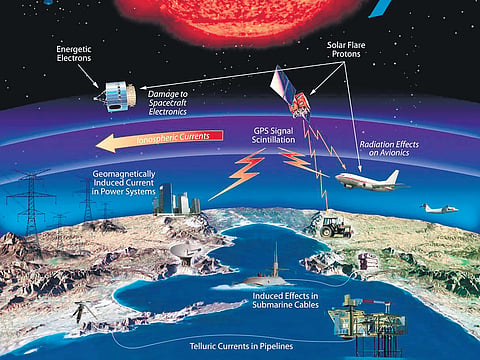
When energetic protons collide with satellites or humans in space, they can penetrate deep into the object that they collide with, causing damage to electronic circuits and even DNA. During more extreme storms, passengers and crew in high-flying airliners at high latitudes may be exposed to radiation risk. Besides, the Sun’s intense geomagnetic and energetic particle emissions are capable of causing large-scale power outages, disruption or blackouts of radio communication and GPS, damage or destruction of submarine communication cables, and temporary to permanent disabling of satellites, the internet, and other electronics, even as simple as the set top box at home.
The latest storm, although severe, did not cause major disruptions. Preliminary reports pointed at certain power grid flickers and fluctuating communications, which were up and running in time.
Bracing the storm
Humans, and the Earth, are insignificant in the Universe’s larger scheme of things. In the event of a solar storm, there is little we can do to prevent it or even shield our planet from its effects. However, early warning systems have been improved that advise power grid and computer equipment shutdown, well in advance, to protect them.
NASA and the NOAA’s Space Weather Prediction Center use satellites in the form of the Advanced Composition Explorer (ACE), and DSCOVR Deep Space Climate Observatory, which watch for corona injections and warn against approaching solar storms up to an hour before they strike Earth. Also, NASA’s Solar Dynamics Observatory studies irregularities on the solar surface. More recently, AI is helping enhance prediction, warning and reaction time, helping us brace ourselves better till the solar storm has passed.
Types of Solar Storms
1.Solar Flare
A large explosion in the Sun’s atmosphere caused by tangling, crossing or reorganising of magnetic field lines
2.Coronal Mass Ejection
CME is a massive burst of plasma from the Sun, sometimes associated with solar flare
3.Geomagnetic Storm
It relates to the interaction of the Sun’s outburst with Planet Earth’s magnetic field
4.Solar Particle Event (SPE)
It occurs when particles emitted by the Sun get accelerated in the Sun’s atmosphere or in interplanetary space by a CME shock
Major Events
September 1859
The Carrington Event was the most intense geomagnetic storm in recorded history. It created strong Auroral displays that were reported globally and caused sparking and even fires in multiple telegraph stations. The geomagnetic storm was most likely the result of a coronal mass ejection (CME) from the Sun colliding with Earth’s magnetosphere
May 1967
Blackout of Polar surveillance radars during the Cold War led the US military to scramble for nuclear war, until solar origin was confirmed
August 1972
This was the most extreme solar particle event (SPE) by some measures and the most hazardous to human spaceflight during the Space Age, causing accidental detonation of numerous magnetic-influence sea mines. It also saw the fastest CME transit time being recorded
November 1991
This geomagnetic storm led to Aurorae being visible in the United States, as far south as over hot and arid Texas
