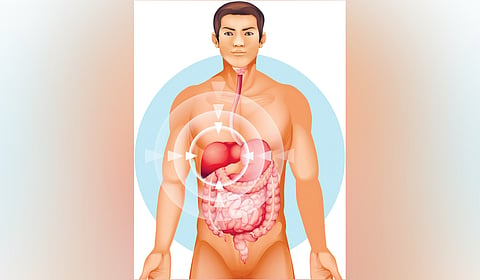

KOCHI: George (name changed), was 55-years-old when he was diagnosed with fatty liver. Since he was a teetotaller, he did not consider it to be a serious issue. However, during a subsequent health check-up, he was diagnosed with liver cancer. “He was suffering from other lifestyle diseases, including diabetes and cholesterol.
The situation could have been avoided had he followed up regularly with a fibroscan and other liver-related tests. Such diseases, if identified early, are preventable and reversible,” said Dr John Menachery, senior consultant hepatologist at Rajagiri Hospital, Aluva.
People who avoid alcohol tend to believe that they are safe from fatty liver disease. However, the number of people affected by fatty liver - alcoholic fatty liver disease (ALD) and non-alcoholic fatty liver disease (NAFLD) - has been on the rise in India. Unfortunately, most patients identify the condition at a later stage as it is mostly asymptomatic.
Fatty liver disease, the leading cause of liver cirrhosis, is now referred to as metabolism associated steatotic liver disease (MASLD) after a new nomenclature was adopted. This change reflects the growing understanding of the condition’s metabolic origins, says Dr Piyush Ranjan, vice-chairman of department of gastroenterology at Sir Ganga Ram Hospital, Delhi.
“Earlier, fatty liver, which used to be diagnosed on ultrasound, was thought to be an innocuous condition and people did not bother about it. Follow-up studies have showed that fatty liver can progress to cirrhosis in some cases, and to hepatocellular carcinoma in some people,” said Dr V Mohan, chairman of Dr Mohan’s Diabetes Specialities Centre, Chennai.
According to a study published in 2022 in the Journal of Clinical and Experimental Hepatology, ‘Prevalence of Non-alcoholic Fatty Liver Disease in India: A Systematic Review and Meta-analysis’, NAFLD prevalence in average-risk and high-risk subgroups was estimated to be 28.1% and 52.8%, respectively. The study concludes that about one in three adults or children have NAFLD in India.
What is fatty liver?
“The fat content in the liver should be less than 5%. Fatty liver is a condition when the fat content increases. The colour of the liver, which is chocolate or brown, turns yellow. When too much fat is deposited in the liver, it can lead to inflammation inside the liver and scarring and loss of liver function,” said Dr John.
Dr Abraham Koshy, director of hepatology at VPS Lakeshore, Kochi, said fatty liver is prevalent in at least 20% – 30% of the Indian population. “There is an increase in the number of people affected by fatty liver in India. Earlier fatty liver was seen mostly in adults. However, with recent lifestyle changes, even children in the age group of 5 - 12 are also being diagnosed with the condition,” he said.
“The overall prevalence of MASLD is around 30% of the population, while in people with diabetes it is 60%-70% of all people with type-2 diabetes. However, if diabetes and obesity are present, nearly 90% of them may have MASLD,” Dr Mohan added.
Identifying the condition
With screening, identification of risk factors and lifestyle modifications, the condition can be completely prevented. “The condition can be easily diagnosed with a liver function test. Usually, we identify the presence of fatty liver disease in a patient through an ultrasound scan. Some blood tests are carried out for further treatment and management of the condition,” said Dr Charles Panackel, senior consultant, hepatology and liver transplantation at Aster Medcity, Kochi.
The condition usually has no symptoms. “Usually, what I have observed is that the condition is diagnosed when the person undergoes an ultrasound scan for the treatment of any other disease. Sometimes, an ultrasound scan may not give you a clear picture of the severity of fatty liver. The patients do not have to worry about the grading of fatty liver as well. The disease can be diagnosed with a liver function test,” said Dr John, adding that further tests, including fibroscan, platelet count and endoscopy, will provide a clear picture of the condition.
Management
The condition, if untreated and not properly managed, can lead to other complications, including liver damage, heart problems, cirrhosis, and in later stages liver cancer. “In the initial stage, people may take it lightly as it is less harmful. However, the condition can lead to liver cirrhosis, inflammation, bleeding, giddiness, jaundice, and even liver damage and liver cancer,” said Dr Charles.
“The disease becomes dangerous when liver functions are affected. If there is no inflammation in the liver, then it is a relatively harmless condition. If there is inflammation, it can lead to fibrosis and cirrhosis,” said Dr John, emphasising that lifestyle modifications are recommended to address and solve the issue. “Recognising the risk factors and controlling diabetes levels and cholesterol through proper diet and exercise can help. Also, fibrosis and inflammation can cause liver damage,” he said.
Currently, the primary treatment approach focuses on addressing underlying risk factors such as diabetes and obesity. “Lifestyle changes, including dietary management and regular exercise, form the foundation of treatment,” said Dr Ranjan.
“The condition can be reversed by following a proper diet, exercise and even walking for 30 to 45 minutes every day. It is unfortunate that, in my experience, only around 10% of the patients follow these directions to manage the condition,” said Dr Abraham.
“Carbohydrates like white rice or refined wheat should be replaced with good quality protein preferably from vegetable sources (plant sources) and good quality fats (monounsaturated fats like nuts, seeds, and healthy oils),” said Dr Mohan.
The disease is still in an area of active research and a number of newer drugs are expected to be available in near future. “Drugs like Resmetirom, which acts on thyroid hormone receptors, have now have recently been approved by the FDA in the US for treatment of MASLD. These are specific treatments, but they are very expensive and do have side effects. Many other drugs are also in the pipeline for treating MASLD. GLP-1 receptor analogues like semaglutide, liraglutide and dulaglutide have shown to reduce fatty liver by managing weight loss and obesity. SGLT2 drugs like dapagliflozin have also shown to be beneficial for those with fatty liver,” added Dr Mohan.
“Vitamin E and Pioglitazone are the drugs which showed improvement in fatty liver in initial studies. Saroglitazaar is a PPAR agonist drug used to treat hyper triglyceridemia has been approved by DGCI in fatty liver,” Dr Ranjan said.
Alcoholic fatty liver
Alcoholic fatty liver is a condition caused when fat accumulates due to consumption of alcohol. Continuous drinking can result in cirrhosis. According to the World Health Organisation’s latest guidelines, no level of alcohol consumption is safe for health. “Simple fatty liver due to alcohol can be reversed with abstinence from alcohol for more than three months. However, once it has reached the stage of cirrhosis, then reversal may not occur even after keeping away from alcohol,” said Dr John.
According to a study published in 2020, ‘Epidemiology of non-alcoholic and alcoholic fatty liver diseases’, in India, alcohol is the most common cause of cirrhosis (34.3%) and almost 20% of all liver disease patients (irrespective of aetiology) are current alcohol consumers.
Risks
People with risk factors need to be more cautious. “As diabetes, hypertension, cholesterol, etc. are risk elements, lifestyle modifications, exercise, and diet can prevent the occurrence of the condition,” said Dr Abraham.
Dr Charles pointed out that the risk of getting affected by fatty liver is high if the person has a family history.
A significant number of patients who undergo liver transplant surgeries are also fatty liver patients, said Dr Abraham. “In my experience, around 30% of people who undergo liver transplantation are fatty liver cases. Earlier, most of the transplant cases I dealt with were caused by alcoholism and virus infection. It is because the condition, in many patients, is asymptomatic even in the later stage,” he said.
(With inputs from Sinduja Jane @ Chennai, Ashish Srivastava @ New Delhi)
