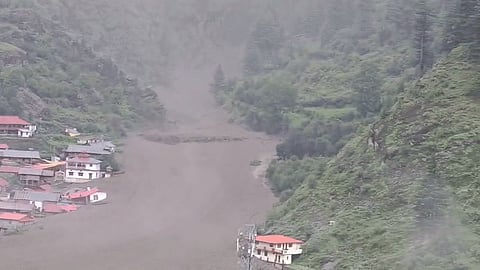

India has demonstrated global leadership in disaster reduction; however, there are critical areas where it must learn from others and its own mistakes as well. The recurrence of Himalayan disasters may have natural origins, but the devastation they cause is often attributable to human errors. The Dharali flood on August 6 is not fundamentally different from previous incidents that have marked the history of Uttarakhand and the Himalayas as a whole.
Each major disaster has been studied, documented, and lessons learnt—but ironically, these lessons have frequently been ignored too. While India has significantly improved its disaster response capabilities due to the commitment of national and state leadership, reflected in the seamless coordination of national, state, local, and lateral agencies, serious questions remain regarding the ‘prevention and risk mitigation’ aspects of disaster management.
Historically, the Himalayas and states like Uttarakhand have been prone to events such as flash floods, landslides and cloudbursts. However, recent years have witnessed both the increase in frequency , and a multiplication of their destructive impacts.
One critical issue has been the inadequate network of weather monitoring and automatic sensors. The recent major flash flood was not solely caused by a cloudburst; it was likely exacerbated by a glacial event, possibly triggered by an avalanche and/or accompanied by landslides. Evidence supporting this includes the presence of upstream lakes and the potential combination of hazard-trigger events.
Balancing developmental aspirations and forces against the backdrop of changing climate extremes and natural hazard conditions is crucial to mitigating potential losses and damages. It is ironic that a nation with rich experience and expertise in disaster management is increasingly facing severe disaster-related devastations and suffering. Ignoring the natural course of rivers—establishing housing and infrastructure in floodplains simply because the river has not flooded in recent times– constitutes one of many significant mistakes.
States like Uttarakhand require serious investments in automatic weather monitoring and extreme sensor networks, which remain inadequate; the difficult terrain renders the sparse network insufficient for providing accurate and timely warnings or alerts. It is vital to compile the lessons learnt from past Himalayan disasters, such as the 2013 Kedarnath flood and the glacial floods of Tapovan and 2021.
This compilation should lead to the creation of a prototype framework for disaster-resilient local development in the state. The Integrated Centre for Adaptation, DRR and Sustainability (ICARS), a newly established Centre of the Ministry of Science and Technology in collaboration with IIT Roorkee at Greater Noida. In summary, a rapid assessment of the recent Uttarkashi flash flood which devastated Dharali leads to five key questions:
How can we integrate modern AI, machine learning, space technology, and modelling to improve extreme and natural hazard warnings in the Himalayas? How can we convert weather and local/regional monitoring data, along with ground information, into an understanding of potential cascading scenario?
How can we enforce and populate systemic and cascading hazard zones for local communities and governments to determine appropriate infrastructure and housing locations? What are the key imperatives for local capacity building aimed at risk reduction and disaster prevention, in addition to disaster response? What standard yet flexible models can be developed for disaster-resilient development at local and regional levels in Himalayan regions, particularly in states like Uttarakhand?
