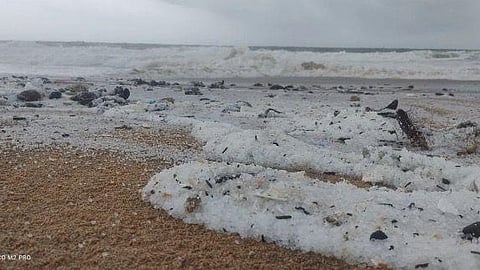

The global plastics treaty negotiations in Geneva ended without agreement, and one of the most preventable yet damaging sources of microplastic pollution has been left off the table. Plastic pellets — commonly known as nurdles — are the raw feedstock of the plastics industry. Spills from their production and transport release an estimated 4,45,000 tonnes into the environment every year. Once they escape, they are almost impossible to clean up, spreading across borders and ecosystems. Yet, the revised treaty text that collapsed contained no binding language to regulate pellet loss, a gap experts say could undermine the entire ambition of the agreement.
For India, this omission is especially jarring. Just this May, the sinking of the MSC Elsa 3 off Kerala spilled millions of pellets that washed ashore from Kochi to Tamil Nadu’s Dhanushkodi. Local communities organised beach clean-ups, but the scale of the contamination was overwhelming. Pellets blanketed shorelines, entered fishing grounds, and were even found in the Dhanushkodi Flamingo Sanctuary, threatening migratory bird populations. The spill echoed the catastrophic X-Press Pearl disaster of 2021 off Sri Lanka, which released over 1,600 tonnes of nurdles and remains the world’s worst recorded pellet spill.
Despite these direct impacts, India did not push for pellet regulation in Geneva. Instead, it aligned with the Like-Minded Countries (LMCs), a bloc dominated by oil-producing nations such as Saudi Arabia, Kuwait, and Iran, which went so far as to call for deleting the treaty article on “releases and leakages” altogether.
Their argument: plastic pellets are raw materials, not waste, and should not fall within the treaty’s scope.
This position has sparked outrage from environmental experts and coastal representatives in India. “India’s alignment with the Like-Minded Group is a missed opportunity for leadership,” Thamizhachi Thangapandian, Member of Parliament from South Chennai and part of the Interparliamentary Coalition to End Plastic Pollution, told TNIE. “With 7,500 km of coastline and millions dependent on marine ecosystems, we cannot afford silence. Sri Lanka has shown what leadership looks like—calling for binding measures, accountability, and compensation. By contrast, India’s reticence sidelines states like Tamil Nadu and Kerala, which are living the consequences of pellet pollution.”

Sri Lanka’s intervention in Geneva was pointed and personal. Recalling both the X-Press Pearl and Elsa 3 disasters, its delegation called for mandatory global measures to eliminate plastic leakages into marine and freshwater ecosystems, including accountability for maritime incidents and leak-proof transport packaging. “Once released, plastic pollution is often impossible to recover fully and causes irreversible harm — ecological, social and economic. Therefore, prevention must be prioritised,” a Sri Lankan negotiator said. Recently, Sri Lanka’s Supreme Court ordered the owners and operators of the X-Press Pearl to pay $1 billion in compensation for the devastating environmental and economic damage caused when the ship caught fire and sank off Colombo in 2021.
Scientists back Sri Lanka’s position. Nurdles are a transboundary pollutant and this year alone, pellets have been documented washing up in Mozambique, Costa Rica, Thailand, Fiji and the Maldives, many of which do not produce or use pellets themselves. Lightweight and buoyant, they can travel vast distances, spreading industrial waste to the world’s most pristine coastlines. Wildlife mistake them for food, leading to starvation and organ damage. As they degrade, they release microplastics and leach toxic additives, while their surfaces attract harmful chemicals and pathogens, creating a toxic cocktail that enters food chains.
“The recent MSC Elsa 3 incident is a stark reminder of how pellets devastate ecosystems and livelihoods,” said Megan Kirton, senior project officer at Fidra, a UK-based NGO that tracks nurdle pollution. “Up to 1,222 tonnes of pellets leak every day from the global supply chain. Unless the treaty addresses this with binding measures covering every actor from producers to transporters, negligence will continue and communities will keep paying the price.”
Experts point out that 95% of pellet loss could be prevented if companies were required to adopt standardised containment measures, backed by independent verification. But globally, there is no mandatory framework covering the entire supply chain — from production plants to shipping containers.
“Excluding plastic pellets and other feedstock from the treaty is indefensible,” said Amy Youngman, an international environmental attorney with the Environmental Investigation Agency.
“These materials are the starting point of all plastic products and one of the easiest sources of pollution to prevent. If we cannot regulate the raw material itself, the treaty risks becoming a hollow exercise.”
Sudheer Kumar Shukla, Head of Think at the New-Delhi Mobius Foundation, added that leaving nurdles out signals “a dangerous concession to industry interests over environmental and human health. Refusing to even acknowledge them at the negotiating table — at the behest of Like-Minded Countries — signals a troubling disregard for both science and the plight of vulnerable coastlines. If regulators won’t name the problem, the industry has little incentive to solve it.”
The Asia-Pacific is particularly exposed. The region produces 52% of the world’s plastics and hosts some of the busiest shipping lanes. South Korea and Singapore are among the top exporters of primary plastics, while China is the world’s largest importer. With 31 of the world’s 50 busiest ports located here, every stage of the supply chain poses risks of pellet loss. It is estimated that 150,000 tonnes of pellets are lost in Asia-Pacific annually, though experts say the figure is likely far higher due to under-reporting. Major spills have already been documented in Sri Lanka, Hong Kong, and India, and the region’s rich biodiversity and tourism-dependent economies remain highly vulnerable.
India’s reluctance to address pellet pollution has also exposed fault lines between the Central government and coastal states. Tamil Nadu, for example, banned single-use plastics ahead of national timelines and has pioneered coastal restoration projects that integrate community participation. “Our state’s initiatives show proactive measures can coexist with growth,” said Thangapandian. “But without the Union government backing on global rules, states like ours are left unprotected against international spills and transboundary pollution.”
Underlying the political divide is the petrochemical industry’s clout. “Plastics are cheap because they are kept cheap,” explained Swathi Seshadri, petrochemical expert at the Institute for Energy Economics and Financial Analysis. “Direct subsidies, cheap land, subsidised electricity and water, and externalising environmental costs, all keep polymer prices artificially low. If true costs are factored in, pellets would be transported and handled with far more care.”
The Institute for Energy Economics and Financial Analysis (IEEFA) warned that beyond environmental damage, continued reliance on plastics poses serious economic risks. “The polymer industry is in a state of secular decline, with slower growth, lower operating margins, and reduced profitability,” it said in a statement. “The Asia-Pacific region will pay the highest price, as expansion of polymer production is concentrated here between 2010 and 2030, even though the region is already the largest importer. Emerging economies in Asia — expected to contribute 60% of global economic growth — will be left vulnerable to a severe economic downslide, the cost of which will ultimately be borne by ordinary citizens.”
As the talks closed without a deal, UNEP Executive Director Inger Andersen struck a note of frustration. “The world cannot afford to wait. Plastic pollution is accelerating, and every delay means more damage to our oceans, our health, and our economies. We must come back to the table with a sense of urgency and responsibility.”