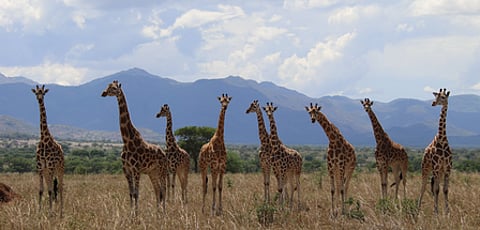

A pioneering evaluation has formally identified four separate giraffe species, challenging earlier classifications that considered the tallest land mammal as one single species. The review conducted by the IUCN Species Survival Commission (SSC)’s Giraffe and Okapi Specialist Group (GOSG) Taxonomic Task Force signifies a significant advancement in understanding giraffe taxonomy. It alters the approach towards giraffe diversity conservation.
The GOSG Taxonomic Task Force’s report ‘An Evaluation of the Taxonomic Status of Giraffe (Giraffa spp.) 2025’ officially recognised the four separate giraffe species.
Historically, the giraffe has been treated as a single species with nine subspecies. It has long been under scientific debate on giraffe taxonomy. The latest report recognises four distinct species and will help draw up comprehensive conservation plan in the future. The four species are Northern giraffe (Giraffa camelopardalis), Reticulated giraffe (Giraffa reticulata), Masai giraffe (Giraffa tippelskirchi), and Southern giraffe (Giraffa giraffa). (see box)
“Recognising these four species is vital, not only for accurate IUCN Red List assessments, targeted conservation action and coordinated management across national borders,” said Michael Brown, co-chair of the IUCN SSC GOSG and Conservation Science Coordinator for the Giraffe Conservation Foundation and one of the co-authors of the assessment.
“The more precisely we understand giraffe taxonomy, the better equipped we are to assess their status and implement effective conservation strategies,” Brown noted. The IUCN (International Union for Conservation of Nature) is a global organisation dedicated to conserving nature and promoting sustainable development through knowledge.
The GOSG convened a classification group, Taxonomic Task Force, in 2024-2025 to evaluate current evidence latest genetic, morphological and biogeographical data. The group used an integrative framework based on the Traffic Light System — a structured methodology that assesses taxonomic distinctiveness based on converging lines of evidence. In addition to it, it also reviewed published literature, original datasets and expert consultation.
One of the most extensive studies conducted in 2024 revealed that discriminant functions found statistically significant cranial shape differences between all four giraffe species, and in some cases, also between subspecies of the same species. The distinct cranial morphologies were predominantly linked to ossicone characteristics (a skin-covered bone structure similar to horns) in giraffes.
Additionally, biogeographic assessments also considered the role of natural barriers – such as major rivers, rift valleys and arid zones – that could have contributed to evolutionary isolation. After that, GOSG recognised four distinct giraffe species and their constituent subspecies.
Previous assessment noted that there is progressive variation in coat coloration and ossicone development from southern to northern Africa, but a greater diversity in these features, including spot patterns and colour, and ossicone development, in East Africa. But new technologies like 3D geometric morphometrics further deepens understanding of scientists.
“Together, these multiple lines of evidence provide scientific support for elevating certain giraffe populations to full species status, reflecting their distinct evolutionary histories,” said Brown.
IUCN experts believe recognising four species leads to a more nuanced understanding of the unique conservation threats and opportunities that these different taxa face across the diverse regions of Africa that they inhabit.
