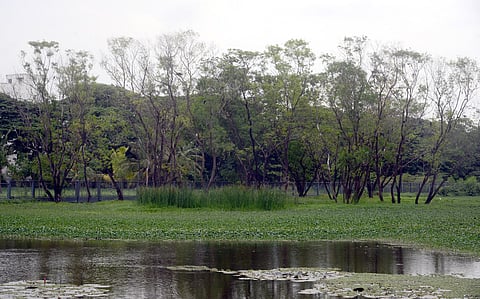

A new global assessment released this week has raised concerns over the continued and accelerating destruction of wetlands, warning that if current trends continue, up to 20 per cent of the world’s remaining wetlands could vanish by 2050 — a loss that could strip away $39 trillion in ecosystem benefits annually and imperil global water, food, and climate security.
The Global Wetland Outlook 2025: Valuing, Conserving, Restoring and Financing Wetlands (GWO 2025), published by the Convention on Wetlands, comes ahead of COP15, the international conference on wetlands, to be held in Victoria Falls, Zimbabwe later this month. It is the most comprehensive report yet on the state of wetlands worldwide.
Wetlands, which cover just 6 per cent of the Earth’s surface, are among the most productive ecosystems on the planet. They supply clean water, absorb carbon, protect against floods, and sustain hundreds of millions of livelihoods. Yet, the report finds that wetlands are disappearing faster than any other ecosystem, at an average annual loss rate of 0.52 per cent.
Since 1970, the world has lost over 411 million hectares of wetlands — an area larger than the size of India. Among the worst-hit types are inland marshes, peatlands, lakes and mangroves. For example, inland marshes and swamps alone have shrunk by an estimated 177 million hectares in the last five decades. Wetland degradation is now reported in every region, with the steepest declines in Latin America, Africa, and Asia, including large parts of South Asia.
“The scale of destruction is unprecedented. What we are witnessing is the systemic unravelling of nature’s most valuable safety net,” said Dr Musonda Mumba, secretary general of the Convention on Wetlands. “This is not just an ecological crisis—it’s a humanitarian and economic one.”
$550 billion needed to turn the tide
To reverse the damage and secure the benefits wetlands offer, the report estimates that conserving and restoring 550 million hectares of wetlands — the area needed to meet the Kunming-Montreal Global Biodiversity Framework (KM-GBF) goals — will require at least $550 billion in targeted investments over the next 25 years. “The finance gap is huge,” said Ritesh Kumar, South Asia director at Wetlands International and one of the lead authors of the report. “Our modelling shows that restoring 123 million hectare of degraded wetlands and conserving another 428 million hectare will require a mix of public and private financing totalling $550 billion, which is only 0.5 per cent of global GDP. Considering the cost of inaction is far greater — this ballpark figure is meagre. Lost wetlands mean lost water security, lost food systems, and lost protection against climate extremes."
The report says that restoring wetlands is significantly more expensive than preserving healthy ones, with annual costs ranging from $1,000 to over $70,000 per hectare, depending on the wetland type and region. By contrast, conserving existing wetlands costs far less and delivers high returns in ecosystem services.

According to the data, well-managed wetlands currently deliver between $7.98 trillion and $39.01 trillion annually in global benefits — including water purification, fisheries, agriculture, flood protection, tourism, and carbon sequestration. The report calculates that if all remaining wetlands are maintained through 2050, the net present value of benefits would exceed $205 trillion.
Grim forecast
The report forecasts that up to 20 per cent of the world’s remaining wetlands could disappear by 2050 without immediate intervention. Already, one in four wetlands is in poor ecological condition, and degradation is accelerating in developing countries, especially in Asia and Africa, where population pressures and economic development are intense. Data from the World Wetlands Survey 2024 reveals that 24 per cent of wetlands in Asia are in poor condition, and ecological deterioration has worsened in five of six world regions since 2011.
South Asia, home to wetlands like the Sundarbans in India and Bangladesh, and the Indus Delta in Pakistan, is particularly vulnerable. These ecosystems buffer millions against sea-level rise and storms but are being rapidly eroded by pollution, damming, overfishing, and climate change.
Pathways for recovery
The report outlines four strategic pathways to recover and protect wetlands, which includes integrating wetland valuation into national policies to ensure ecosystem services are factored into infrastructure, agriculture, and urban planning.