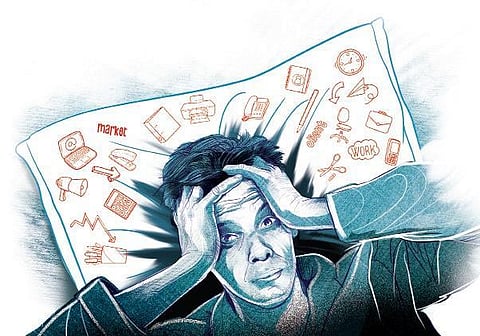

It began subtly. Anil Kumar, a 42-year-old chartered accountant from Kochi, found himself waking up at 2am most nights, unable to fall back asleep. At first, he thought it was due to work stress. He tried herbal teas, switched off his gadgets early, and even started using over-the-counter sleep aids. But what began as an occasional annoyance turned into a nightly battle. He would wake up groggy, mentally foggy, and his productivity would plummet. His wife noticed that he snored loudly and, alarmingly, sometimes seemed to stop breathing during sleep. The final jolt came when Anil briefly nodded off behind the wheel and was jolted awake only when his car grazed the highway divider. It was this scare that finally pushed him to seek medical help.
Anil’s story is not rare. His case mirrors what many experts now recognise as an escalating epidemic of sleep disorders across India. Specialists believe these disorders are vastly underdiagnosed, often dismissed as lifestyle quirks or treated superficially. “Sleep is an essential component of health, just like food and exercise. We spend one-third of our lives asleep,” says Dr Sapna Erat Sreedharan, professor of neurology at Sree Chitra Tirunal Institute for Medical Sciences and Technology (SCTIMST), Thiruvananthapuram. “What many people don’t realise is that sleep isn’t a passive state — your brain is incredibly active during this time. It’s when it clears out toxins, consolidates memories, and fine-tunes physiological processes.”
Understanding sleep disorders
Sleep disorders are typically classified into seven broad categories. These include insomnia, sleep-related breathing disorders like obstructive sleep apnoea (OSA), central disorders of hypersomnolence such as narcolepsy, circadian rhythm disorders, parasomnias like night terrors and sleepwalking, sleep-related movement disorders such as restless legs syndrome, and sleep disturbances that occur as a consequence of neurological or psychiatric illnesses. Among these, insomnia and sleep apnoea top the list in terms of frequency and impact.
“Almost 60-80% of people will experience short-term insomnia at some point in their lives, often due to stress or illness. But when it lasts longer than three months, it turns into a chronic condition,” Dr Sapna adds. Chronic insomnia can impair memory, reduce concentration, and diminish work performance. It also increases the risk of cardiovascular disease, anxiety, and depression. About 15% of the population is believed to suffer from it, though actual numbers are difficult to pin down due to self-medication and lack of awareness.
Sleep apnoea, the unseen epidemic
Obstructive sleep apnoea, meanwhile, has grown to become what some doctors now describe as a lifestyle disease. “In OSA, the throat muscles relax excessively during sleep, blocking the airway,” explains Dr PS Shajahan, professor of pulmonary medicine at Government TD Medical College, Alappuzha. A less common form, central sleep apnoea, results from the brain failing to send proper signals to breathing muscles.
“Loud snoring is one of the most ignored red flags,” he says. “But untreated sleep apnoea has serious consequences. It increases the risk of heart attack, stroke, type-2 diabetes, and causes major cognitive impairment.”
The social and economic consequences are also concerning. "OSA contributes to road traffic accidents, especially when drivers fall asleep at the wheel. In western countries, 10-15% of such accidents are linked to sleep disorders. The problem extends into households as well — many partners are forced to sleep in separate rooms due to loud snoring and disrupted sleep,” Dr Shajahan adds.
Studies suggest that 10-20% of Indian adults may suffer from OSA, although diagnosis rates are much lower, particularly in non-urban populations.
A problem among the young, too
Contrary to popular belief, sleep disorders are not limited to older or overweight individuals. Young adults are increasingly showing up at clinics with fragmented or poor-quality sleep, says Dr Aswathy Thazhakottuvalappil, consultant in the department of respiratory medicine at KIMSHEALTH, Thiruvananthapuram.
“There’s a growing number of young, even non-obese individuals with sleep apnoea and other disorders. In women, especially, psychological stress, anxiety, and screen addiction play a significant role,” she says. “These problems are often brushed aside as ‘normal’ stress or overwork. But persistent fatigue, headaches, poor concentration, and morning lethargy should not be ignored.”
Left unaddressed, these symptoms can evolve into serious health problems — including uncontrolled hypertension, metabolic dysfunction, kidney issues, and stroke.
The careful clinical process
Dr Sapna stresses that most sleep disorder diagnoses begin with a detailed history. “The first step is asking the right questions,” she says. “When do you go to bed? Do you use your phone late? Do you feel tired during the day? Do you snore? Has your partner noticed pauses in breathing? These details matter.”
She points out that around 90% of diagnoses are made through careful clinical evaluation. But for more complex cases, such as suspected apnoea or narcolepsy, a sleep study — technically known as polysomnography — is essential.
The gold-standard level-1 polysomnography is conducted overnight in a sleep lab under technician supervision. It records electrical brain activity, breathing, oxygen levels, body movements, and heart rhythm. Patients are usually advised to avoid caffeine and alcohol and to refrain from napping the day of the study. Simpler versions, like level 2 and 3 studies, can be done at home and are primarily used to assess breathing disorders.
“Home-based studies are gaining popularity because people find it difficult to sleep in unfamiliar hospital environments. But their utility is limited to detecting only a subset of disorders,” Dr Sapna notes.
Treatment: Individualised and multimodal
For chronic insomnia, cognitive behavioural therapy for insomnia (CBT-I) is considered the gold standard. “CBT-I works better than medication in the long run,” Dr Sapna notes. “It targets the root causes of poor sleep, such as unhelpful beliefs and behaviours. But in India, access to trained therapists is limited. This pushes patients towards long-term use of sleeping pills, which can lead to dependency and cognitive issues.”
Obstructive sleep apnoea, on the other hand, often requires mechanical intervention. “CPAP (Continuous Positive Airway Pressure) is the most effective therapy for OSA,” says Dr Aswathy. “We also look at mandibular devices and, in some cases, surgical correction. Treatment is always tailored to the patient’s condition.”
Emerging technology like wearables and sleep apps can provide preliminary data but are not diagnostic tools. “People come with watches showing less sleep hours demanding evaluation,” says Dr Sapna. “But we need more trained sleep technologists and better public understanding of what these devices can and cannot do.”
Sleep health - a public health priority
The doctors agree that sleep needs to be treated as a vital sign, monitored and discussed as routinely as blood pressure or cholesterol. Public health campaigns, better access to sleep studies, and integrated mental health support are crucial to addressing what they term a “silent epidemic.”
Sleep disorders have been described in literature for centuries — Charles Dickens’ portrayal of Joe, the obese, sleepy coachman in ‘The Pickwick Papers’, for instance, is now thought to be one of the earliest depictions of sleep apnoea. But societal recognition has lagged far behind. “Sleep hygiene should be taught just like balanced diets and physical activity,” says Dr Sapna.
A new beginning
Back in Kochi, Anil Kumar was diagnosed with moderate sleep apnoea. A sleep study confirmed that he experienced frequent nighttime breathing interruptions. He began CPAP therapy and underwent cognitive behavioural sessions to improve his sleep hygiene. Three months later, he feels alert, well-rested, and safer on the road.
His story underscores an essential truth: quality sleep is not a luxury—it is a biological necessity. When we ignore it, the consequences ripple across every area of life.
India is slowly waking up to this reality. But, for a meaningful change, we need a coordinated effort across medicine, technology, policy, and public behaviour.
“Sleep disorders affect how we live, work, and think during the day. They are not just nighttime issues. Addressing them isn’t optional — it’s essential,” says Dr Aswathy.
