
CHENNAI: Two years of relentless conflict in the Gaza Strip have left an environmental disaster of unprecedented scale, the United Nations Environment Programme (UNEP) warns in a new report released this week.
The assessment portrays a collapsing ecosystem, polluted water supplies, and farmland laid to waste, raising fears that recovery could take decades without immediate, science-based interventions.
The report titled "Environmental Impact of the Escalation of Conflict in the Gaza Strip" details the destruction up to September 2025. It says the territory’s environmental collapse is compounding a dire humanitarian crisis.
The report comes just weeks after an independent panel concluded parts of Gaza are already in famine. “Ending the human suffering that has engulfed Gaza must be the priority,” said UNEP Executive Director Inger Andersen.
“But restoring freshwater systems and removing debris are equally urgent to save lives and rebuild a foundation for recovery.”
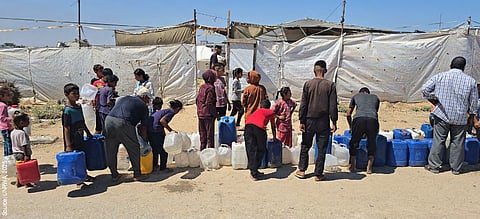
The war has crippled Gaza’s water infrastructure. Of the 54 storage reservoirs and pumping facilities that existed before October 2023, only nine remain active — just three of them undamaged —representing an 84 per cent loss in capacity.
Gaza’s seawater desalination plant, once capable of producing 30,000 cubic meters per day, is operating at less than a sixth of that due to war damage and chronic fuel shortages. Of 214 groundwater desalination units, only 84 remain functional. Together, they supply just 22 million cubic meters per year, well below the population’s needs.
None of Gaza’s six wastewater treatment plants are operational, pushing untreated sewage into the aquifer and marine environment. With piped networks shattered, many families have resorted to makeshift cesspits, increasing risks of groundwater contamination, the report says.
The public health toll has been devastating. Reported cases of acute watery diarrhoea surged 36-fold between 2023 and 2025, from 11,562 to over 412,000 cases. Acute jaundice syndrome, a marker of hepatitis A, exploded 384-fold to 41,515 cases. Children under five account for 65 per cent of diarrhoeal cases. Polio, absent for decades, has re-emerged through wastewater transmission, while respiratory infections linked to dust from explosions and rubble exceeded 37,000 cases in June 2025 alone.
Before the war, nearly one-third of Gaza’s land was used for agriculture, producing olives, citrus, vegetables, and poultry. Today, agriculture has all but collapsed. By August 2025, 91.7 per cent of Gaza’s cropland had been damaged, according to satellite analysis. The destruction is near-total for certain crops: 97 per cent of tree crops such as olive groves, 95 per cent of shrubland, and 82 per cent of annual crops like vegetables are gone. With farmland inaccessible or destroyed, food production has collapsed.

Over half a million people face famine conditions, and nearly one million more are in a state of emergency. “Food production at scale is no longer possible,” the report warns. Fuel shortages have worsened the damage, with civilians cutting down the few remaining trees for firewood. Soil, compacted by military activity and stripped of vegetation, has lost its ability to absorb rainwater, raising flood risks and reducing groundwater recharge. UNEP warns that damage to soils may be permanent.
The war has also levelled Gaza’s urban fabric. Of an estimated 2,50,000 buildings, 78 per cent have been damaged or destroyed, including more than 2,82,000 housing units, leaving most of Gaza’s 2.2 million people displaced. The destruction has created 61 million tonnes of debris — 20 times more than all previous Gaza conflicts since 2008 combined. The volume is equivalent to 15 Great Pyramids of Giza or 25 Eiffel Towers. While much of the debris is inert concrete and brick, UNEP highlights dangerous “hot spots” where asbestos, industrial chemicals, and heavy metals from destroyed solar installations pose serious contamination risks. In refugee camps, older asbestos-laced construction is especially hazardous.
Soil contamination is another looming crisis. While no comprehensive chemical survey has been conducted, UNEP warns of significant risks from heavy metals, unexploded ordnance, fuel spills, and industrial waste, noting that past conflicts suggest contamination could persist for decades. Marine ecosystems are also threatened, with untreated sewage and contaminated runoff likely polluting Gaza’s coastal waters, though testing remains impossible due to security constraints.
UNEP has set out 30 recommendations to begin reversing the damage. These include rapid reconstruction of water and sewage infrastructure, large-scale debris clearance with safe handling of asbestos and hazardous materials, mapping of soil contamination, long-term ecological restoration, recycling of rubble to aid reconstruction, and the inclusion of local expertise and communities in planning. The report stresses that Gaza’s recovery hinges on an immediate ceasefire and coordinated, science-based action. Without it, UNEP warns, the enclave faces “a legacy of environmental destruction that could affect the health and well-being of generations.”
Since 1999, UNEP has conducted over 40 post-conflict environmental assessments worldwide, from the Balkans to Sudan. But the Gaza findings rank among the most severe. Compared to UNEP’s first assessment in June 2024, debris has risen 57 per cent in just over a year, while damage to cropland now exceeds 90 per cent. “The situation is going from bad to worse,” Andersen said. “If this continues, it will leave behind an ecological collapse that will take generations to undo.”