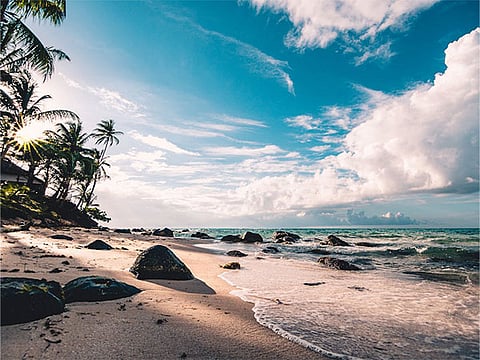

On February 16, the National Green Tribunal (NGT) gave a green signal to the Great Nicobar Island Development Project (GNIDP). The six-member bench of NGT, headed by Justice Prakash Shrivastava, was satisfied that adequate safeguards were in place in the environment clearance (EC) for the ₹81,000 crore project that has been in news for quite some time over the ecological cost it might extract.
Great Nicobar Island
At 910 sq km, the Great Nicobar Island is at the southernmost tip of Andaman and Nicobar Archipelago. It is located in the Indo-Malayan bio-geographic zone. The Great Nicobar Biosphere Reserve is one of the 11 Biosphere Reserves declared under the Man and Biosphere Programme of Ministry of Environment, and Forests, Government of India and UNESCO.
The project
The GNIDP is a mega infrastructure project planned over 166 sq km area. It involves an International Container Transshipment Terminal (ICTT) at Galathea Bay, a civil-cum-defence airport, development of a township and a 450 MVA gas and solar based power plant. Holistic development of the Great Nicobar Island is planned over a span of 30 years at an estimated ₹81,000 crore.

Forest clearance for 130.75 sq km was accorded by Centre in October 2022. The EC came the next month.
Strategic importance
The Great Nicobar Island Development Project is significant from the national security perspective. “The Indian Ocean Region (IOR) in general and the Indian Ocean in particular has turned into a strategic hotspot in recent years. In response to the increasing strategic value of this IOR, a critical mass of development in the Andaman & Nicobar Islands is necessary for strengthening India’s regional presence,” says the feasibility report.
The island is equidistant from Colombo, Port Klang and Singapore and very close to the East-West international shipping corridor. It is barely 40 km from the major international sea route passing through Malacca Strait. The ICCT is planned to tap into the route connecting East Asian exports with the Indian Ocean, Suez Canal and Europe.
Holistic development through greater connectivity will support tourism, bring in employment for local residents.
The persisting concerns
About 15% of forest land will be diverted for the project. Of the total area of 910.07 sq km, 166.1 sq km is required for development.
For execution of the project, over 9.65lakh trees will be felled. The region includes the nesting ground of leatherback turtles, saltwater crocodiles, coral reefs, mangroves and avian species.
Of the 8,000 people who live on the island, important are indigenous islanders, categorised as Scheduled Tribes. The Mongoloid Shompens are hunter-gatherers, dependent on the forest and marine resources for sustenance. Nicobarese, another Mongoloid tribe lived along the west coast, were relocated to Afra Bay on the north coast and to Campbell Bay after the 2004 tsunami devastated their settlement. There are about 237 Shompen and 1,094 Nicobarese individuals. For the project 84 sq km of their land will be occupied.
Members of Nicobarese Tribal Council have expressed disagreement with their lands being designated as project area which they say was without their consent.
The island sits on a major seismic fault line. The epicentre for the earthquake and Tsunami of 2024 was 80 miles from this location under which the southern tip of the island sunk. Geologists warn against any developmental activities.