
Having grown up watching numerous animated films, television serials and theatre productions based on the Ramayana, one of the many elements that always intrigued us were the floating stones used to construct the bridge from India to Sri Lanka at as Dhanushkodi, the last point of India. When we arrived at the Panchamukhi Hanuman Temple and witnessed not just one but many such stones afloat, we felt a deep sense of affirmation, as though much of the story was indeed true. It was here that we learnt of a lesser-known legend. According to the Ramayana, two monkeys named Nala and Nila, in their youth, would often throw murtis worshipped by sages into the water. As a consequence, the sages cursed them, declaring that any stone they threw into water would float instead of sinking — thus enabling the construction of Ram Setu. The temple itself houses centuries-old, naturally occurring idols believed to be svayambhu depicting a five-faced Hanuman avatar.
Rameshwaram is full of such surprises and supporting evidence. Be it the Vellundhi Teertha (natural freshwater spring found within the sea, surrounded by saline water, believed to have emerged when Ram struck the ground with his bow after Sita felt thirsty) or the Vibhishan Temple, which stands as the only historical structure to have survived the cyclone of 1964 AD that washed away Dhanushkodi.
With fresh memories of what we had just viewed, we arrived at The Residency Towers, currently the only premium accommodation in Rameshwaram. Located on the Madurai–Dhanushkodi Highway, the hotel blends modern five-star facilities with traditional hospitality. A strictly pure vegetarian property, highly valued by devotees, it is a preferred choice for both pilgrims and leisure travellers. The hotel offers 98 rooms, ranging from standard categories to expansive suites, with options featuring pool views or private balconies. It features a gym, games room, restaurants, garden area and more. We headed to the poolside for evening high tea, reflecting on the day’s experiences — beginning with our arrival via the new Pamban Bridge. Stretching across the turquoise waters of the Palk Strait, it connects the island to mainland Tamil Nadu. Its predecessor, the historic 1914 cantilever bridge, stood resilient through storms and time and this new bridge honours that legacy while boasting sea vistas and a quiet sense of anticipation of the island’s spiritual offerings.
We later stepped into the spa for Shirodhara, an ayurvedic therapy where warm oil is gently streamed onto the forehead, soothing both mind and body. By nightfall, the island’s calm enveloped us, promising a day of discovery ahead.
The next morning found us at Agni Teertham, just outside the Ramanathaswamy Temple. Legend holds that Lord Ram bathed here to cleanse himself of the sins of battle, a ritual devotees continue to this day. Stepping inside the temple complex, pilgrims encounter the 22 sacred wells, each believed to possess purifying properties. After bathing in these waters, entering the main shrine of Ramanathaswamy Temple feels like stepping into an epic carved in stone. Towering gopurams, ornate pillars and shiva linga-lined corridors walk us through numerous smaller shrines, yet the temple’s most distinctive feature is its singularity: it is the only temple in India where Vishnu is depicted in yog nidra, the cosmic sleep. Dedicated to Lord Shiva, this shrine is a significant pilgrimage site, part of the char dham and one of the 12 jyotirlingas too.
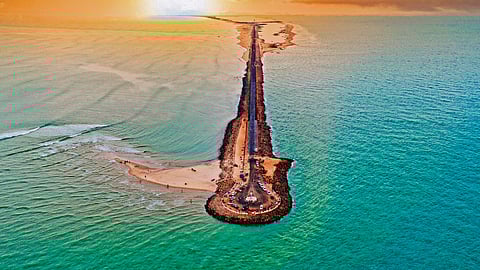
After the temple visit, we returned to the hotel for a thali lunch — a vibrant spread of traditional Tamil dishes. From tangy sambars to ragi ambal, each bite celebrated local flavours. We then set off towards Dhanushkodi, where the drive in itself is a surreal experience: flanked by the Bay of Bengal on one side and the Indian Ocean on the other, the wind rushing past and an almost reverential silence broken only by the waves. En route, haunting remnants of a bygone era — the old railway station, a church and public buildings, stand as quiet reminders of a town frozen in time, where permanent settlement is no longer permitted.
On our last day here, we also managed to squeeze in visits to Natraja Temple, Gandhamadhana Parvatham, Lakshmana Teertham and Kodanda Ramar Temple. We culminated our trip by spending some quiet at the hotel enjoying evening bhajans in the lobby and serene walks on the pristine beach.