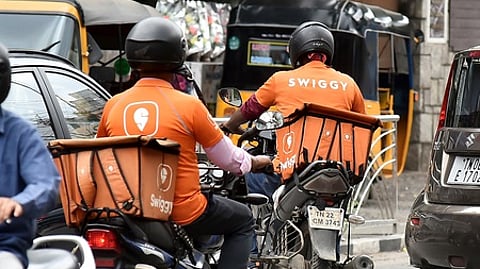

Quick commerce, or colloquially, q-commerce, represents a distinct modality of e-commerce structured around the promise of ultra-rapid delivery of everyday essentials, typically within a window of 10 to 30 minutes. Operating through localised hubs or ‘dark stores’, it functions within tightly knit, hyper-local neighbourhood networks. Orders are placed via mobile applications, processed through algorithmic systems, and executed by app-based workers whose labour underwrites the sector’s defining imperative—speed. In March 2025, India’s leading quick-commerce platforms, including Blinkit, Zepto and Swiggy Instamart, together delivered over 48 lakh orders daily, nearly doubling their scale from the previous year and signalling a qualitative transformation in grocery consumption patterns across India’s urban landscape.
In January 2026, amid escalating safety concerns and widespread labour protests, India’s Union Ministry of Labour stepped in to curtail the ultra-fast “10-minute delivery” marketing claims. On 13 January 2026, following a series of deliberations between labour minister Mansukh Mandaviya and senior executives from leading platforms, including Blinkit, Zepto, Swiggy Instamart and Zomato, the companies were urged to discontinue explicit “10-minute delivery” assertions across their advertisements, apps, and promotional materials. Consequently, Blinkit promptly amended its tagline from “10,000+ products delivered in 10 minutes” to “30,000+ products delivered at your doorstep,” while Swiggy, Zepto and others indicated imminent rebranding adjustments.
Global origins, Indian trajectory
The q-commerce model first emerged globally in the mid-2010s. Getir, founded in Turkey in 2015, is widely recognised as the earliest avatar to scale instant grocery delivery. Comparable models subsequently sprouted across Europe through companies such as Glovo and subsidiaries of Delivery Hero. The Covid-19 pandemic accelerated the transition of instant delivery from a niche convenience to a mass necessity.
In India, Swiggy launched Instamart in 2020 by extending its food-delivery infrastructure into groceries and household essentials. Grofers, founded in 2013, pivoted decisively towards a 10-minute delivery model in 2021 and rebranded as Blinkit, explicitly embracing the q-commerce paradigm. Zepto entered the market the same year as a q-commerce-only startup. The size and impact of this sector can be fathomed by the fact that on New Year’s Eve 2026, Zomato and Blinkit together fulfilled a record 75 lakh orders in a single day, serving over 63 lakh customers through more than 4.5 lakh delivery partners, even amid calls for a nationwide gig-worker strike.
Loss-making business model
One of the many commonalities among these q-commerce firms is that almost all of them incur substantial losses annually. The entire q-commerce segment in India operates on a distinctive model in which present-day losses are deliberately absorbed as a strategic subsidy to capture market share, largely underwritten by venture capital. This approach, while financially viable for well-capitalised platforms, can be deleterious for competition, as sustained subsidies in the form of venture capital enable them to undercut prices and often driving smaller retailers out of the market. A growing body of scholarship on the gig and platform economy corroborates how these firms manipulate financial losses during their expansionary phase by externalising costs and risks onto labour and ancillary actors.
Empirical examples from India reinforce this dynamic: Zomato, after years of losses, reported its first profitable quarter in FY 2022–23. Globally, the trajectory of Amazon provides a parallel: initial loss-making through aggressive pricing and logistics investment enabled the platform to capture market share, after which it achieved profitability while smaller competitors were edged out.
Workforce expansion
This expansion is predicated upon a vast, flexible, readily replaceable and vulnerable workforce. Reuters estimates that over 400,000 delivery workers are engaged in India’s instant-delivery ecosystem, a figure that almost certainly understates the true magnitude when informal, intermittent and part-time participation is taken into account. These workers are formally designated as “delivery partners”, a legal classification that enables platforms to exercise extensive control through algorithmic management while not recognising as workers.
This permits platforms to discipline labour via opaque software-driven mechanisms, including the unilateral and often unexplained deactivation of worker IDs, without commensurate accountability. Scholarly literature conceptualises this regime as one of “algorithmic control”, which systematically erodes worker autonomy and engenders what Guy Standing describes as the precariat (a portmanteau created by subsuming two words: precarious and proletariat).
Working hours, economic precarity
Working hours within the sector remain largely unregulated. Numerous workers report routinely logging 9-12 hours per day to secure sufficient orders and performance-linked incentives, particularly during peak demand cycles and festive periods. While platforms regularly advertise flexibility, declining per-order remuneration, rising fuel and maintenance costs, and stodgy urban traffic exert persistent pressure on workers (delivery partners) to remain logged in for extended durations. Gross earnings for delivery partners were reported at approximately H102–105 per hour in 2025; however, after accounting for operational expenses and vehicle costs, net monthly incomes frequently compress to between H18,000 and H22,000.
Quantitative studies on gig work in India indicate that the net earnings of food-delivery workers average around H265 per day, substantially below those of the typical self-employed worker or casual labourer in urban contexts. This fragile income profile, combined with the absence of employment benefits, coheres with the notion of “shadow employment”, wherein workers remain economically productive yet institutionally dispensable.
Social security gaps
Social security coverage for delivery workers remains conspicuously inadequate, if not entirely absent. Although India’s labour reforms include the Code on Social Security, 2020—which envisages aggregator contributions towards health insurance, pensions and welfare schemes—implementation has been uneven and lackadaisical, leaving most delivery workers without minimum-wage guarantees, paid leave or robust dispute-resolution mechanisms.
A handful of state governments have initiated interventions. Karnataka enacted the Karnataka Platform-Based Gig Workers (Social Security and Welfare) Act, 2025, mandating aggregator contributions to welfare funds and establishing a dedicated welfare board. Rajasthan had earlier passed similar legislation creating a gig-workers’ welfare board financed through levies on aggregators. Telangana and Delhi had likewise signalled policy initiatives to extend protections, though critics argue that these measures fall short of ensuring enforceable work standards or statutory minimum wages. Academic research consistently emphasises that in the absence of comprehensive and enforceable regulatory frameworks, gig work is likely to remain structurally precarious and economically volatile.
Collective action and nationwide mobilisation
Till date, the delivery workers have made a few attempts to mobilise for collective bargaining. On December 31, 2025, gig and platform workers across India participated in a nationwide strike called by the Telangana Gig and Platform Workers Union and the Indian Federation of App-Based Transport Workers (IFAT), with support from regional collectives across multiple states. The action followed an earlier flash strike on December 25, which unions claimed disrupted 50–60 per cent of deliveries in several cities. Union leaders framed the mobilisation as a protest against declining per-order payouts, unsafe delivery targets, arbitrary account deactivations and the complete absence of social security.
Estimates suggest that approximately 1.7 lakh workers participated in the December 31 protest. The strike’s demands centred on higher and stable remuneration, statutory recognition as workers, comprehensive accident and health insurance, pension coverage, regulated working hours and transparent grievance-redressal mechanisms.
The strike unfolded against a backdrop of surging delivery volumes. Platforms responded by dangling incentive bonuses and surge payments to sustain operations during the holiday peak. Although localised disruptions were reported, services stabilised as the day progressed, illustrating both the potential and the structural limitations of gig-worker mobilisation within a fragmented and algorithmically managed workforce. Analytical models suggest that cooperative remuneration structures yield more stable outcomes than punitive or excessively incentive-driven regimes.
The conditions precipitating these protests are also reflected in recurrent road-safety hazards. In early January 2026, a Zepto delivery partner was killed in a road accident in Hyderabad, prompting union condemnation of high-pressure delivery regimes. Comparable fatalities and assaults involving delivery workers have been reported across the National Capital Region and Bengaluru.
Public debate
Proponents of q-commerce, including sections of tech economists, startup commentators, argued that the sector represents an efficiency-enhancing innovation that reduces transaction costs, expands consumer choice, formalises parts of informal retail through supply-chain integration, and generates large-scale employment opportunities for the urban youth. In contrast, intellectuals like Jean Dréze, Reetika Khera, Jan Breman have been arguing that q-commerce entrenches precarious work, undermines labour protections through misclassification, accelerates the displacement of small retailers, and represents a form of capital-subsidised competition that erodes social welfare in the long run. Internationally, thinkers like Nick Srnicek and Shoshana Zuboff situate quick commerce within a wider critique of platform capitalism, highlighting its reliance on venture-capital-financed losses, algorithmic control, and data extraction, while labour activists and union-linked intellectuals foreground the moral and social costs of speed-driven delivery regimes, including road safety risks and psychological stress.
Between these two extremes, a smaller reformist group—including Nitin Pai, Ravi Sundaram, Ramesh Chand, Ashok Gulati and Arvind Panagariya—accepts that q-commerce is here to stay but argues for strong regulation, minimum wages, social security contributions and antitrust oversight to limit its harmful effects.
