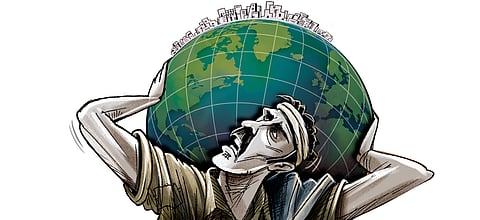

The impact of climate change and the fight against it both affect poor, vulnerable and ordinary people. While the effects often receive significant attention from policymakers, the challenges faced by migrant labourers in the fight against it often go unnoticed.
Corporations and governments manufacturing solar panels, electric batteries and mining rare earth materials to reduce carbon emissions increasingly rely on migrant labour under harsh conditions. Many migrants face excessive production targets, long working hours and safety violations. In effect, the global green transition is being powered by workers exposed to various forms of exploitation.
A new analysis shows migrant workers are facing systemic labour abuse in industries at the forefront of the energy transition.
A 2025 report by the Business and Human Rights Resource Centre (BHRC), based on hundreds of documented cases, found companies involved in the green transition often fail to address structural causes of exploitation, risking a repeat of the inequalities that marked earlier industrialisation.
Chinese companies dominate the sector, particularly in rare earth extraction and processing. The report found more than one-third (36 per cent) of the abuse cases involved Chinese-headquartered firms operating in different parts of the world. China controls around 75 pc of Indonesia’s nickel refining capacity and is also involved in projects such as a low-carbon kiln in France and a solar plant in Bosnia and Herzegovina.
Migrant worker abuse was also reported in electric vehicle (EV) manufacturing. Four cases were documented in the United States at facilities linked to companies such as Hyundai and Tesla, including plants in Alabama, Texas and Georgia. Workers producing chips for Tesla in Taiwan also reported exploitation, while Tesla faced allegations of paying migrant workers less than domestic employees for similar work.
Rights violations were also flagged in supply chains of six solar and green hydrogen projects involving multinational companies in Saudi Arabia.
The green economy is projected to exceed USD 7 trillion annually by 2030, with migrants increasingly filling labour shortages across sectors ranging from mineral extraction to recycling and manufacturing.
Trend of violations
The BHRC documented 747 allegations of migrant worker abuse globally, many linked directly to industries driving the energy transition, including critical mineral production, EV manufacturing and renewable energy infrastructure. Migrant workers are involved in mining nickel, cobalt and alumina for EV batteries, installing renewable infrastructure, building sustainable urban projects and manufacturing electric vehicles.
The report identified 23 cases of abuse directly tied to industries central to the energy transition - seven in transition mineral production, six in EV supply chains, three in sustainable urban development, three in recycling and re-commerce, two in renewable and low-carbon energy, and one each in ecotourism and low-carbon cement kiln construction. These cases frequently involved excessive production targets and unreasonable working hours. Safety violations were recorded in over half (52%) of the cases - far higher than the 25% rate in the wider database - indicating that speed is often prioritised over worker safety as companies rush to meet decarbonisation targets and secure green incentives.
The report notes that excessive production targets appeared in 19 pc of green economy cases compared to 7 pc globally, while unreasonable working hours accounted for 29 pc of cases against 21 pc worldwide. “Climate solutions cannot be built on exploitation,” said Catriona Fraser, Migrant Workers Researcher at BHRC. “With the green economy projected to exceed USD 7 trillion by 2030, companies benefiting from this transition must ensure migrant workers’ rights are protected.” Beyond workplace exploitation, migrant workers are also facing growing climate-related risks. Heat exposure was reported in 44 cases, most frequently in Saudi Arabia (11) and the United States (10). In some cases, it led to chronic illnesses such as kidney failure and even deaths.
Migrant workers in the United States were also affected by wildfires, with three documented cases.
