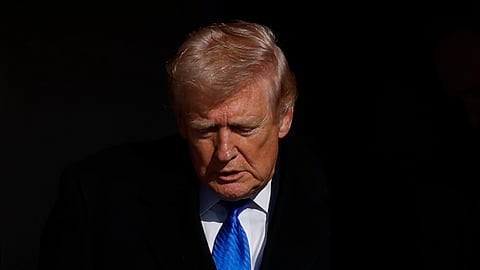

"I HAVE INSTRUCTED THE DEPARTMENT OF WAR TO POSTPONE ANY AND ALL MILITARY STRIKES AGAINST IRANIAN POWER PLANTS AND ENERGY INFRASTRUCTURE FOR A FIVE DAY PERIOD," US President Donald Trump posted on his Truth Social platform on Monday at 4:34 pm (IST).
However, about 15 minutes before this announcement, an unusually large number of oil trades were made — far more than normal — placing bets in a way that later benefited from falling prices, raising questions over the timing and whether some traders had prior insight into the decision.
Between 4:19 pm and 4:20 pm (IST) on Monday, oil trading volumes surged to about $580 million, according to the Financial Times, while Bloomberg estimated the value at around $650 million.
During this two-minute window, around six million barrels of oil — including Brent crude from Europe and West Texas Intermediate (WTI), a US grade of light, easily refined crude — were traded, far above the usual 700,000 barrels at that time over the past five days, Bloomberg reported.
And about 15 minutes later came Trump's post citing "very good" talks to end the conflict. This sparked a big sell-off in global energy markets, with crude prices dropping over 14%, while S&P 500 futures, European and Asian stocks jumped as investors retracted bets on a prolonged conflict.
Therefore, traders who wagered on falling prices ahead of the announcement likely profited from Trump’s sudden reversal, raising questions about whether some acted on advance knowledge.
However, this is clearly not a one-off.
The well-timed oil trades mirrored past activity on prediction market Polymarket, where large, profitable bets were placed before US military actions in Venezeula and Iran, and fit a broader pattern of big positions being taken ahead of key government announcements.
Stephen Innes, an analyst at SPI Asset Management, told AFP that the "size" and "timing" of the trades stood out, hinting at possible prior intel.
"Traders are not clairvoyant. When positioning shifts minutes ahead of a market-moving headline, it usually means someone is acting on...intel before the story broke," he added.
Innes noted that the oil market is "not just traders speculating on price; it's a tightly connected ecosystem of physical players, refiners, shippers and governments, all operating within overlapping information channels."
He added that the activity could have been driven by a large producer hedging against a potential price drop, given that oil futures had surged 40 percent since the start of the war.
A market strategist at a US brokerage told FT that while it is difficult to prove a direct link, the unusually large oil trades 15 minutes before Trump’s post raised questions about who could have acted so aggressively.
One trader told FT that energy consultants had flagged multiple large block trades with unusual timing, while another portfolio manager said the pattern had caused frustration among investors.
"My gut from watching markets for the last 25 years is this is really abnormal," the strategist added, noting that Monday had no major economic data or Fed events to explain such a large trade.
A few hours after the US president's announcement, Iran's parliamentary speaker, Mohammad Bagher Ghalibaf, reportedly involved in talks, said "no negotiations" were underway, insisting Trump was seeking "to manipulate the financial and oil markets."
And on Tuesday, Iranian media reported that Israeli-US strikes targeted two gas facilities and a pipeline, after Trump’s announcement to halt strikes on energy sites. This sent oil prices, which had fallen on Monday, spiking once more, with Brent back above $100 a barrel.
