
Top Developments
Trump postpones military strikes: US President Donald Trump said he will hold off on attacking Iranian power plants for five days after "very good" talks with Tehran.
Iran denies Trump's claims: Iranian news agency reported that there is no dialogue between Tehran and Washington, adding that Trump's comments on postponing military strikes are intended to reduce energy prices and implement military plans.
Iran threats: Iran threatened to deploy "naval mines" in the Gulf if the United States and Israel were to attack any of its coasts or islands.
IRGC warning: Iran’s Islamic Revolutionary Guard Corps said it will “completely close” the Strait of Hormuz if the US targets Iranian energy infrastructure. They also threatened to attack West Asia electrical plants powering US bases.
Iranian maritime statement: Iranian Foreign Minister Abbas Araghchi said the strait is not closed, but ships are hesitant due to insurance concerns over the US-initiated war. He added: “Freedom of Navigation cannot exist without Freedom of Trade. Respect both—or expect neither.”
The United States and Iran escalated threats on Sunday as the Middle East war entered its fourth week, putting lives and livelihoods at risk across the region. Iran warned that the Strait of Hormuz, a crucial route for oil and other exports, could be “completely closed” if the US attacks its power plants, following President Donald Trump’s 48-hour deadline to reopen the waterway.
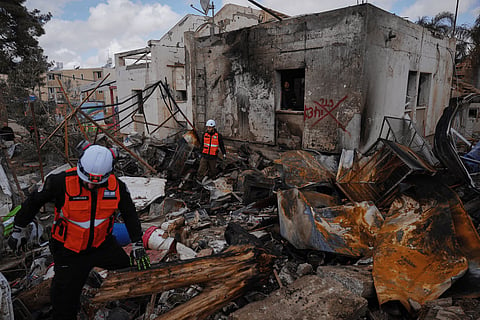
Israeli communities near a secretive nuclear site were struck by Iranian missiles late Saturday, wounding scores, though Prime Minister Benjamin Netanyahu called it a “miracle” no one was killed. Netanyahu said Israel and the US were advancing toward their war objectives, which include curbing Iran’s nuclear and missile programs and weakening its regional influence.
The conflict, launched on February 28, has killed over 2,000 people, disrupted the global economy, and pushed oil prices higher. Meanwhile, Iranian-backed Hezbollah claimed an airstrike that killed a man in northern Israel, and Lebanese President Joseph Aoun described Israeli attacks on bridges in the south as a “prelude to a ground invasion.”
US Treasury Secretary Scott Bessent said Sunday that Washington may need to “escalate to de-escalate” in its war against Iran, after President Donald Trump gave conflicting signals about the military campaign. On Saturday, Trump threatened to “obliterate” Iranian energy plants if Tehran did not fully open the Strait of Hormuz, just a day after saying US objectives were “very close” and that he was considering “winding down” operations.
Bessent defended the strategy as the “only language the Iranians understand” and lifted US sanctions on Iranian and Russian oil already on ships to stabilize global markets, a move critics say could indirectly fund Iran amid the ongoing conflict. Oil prices have surged worldwide, raising costs at US pumps ahead of the midterms, though Bessent argued that neutralizing Iran’s nuclear threat will justify temporary economic pain. Meanwhile, Reza Pahlavi, son of Iran’s last shah, urged Trump and Israeli Prime Minister Benjamin Netanyahu to spare civilian infrastructure, saying it “belongs to the Iranian people and to the future of a free Iran.”
Iran’s military warned Sunday that it could strike desalination and other critical water facilities belonging to the US and Israel if its own energy and water infrastructure is attacked.
Desalination plants are crucial in the Middle East, supplying 70–90% of drinking water in countries like Saudi Arabia, Oman, and Kuwait, and underpinning major cities such as Dubai and Riyadh. Experts warn that attacks on these facilities could trigger rationing, economic disruption, and even mass evacuations. While some plants have security measures such as missile batteries and reserves to cushion short-term outages, prolonged strikes could have catastrophic consequences.
Previous incidents include Iranian drone strikes on Bahrain’s desalination plant and US strikes on Qeshm Island in Iran, illustrating the heightened vulnerability of the region’s water infrastructure. Analysts say any escalation could make the war far more severe than the current military conflict.
Trump has warned he may strike Iranian power plants if Tehran does not reopen the strategic Strait of Hormuz by Monday night, a crucial route for global oil supplies.
Iran has over 90 power plants, including gas-fired stations, combined-cycle plants, and a single nuclear facility at Bushehr, generating just 1,000 megawatts, far short of national needs. High demand during droughts and hot summers, combined with ageing infrastructure and sanctions, has already forced periodic electricity rationing.
The country’s largest facilities include Damavand near Tehran (2,900 MW), Shahid Salimi Neka in Mazandaran (2,214 MW), and Shahid Rajaee Combined Cycle in Qazvin (2,042 MW). Any attacks on these plants could worsen power shortages and affect millions, further escalating the region’s humanitarian and energy crises.
Israel's military will expand its ground operations in Lebanon against Hezbollah, its army chief said Sunday, warning that the offensive against the group was still in its early stages.
Lebanon was pulled into the Middle East war when Hezbollah began firing rockets into Israel on March 2 to avenge the killing of Iran's supreme leader Ayatollah Ali Khamenei in an Israeli-US strike.
"The operation against the Hezbollah terrorist organisation has only begun... This is a prolonged operation," Lieutenant General Eyal Zamir said in a statement.
"We are now preparing to advance the targeted ground operations and strikes according to an organised plan," he added.
In a separate statement Sunday, military spokesman Brigadier General Effie Defrin said the expansion of the ground operation would begin within the coming week.
"In the coming week, we will begin to deepen our hold and strengthen the protection of our citizens" in northern Israel, Defrin said.
"We will expand our control on the ground and broaden our maneuvering in order to prevent direct fire on our communities."
Over three weeks into the conflict, Iranian missile strikes have killed at least 15 people in Israel and injured many more, including around 200 in overnight attacks near a nuclear facility in the south, but public support for the war remains strong, according to the Guardian.
Polling by the Israel Democracy Institute shows more than 90% of Jewish Israelis back the decision to launch the new conflict. Despite air raid sirens, school closures, cancelled flights, and warnings that the campaign could last weeks, over half of those surveyed want the US and Israel to continue bombing Iran until its government falls.
Even opposition politicians have largely put aside election campaigning for parliamentary elections scheduled this autumn, rallying behind the attacks in an almost unanimous display of national unity.
Source: AFP
Iran: HRANA reports at least 3,230 killed, including 1,406 civilians (210 children), 1,167 military personnel, and 657 unclassified. Government figures not updated; AFP cannot independently verify.
Lebanon: 1,029 dead, including 832 men, 79 women, 118 children, and 40 healthcare workers; 2,786 wounded. Hezbollah losses not announced.
Israel: 16 civilians killed by Iranian missiles, including 13 Israelis (4 minors), 1 Filipino, 1 Thai; 2 military personnel killed in southern Lebanon; ~450 injured.
West Bank: 4 women killed by Iranian missile fire.
Gulf states & US personnel: 35 killed, including 17 civilians.
Kuwait: 6 dead (2 soldiers, 2 border guards, 2 civilians, including 11-year-old girl)
UAE: 8 dead (6 civilians, 2 military; helicopter crash)
Saudi Arabia: 2 civilian deaths
Bahrain: 2 civilian deaths
Oman: 3 dead (1 mariner, 2 in industrial drone attack)
Qatar: 7 dead (4 servicemen, 3 Turkish nationals; helicopter crash)
US: 7 killed in Gulf, 6 in Iraq; ~200 injured across region
Iraq: At least 68 dead, including:
49 Iran-backed fighters (US-Israel strikes)
1 Iraqi officer (drone attack)
5 Iranian Kurdish militants (strikes on northern positions)
6 crew in US refuelling aircraft crash (non-hostile)
1 French soldier (Iranian drone)
Civilian deaths: 1 rocket shrapnel, 4 in Baghdad strike (2 Iranian advisors)
Jordan: 29 injured by debris; no deaths.
Syria: 8 injured by falling debris from Iran-Israel exchanges.
US casualties in Mideast: ~200 injured, including 10 seriously; most returned to duty.
Kataeb Hezbollah -- an Iran-backed armed group in Iraq -- says it will extend its five-day pause on attacking the US embassy in Baghdad, announced Thursday.
Since the start of the war in the Middle East, pro-Iran armed groups have claimed responsibility for near-daily attacks on US interests in Iraq and across the region, while strikes have also targeted these groups.
Benchmark US oil contract WTI was up Monday after US President Donald Trump gave Iran a 48-hour ultimatum to open the Strait of Hormuz or face decimation of its energy infrastructure and Israel warned the war would continue for several more weeks.
The price of West Texas Intermediate (WTI) was up 0.44 percent to $98.66 per barrel. It had climbed to just over $100 a barrel earlier Monday.
South Korea's benchmark Kospi index and Japan's Nikkei sharply dropped in early trade.
The Kospi was down 4.69 percent at 5,509.88 points. The Nikkei 225 was down 3.54 percent at 51,483.91 points.
The price of North Sea Brent crude, the global market benchmark, was down 0.02 at $112.17 per barrel.
On February 27, the day before the US-Israeli attacks began on Iran, WTI had stood at $67.02 and Brent was at $72.48 per barrel.
The United States and Iran threatened to target critical infrastructure Sunday as the war in the Middle East, now in its fourth week, puts lives and livelihoods at risk throughout the region.
Iran said the Strait of Hormuz, crucial to oil and other exports, would be "completely closed” immediately if the U.S. follows up on President Donald Trump's threat to attack its power plants. Trump late Saturday set a 48-hour deadline to open the strait.
Chuck Schumer, the US Senate’s minority leader, has called for an end to the US military operation against Iran.
“Enough is enough. End this war,” Schumer wrote in a statement posted on X.
“Even some Republican Senators are openly admitting they have no clue what the Administration is trying to accomplish in the Middle East,” the lawmaker from New York added.
In an earlier post on X, Schumer also noted that tens of billions of dollars “are being wasted” in the conduct of the war against Iran, resulting in a gallon of gas now costs “an average of $3.94”.
Lives are on the line.
— Chuck Schumer (@SenSchumer) March 22, 2026
Tens of billions of dollars are being wasted.
A gallon of gas now costs an average of $3.94.
And THIS is all he has to say? https://t.co/rHvDOjMirM
Lebanese President Joseph Aoun is calling Israel’s latest attacks on his country a “collective punishment” on Lebanese civilians.
These attacks on critical infrastructure by Israeli forces are making the situation very difficult for both the Lebanese government and the people, who are trying to escape the areas being bombarded.
President Aoun also denounced the deliberate attack by Israel in the south in a bid to create a de facto buffer zone.
Iranian news agencies reported explosions in capital Tehran early Monday morning, with Fars saying airstrikes had occurred in multiple locations.
"Explosion heard in Tehran," local media Mehr posted on Telegram.
Fars reported that "airstrikes targeted areas of Tehran", specifying five areas and that "terrible sounds of explosions have been reported".
The head of the International Energy Agency said Monday that at least forty energy assets had been "severely or very severely" damaged in the Middle East due to the war in the region.
"At least forty... energy assets in the region are severely or very severely damaged across nine countries," Fatih Birol told the National Press Club in Australia's capital.
International Energy Agency chief Fatih Birol warned on Monday that the global economy is under "major threat" from the energy crisis caused by the Middle East war, adding that "no country will be immune" to its effects.
At least 40 energy assets across nine countries in the region were "severely" damaged due to the war, Birol added.
Oil prices rose early Monday after the United States and Israel warned at the weekend that the Iran war -- which has disrupted oil deliveries through the Strait of Hormuz -- would continue for several more weeks.
The price of West Texas Intermediate (WTI), the US benchmark crude, for May delivery climbed to just over $100 a barrel during early Monday trading. North Sea Brent crude was up 1.73 percent to $113.44 per barrel minutes after trading opened on the Chicago Mercantile Exchange.
Israel's military said it launched a "wide-scale wave" of strikes on the Iranian capital early Monday morning.
"The IDF has begun a wide-scale wave of strikes targeting Iranian terror regime infrastructure in Tehran," the Israeli military posted on Telegram using its official acronym.
The Saudi Ministry of Defense says the country’s air defences intercepted one missile while the other fell in an open area.
Explosions rang out in Tehran early Monday morning, Iranian media reported, as Israel announced it launched a fresh wave of strikes.
"Explosion heard in Tehran," local media Mehr posted on Telegram, while Fars news agency said airstrikes had targeted five areas of the Iranian capital and that "terrible sounds of explosions have been reported".
"More details on the extent of damage and possible casualties will be announced later," Fars posted.
In its own statement, Israel's military announced it had "begun a wide-scale wave of strikes targeting Iranian terror regime infrastructure in Tehran".
Stocks tumbled Monday and oil prices rose after Donald Trump and Iranian leaders traded threats over the key Strait of Hormuz, while Israel said the Middle East war could last several more weeks.
With the conflict now in its fourth week and showing no sign of ending, the head of the International Energy Agency warned of the worst global energy crisis in decades and said the world economy was under "major threat" from the crisis.
Saudi Arabia's Ministry of Defense said it detected two incoming ballistic missiles on Monday, as the kingdom and its Gulf neighbours face Iranian strikes.
"Two ballistic missiles were launched towards the Riyadh region, one of which was intercepted and the other fell in an uninhabited area," the ministry posted on social media.
Saudi Arabia and the United Arab Emirates reported coming under fresh attacks on Monday morning, with explosions and sirens sounding over the oil-rich Gulf.
The Saudi Ministry of Defense said it had detected two incoming ballistic missiles targeting the capital on Monday, "one of which was intercepted and the other fell in an uninhabited area".
The UAE defence ministry said it was "currently responding to incoming missile and drone threats from Iran", explaining "the sounds heard are the result of the Air Defence Systems intercepting missiles and drones".
A strike on a broadcast station in southern Iran killed at least one person, state television reported on Monday.
"The 100-kilowatt AM transmitter of the Persian Gulf Radio and Television Centre was attacked by the American-Zionist terrorist army," the state-run Islamic Republic of Iran Broadcasting reported.
"In this attack, which was against international laws, one of the centre's security colleagues was martyred and another person was injured."
Israel's military said on Monday morning it was working to intercept missiles fired from Iran, and urged people to take cover.
"A short while ago, the IDF identified missiles launched from Iran toward the territory of the State of Israel," Israel's military posted on Telegram, using the official acronym for the country's armed forces. "Defensive systems are operating to intercept the threat."
As US President Donald Trump's deadline on opening the Strait of Hormuz approaches, Iran on Monday threatened to attack West Asia electrical plants powering American military bases.
The statement from Iran's paramilitary Revolutionary Guard marks the latest attempt by Tehran to try and explain its attacks on the Gulf Arab countries.
Iranian state television read out the statement on air Monday morning.
"What we have done is to announce our decision that if the power plants are attacked, Iran will retaliate by targeting the power plants of the occupying regime and the power plants of regional countries that supply electricity to US bases, as well as the economic, industrial and energy infrastructures in which Americans have shares," the statement said, referring to Israel as an "occupying regime." It added, "Do not doubt that we will do this."
The US military, on Monday, targeted a turbine engine production site in north-central Iran's Qom province, U.S. Central Command said.
The facility was used to make drone and aircraft components linked to the Islamic Revolutionary Guards Corps (IRGC).
"The Qom Turbine Engine Production Plant produced gas turbine engines for attack drones and aircraft components used by Iran’s Islamic Revolutionary Guards Corps," CENTCOM said in a post on X.
CENTCOM also shared before and after aerial images of the site. The first image, dated March 6, 2026, shows the facility intact, while the second, taken three days later, shows extensive damage.
Israeli forces said they intercepted a “limited number of missiles” fired from Iran, with shrapnel falling in the northern city of Safed, Channel 12 reported.
Air raid sirens were triggered across northern Israel, including Haifa, but no injuries or damage were reported.
The incident came after several hours of relative calm in the country.
Saudi Arabia’s Defence Ministry said its forces intercepted and destroyed two drones in the country’s eastern region.
Earlier on Monday, the country's air defences intercepted another drone in the same area, as well as a missile targeting Riyadh.
Explosions were heard across Iranian capital on Monday. Al Jazeera reported "massive explosions" in the eastern and western parts of Tehran.
In Iran's Ahvaz, it was reported that a hospital was impacted following an explosion.
It was also reported that a person was killed when a radio station was targeted In Bandar Abbas.
IRGC spokesperson said that the forces attacked Prince Sultan airbase in Saudi Arabia and the US Fifth Fleet in Bahrain, using drones and missiles.
Iran targeted civilian sites across the region "more than 300 times", said Chief of US Central Command, Brad Cooper.
Calling it an act "out of desperation", Cooper said that Iran's military capabilities are deteriorating.
“They’re operating in a sign of desperation … In the last couple of weeks, they’ve attacked civilian targets very deliberately, more than 300 times,” he told UK-based channel Iran International.
Tokyo is "not thinking about" calling on Iran to let Japanese tankers through the Strait of Hormuz, the foreign minister has said, after Tehran said it was ready to help.
Japan depends on crude oil imports from the Middle East, most of which transits the strait, located in the Gulf.
Iran has effectively closed the strait in retaliation for US-Israeli strikes, sending countries reliant on the shipping lane scrambling for alternative routes and tapping reserves.
Stocks tumbled Monday and oil prices jumped after Donald Trump and Iranian leaders traded threats over the key Strait of Hormuz, while Israel said the Middle East war could last several more weeks.
With the conflict now in its fourth week and showing no sign of ending, the head of the International Energy Agency warned of the worst global energy crisis in decades and said the world economy was under "major threat" from the crisis.
Observers, meanwhile, have also raised the prospect of a surge in inflation that could force central banks to hike interest rates, while the choking off of fertiliser shipments has also fanned concerns about global food security.
Iran threatened to deploy "naval mines" in the Gulf if the United States and Israel were to attack any of its coasts or islands.
"Any attempt by the enemy to attack Iranian coasts or islands will naturally, and in accordance with established military practice, lead to all access routes and communication lines in the Persian Gulf and coastal areas being mined with various types of naval mines, including drifting mines deployable from the coasts," said the country's defence council in a statement carried by state media.
The Israeli military said its own artillery fire killed an Israeli civilian a day earlier near the northern border with Lebanon, where its forces are fighting Hezbollah.
After opening an investigation, the military said "the initial findings suggest that the Israeli civilian was killed by IDF artillery fire conducted to support IDF soldiers operating in southern Lebanon".
"Several severe issues and operational errors took place during the incident, including both the planning and execution of the fire," it added.
According to monitoring group NetBlocks, Iran's internet blackout, with the measure passing 552 hour mark, is 'among the most severe registered in any country'.
“International connectivity remains unavailable to the general public while authorities maintain a selective whitelist for global access," it said.
⚠️ Update: It's now day 24 of #Iran's internet blackout, with the measure passing 552 hours among the most severe registered in any country.
— NetBlocks (@netblocks) March 23, 2026
International connectivity remains unavailable to the general public while authorities maintain a selective whitelist for global access. pic.twitter.com/sTLpMHabDY
Russia called for "political and diplomatic" settlement to the Middle East war after US President Donald Trump's ultimatum for Iran to reopen the Strait of Hormuz.
"We believe that the situation should have transitioned to a political and diplomatic settlement," Kremlin spokesman Dmitry Peskov told journalists, including from AFP, at a briefing.
"This is the only thing that can effectively contribute to defusing the catastrophically tense situation that has now developed in the region," Peskov said.
A series of strong explosions were heard on Monday in the Iranian capital, an AFP journalist said, as the war with the United States and Israel raged for its fourth week.
It was not immediately what was targeted but the blasts were felt in central Tehran, rattling the windows of buildings in the area, the journalist said.
President Donald Trump has said that the US and Iran have held talks on 'a complete and total resolution of hostilities in the Middle East'. He added that the US would postpone military strikes against Iranian power plants and energy infrastructure for a five-day period.
In a post on TruthSocial in capital letters Trump wrote: "I AM PLEASE TO REPORT THAT THE UNITED STATES OF AMERICA, AND THE COUNTRY OF IRAN, HAVE HAD, OVER THE LAST TWO DAYS, VERY GOOD AND PRODUCTIVE CONVERSATIONS REGARDING A COMPLETE AND TOTAL RESOLUTION OF OUR HOSTILITIES IN THE MIDDLE EAST.
"BASED ON THE TENOR AND TONE OF THESE IN DEPTH, DETAILED, AND CONSTRUCTIVE CONVERSATIONS, WITCH WILL CONTINUE THROUGHOUT THE WEEK, I HAVE INSTRUCTED THE DEPARTMENT OF WAR TO POSTPONE ANY AND ALL MILITARY STRIKES AGAINST IRANIAN POWER PLANTS AND ENERGY INFRASTRUCTURE FOR A FIVE DAY PERIOD, SUBJECT TO THE SUCCESS OF THE ONGOING MEETINGS AND DISCUSSIONS. THANK YOU FOR YOUR ATTENTION TO THIS MATTER! PRESIDENT DONALD J. TRUMP"
Iranian Foreign Minister Abbas Araghchi held a call with his Russian counterpart Sergei Lavrov on Monday, after US President Donald Trump revealed Washington and Tehran had held "very good and productive conversations regarding a complete and total resolution of our hostilities."
Russia's Lavrov called for an "immediate cessation of hostilities and a political settlement that takes into account the legitimate interests of all parties involved, above all Iran," the Russian foreign ministry said in a readout of the call, which it said was initiated by Tehran.
Reacting to Trump's message, delaying strikes on Iranian nuclear plants, the Iranian embassy in Kabul, Afghanistan said that Trump refrained from attacking after “Iran’s stern warning”.
Iran's Tasnim news agency commented - 'Trump Backs Down!'
A semi-official Iranian news agency carried a statement by Iran's Foreign Ministry, which said that there is no dialogue between Tehran and Washington. It further said that Trump's comments are intended to reduce energy prices and implement military plans.
It further acknowledged the initiatives by regional countries to reduce tensions, but added that such concerns should be referred to Washington.
Reacting to Trump's announcement, a spokesperson for UK Prime Minister Keir Starmer said, “Any reports of productive talks are welcome.”
“We’ve always said that swift resolution to the war is in global interests and the Strait of Hormuz specifically needs to be reopened,” the spokesperson added.
President Donald Trump said that there are "major points of agreement" in US-Iran talks which he said must result in Tehran giving up its nuclear ambitions and enriched uranium stockpile.
Trump said the talks -- which Iran denies are taking place -- were being conducted with a "top person" but not the country's supreme leader.
"We've wiped out the leadership phase one, phase two, and largely phase three. But we're dealing with the man who I believe is the most respected and the leader," Trump told reporters. "We want no enrichment, but we also want the enriched uranium."
President Donald Trump said Monday that "regime change" was effectively underway in Iran, while warning that if talks with Iranian figures contacted by the United States do not succeed then bombing will continue.
Trump made clear talks were not with Iran's new supreme leader Mojtaba Khamenei but with people he described as "very reasonable," while so many top officials had already been killed in the conflict that "there's automatically a regime change."
If talks fail, he told reporters, "we'll just keep bombing our little hearts out."
The International Committee of the Red Cross demanded Monday a halt to the "war on essential infrastructure" in the Middle East, warning of potential "irreversible consequences" including harm to nuclear facilities.
"What we have seen in recent days in the Middle East risks reaching a point of no return," ICRC President Mirjana Spoljaric warned in a statement.
Iran's powerful parliament speaker Mohammad Bagher Ghalibaf said on Monday that "no negotiations" were held with the United States after US President Donald Trump announced talks were ongoing.
"No negotiations have been held with the US, and fakenews is used to manipulate the financial and oil markets and escape the quagmire in which the US and Israel are trapped," Ghalibaf said in a post on X.
The Israeli military announced on Monday that it struck a site in Tehran belonging to Iran's Revolutionary Guards, which was used to coordinate Basij paramilitary battalions. The hit follows an earlier strike that killed the Basij intelligence chief and top commander Gholamreza Soleimani.
Israel said the attack was part of an operational phase aimed at degrading “core Iranian terror regime systems and security capabilities.” The Basij have been accused of playing a key role in the crackdown on recent Iranian protests. This strike is part of a wave of Israeli operations since the joint US-Israel attack on Iran on February 28, which reportedly killed several top Iranian officials.
A malfunction in Israel’s David’s Sling aerial interceptor system allowed two Iranian ballistic missiles to strike the towns of Dimona and Arad on Saturday, wounding dozens and damaging several buildings, the military confirmed. Most injuries were from shrapnel or while rushing to shelters.
David’s Sling, part of Israel’s multi-layered air defence, is designed for heavy rockets and cruise missiles. The system was recently upgraded, but the military said it failed to intercept the missiles, while stressing that about 92% of more than 400 Iranian missiles fired since the February 28 war have been intercepted.
Prime Minister Benjamin Netanyahu said he spoke with US President Donald Trump, who believes US-Israeli military gains in Iran could be turned into a negotiated agreement that safeguards Israel’s interests. Netanyahu reaffirmed ongoing strikes in Iran and Lebanon, saying they are “crushing the missile and nuclear programme” and inflicting heavy damage on Hezbollah.
He added that two Iranian nuclear scientists were recently eliminated, and more operations are expected.
Pakistan Prime Minister Shehbaz Sharif on Monday spoke with Iranian President Masoud Pezeshkian, pledging Islamabad’s support in advancing peace and de-escalation in the Gulf region. The leaders exchanged Nowruz greetings and discussed the “grave situation in the Gulf,” agreeing on the urgent need for dialogue, diplomacy, and conflict resolution.
Following the conversation, Pakistan’s Deputy Prime Minister and Foreign Minister Ishaq Dar held a separate call with his Iranian counterpart Abbas Aragchi to review recent regional developments. Both sides emphasized the importance of continued dialogue to maintain peace, security, and stability, and agreed to remain in close contact.