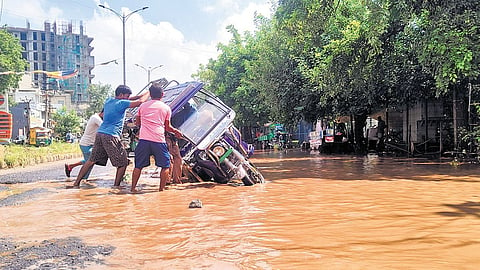

As monsoon fury pummelled the Millennium City, its arterial roads were submerged, sewage water entered homes and traffic movement was disrupted for hours. It is no longer an annual surprise or mere failure of cleaning the drains. The city that has been built over its natural drainage has lost its water bodies, concretised its landscape and allowed infrastructure to lag behind explosive growth. Monsoon merely exposes the failures that exist year-round.
However, the problem isn’t just infrastructure. It’s a governance issue too. It’s a topographical issue too.
Gurugram, erstwhile Gurgaon, was built from the ground up on a promise of emulating a ‘Singapore-style, world-class satellite’ model for a high-density developing city. But did the space have the infrastructural or geographical strength to hold that promise together?
A video of a young girl that did rounds over the internet last week, stranded on a flooded street, sobbing and calling out for her mother, is the epitomisation of a failed urban development model—the failed promise.
Short-duration, high-intensity rainfall can overwhelm even functioning drains. In Gurugram, the problem is amplified because the existing network already operates under considerable stress. Huge traffic movement in the I-T hub area that goes up to Manesar, inflow of people from other cities, rising population adds to it considerably.
Evolving primarily from land of agricultural use, Gurugram’s growth gained prominence in the 1970s. Although comparable to urban cities like Mumbai and Hyderabad in geographic foothold, Gurugram’s growth story lacks organic expansion. Rather, it is one done almost entirely by private players in a sectoral and plotted manner—right into the wrong direction.
For a real estate industry whose project-approval projections exceed two-thirds of the state budget, and the city being in news for selling Rs 200 crore flats, the abhorrence leaves an indelible blot on the squeaky-clean glass image. It is unable to survive even one afternoon of monsoon without collapsing like a house of cards.
City grows beyond capacity
Gurugram’s rapid urbanisation has severely affected its environmental and socioeconomic fabric. This also led to the rapid growth of the ‘urban villages’, which played a crucial role in accommodating the migrating workforce. The beginning of the city’s industrial growth can be attributed to the setting up of a Maruti Suzuki unit in 1981. Subsequently, this growth was boosted in the post-1991 liberalisation period, which made the city into a major I-T services hub, most notably housing over half of the world’s Fortune 500 companies today.
Marked by Master Plan 2001, the development of key corridors such as Udyog Vihar, Cyber City and Golf Course Road was commissioned, which prompted private players to set up a hub in the city. In the absence of vertical growth landscaping laws, they found the city to be a real estate gold mine.
Licences under the Haryana Development and Regulation of Urban Areas Act, 1975, which allowed private builders to negotiate land-transfer deeds directly with farmers without any public intervention, led to large-scale acquisitions and development of private projects. This repeated pattern of unchecked power spanning over four decades converted the city into an urbanised jungle, with no regard for environmental vulnerabilities.
Hence, every monsoon, the floodwater enters basements chokes roads, creating a gridlock, before doing rounds on social media. Governments have come and gone, but the same problem persists as just a topic that’s briefly debated and quickly forgotten.

A major chunk of land conversion in the city was the integration of agricultural land in the urban manifold. Land revenue records suggest that the city built-up area, which consisted of over 620 hectares (ha) in the beginning of 1990s, grew to approximately 2,000 ha by 2000, consuming 6,500 ha of agricultural land.
Between the first in 2001 and the recently operationalised Master Plan 2031, 40 to 90 villages have been added to the primary land space, posing a direct risk to sustainability and the functioning of existing public amenities. This included high-rise towers and residential spaces, adding extra burden to land resources.
While vertical growth outpaces setting up of clean-water sources and sewerage networks, this expanded urban footprint exploits groundwater resources. “We currently face a lot of problems in cooperating with private societies and their model of wastewater disposal.
Many of them lack an operational, state- and centremandated rainwater harvesting setup, and added to that, management flouts rules. This includes keeping authorities in the dark about completion timelines and floodwater dumping on junction grounds,” remarked a high-ranking official in the MCG.
Battered ecology
Gurugram’s natural topography has also been put in the dock repeatedly. With hills on one side and depressions on the other, the region is surrounded by rocky surfaces of Aravalli offshoots—the oldest mountain system in the country. Naturally, this strains underlying areas to treat and rejuvenate water cycles.
K T Ravindran, an architect and urban designer, pointed it out and said that the land has not been given any importance as a design input in the city’s development. “The most water-starved areas being developed into dense housing spaces is an abhorrence to the natural order of urban planning. For a landscape which has little to no open space in the form of green belts and grounds, waterlogging in low-lying areas is a natural consequence,” he added.
Gurugram, just like many other major cities in the country, additionally faces severe groundwater depletion. Semi-treated waste continues to block the rejuvenation of natural boreholes and canal systems, affecting agricultural activities. The Central Ground Water Board under the Ministry of Jal Shakti formally designated the city a ‘dark zone’ due to overextraction of groundwater resources. As highlighted in the Dynamic Ground Water Resources of India report of 2019, the city’s water table has declined by over 80% since the last decade. But an ecological disadvantage is not to be entirely blamed for the problems the city faces every monsoon.
“It has been noted that almost 65 km of road networks developed in the early phases, namely, Sectors 1 to 57, lack an advanced drainage system. The Haryana Shahari Vikas Pradhikaran (HSVP) [formerly Haryana Urban Development Authority (HUDA)] laid no drainage pipes in sub-9-metre roads, which accentuate the problem,” remarked Yash Jaluka, additional commissioner, MCG, who has been at the helm of affairs for over a year.
This, added to improper maintenance of green belts, parks, and sustainable concrete use in buildings, among many other directives by sustainability bodies, continues to act as an added whammy to the city’s woes. Furthermore, deeply problematic maintenance guidelines overrule local body guidelines.
“The state follows a lowest-bid licensing formula, popularly known as L-1 licences for contract-based bidding of outsourced maintenance work. On top of it, maintenance work contracts below the amount of Rs 25 lakh require no prior experience. When we find contractors defaulting, we are bound by the contract to penalise or blacklist the outsourced company and not its proprietor. In turn, defaulters create new companies and keep on securing fresh bids,” said Jaluka. Among these flaws are endless chicken-and-egg dilemmas.
Seeping down the narrow lanes
Gurugram’s expansion can be corroborated by its population explosion. The city region grew from 57 thousand people in 1971 to almost 1.75 lakh in 2001 and over 10.4 lakh in 2011. Corresponding to this, population density nearly tripled in the last three decades, according to some surveys. While much of it was anticipated in some master plans, robust drainage and sewerage infrastructure was largely missing in rapid densification and vertical growth.
The technical manual prescribed by the Central Public Health and Environmental Engineering Organisation framework under the Housing and Urban Affairs Ministry mentions a distinction for the smooth functioning of the water cycle—physically separate drainage and sewerage networks, sized and equipped for different models. “But Gurgaon does not have a very noble beginning. It was an ad hoc growth,” said Ravindran.
“In many bulk societies in the city, the land itself is lower than the invert level of the sewage system, requiring wastewater to be pumped back onto the roads,” Ravindran said. Recent master plans were not blind to it—at least, on paper. In its conventional design, which lacks any major water body that passes through the city, Gurugram’s network of sewage and stormwater drains meets at the Najafgarh lake and its surrounding wetland. While the sewage system caters to routine encatchment and treatment, the four-legged stormwater drain network spans across 550 km. But it invariably falters.
According to the Energy and Resources Institute’s 2021 water sustainability report, Gurugram generates nearly 700 million litres of waste daily but treats only half of it.
As a result, silt and untreated discharge take the form of dense muck and accumulate across drains and the dumping wetland, creating serious blockages and environmental issues. This also included over 640 natural water bodies distributed across the region in 1956, whittling down to less than 251 by the end of 2018.
This makes flooding almost inevitable when wastewater kicks back during concentrated rainfall splashes over time—holding thrice the water volume that flood drains can handle—in peak monsoon months. In the beginning of the current monsoon season, the Gurugram Metropolitan Development Authority (GMDA), along with the Municipal Corporation of Gurugram (MCG), earmarked 155 flood-prone points and recognised 64 natural water ponds for rejuvenation as part of its annual preparedness drive. While most of the points did end up flooding anyway, only 40 of the ponds remained tangled in acquisition and legal limbo.
One dish, too many cooks
Depending on whichever part a person resides in Gurugram, the civic administration is split among at least half a dozen agencies, including MCG, GMDA, HSVP, NHAI and neighbouring municipalities. Their overlapping jurisdictions often create bureaucratic confusion, delayed action and a familiar cycle of blame-shifting for the recurring problems.
In some cases, approvals for HSVP-developed buildings have reportedly flouted MCG norms, while residents grappling with waterlogging are navigating multiple complaint mechanisms for redress. The MCG receives over 100 complaints daily through the Swachh Bharat portal, X, the state grievance portal and its own website, said Jaluka. He said engineers were increasingly occupied with tracking complaints instead of focusing on core engineering work.
A GMDA official, on the terms of anonymity said, “It will certainly get worse before it gets better. We have been repeatedly highlighting in secretariat meetings that local-body authorities need to be integrated into one for more efficient working and, most of all, that people know who to go to with their problems. It’s a pure engineering problem and should be resolved accordingly.”
What now?
Gurugram’s problem needs to be fixed in bits. The start could be moving beyond blaming exceptional rainfall and address the structural failures that make predictable monsoon flooding inevitable.
Architects opine that deep-bore wells could be part of the solution, but only if paired with effective filtration. Otherwise, they risk contaminating groundwater with muck, potentially rendering Gurugram’s aquifers—and the city itself—uninhabitable.
Much remains to be contested and seen beyond flashy flat retails and IT companies for a city that is projected to house over 55 lakh people by 2040—a figure corresponding to those of developed countries like Norway and Finland.
The new high-rise projects if approved after assessing whether existing stormwater infrastructure can accommodate the additional runoff, will help the city paint a different picture some monsoon when it doesn’t cripple like a house of cards.
Up until any urban growth project is seen through the lens of livability and quality of life over its opportunity cost, faltering models would continue to be followed as suit and blame to be passed on. Gurugram’s story is one of what all can go wrong.
As monsoon takes a brief hiatus, the problem is being debated and discussed only to be forgotten by next month when the rains bid the final farewell. The consequences will be evident again next monsoon with submerged roads and falsh alerts on the phone unless Gurugram decides otherwise.